


I’m an ultralight hiker, but tent stakes are one piece of gear that I’ve never bothered to optimize. When I got my first trekking pole-supported shelter many years ago, I was baffled that it came without stakes—and bummed that my 1-pound shelter actually weighed quite a bit more once I accounted for the handful of stakes and extra guylines I needed to buy. Rather than obsess over it, I bought some MSR Mini Groundhogs and swore off thinking about tent stakes ever again.
Recently, though, I’ve jumped headfirst down the ultralight tent stake rabbit role, spurred on by my discovery of Pachallama’s 2-gram carbon fiber stakes. Compared to the average lightweight aluminum stake, which weighs about 10-12 grams, there’s actually a fairly significant weight savings when you consider the eight to ten stakes that many ultralight shelters require.
I’ve been testing them over the past month, comparing them against other carbon stakes, titanium pegs, and an assortment of aluminum stakes in different shapes and sizes. Here’s how they fared.
Compared to something like the MSR Groundhog, the Pachallama stakes don’t have much holding power (Photo: Nathan Pipenberg)
Stake Math
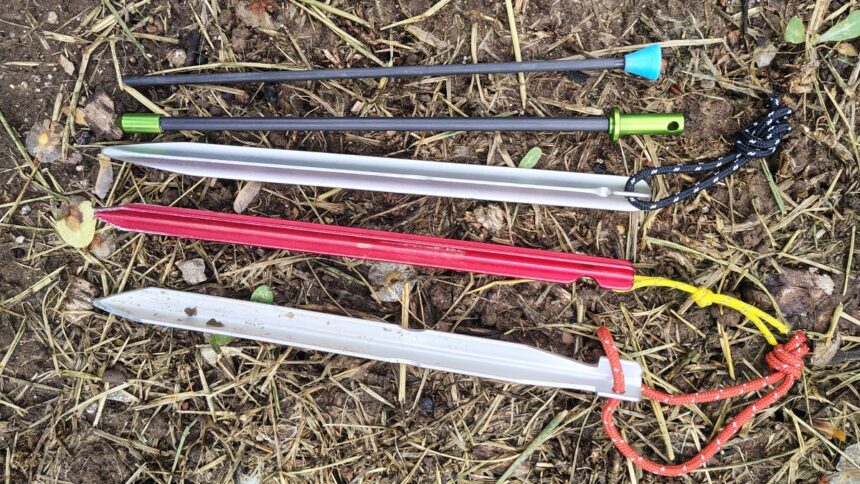
The Pachallama stakes are 2 grams a piece. They’re constructed of carbon fiber, measure just one-eighth inch (3 mm) in diameter, and are six inches long. They have a plastic endcap and a point created by a simple diagonal cut. In terms of weight, they’re substantially lighter than anything else I tested. A slightly thicker carbon stake with aluminum end caps from Mountain Equipment Company hit the scales at 4 grams. Vargo’s 6-inch titanium peg is 7 grams. The MSR Mini Groundhog is 9.5 grams. Finally, a number of aluminum V-shaped stakes all weighed in at about 11 grams each.
At $3.90 per stake, the Pachallama stakes are actually on the cheaper end of the spectrum. REI’s V-stakes are $2.75 a piece, titanium runs about $3-4 each, and stakes like Groundhogs, NEMO Airpins, and MSR Carbon Core are all $5 a pop or more.
Splintering is a risk with these carbon fiber stakes (Photo: Nathan Pipenberg)
Carbon Fiber Durability
With anything this light, durability is the immediate concern. The Pachallama stakes are more than durable enough if you’re pushing them into the ground by hand. Once I came across harder soil and began hammering the stakes into place with a rock, though, their fragility was apparent. They withstood gentle tapping with a rock, but splintered when I drove them in with the force I’d use with an aluminum or titanium stake. With prolonged use and frequent hammering, I doubt they would last long.
Once in the ground, I didn’t have any concerns about them breaking from high tension on the guylines. The strongest wind I experienced using these stakes was about 30 mph, and the stakes held just fine. The bigger concern with peg-style stakes like this is holding power.
Holding Power
Stakes like these are commonly called “nails” or “pegs,” because they’re round and thin. Compared to V-shaped stakes or three-sided stakes like the MSR Groundhog, they don’t have great holding power.
But each stake design has its advantages in different soil conditions. In Idaho, I run into a lot of compacted clay soil, and the peg stakes are great for these campsites. They go in and pull out easily, while still providing plenty of holding power. In dense soil like this, three-sided stakes can be a nightmare. I’ve bent, broken, and ripped the cord loop off of many stakes while trying to pry them from the ground.
Conversely, if the soil is loose and sandy enough, a peg stake is basically worthless, and a V-stake or three-sided stake will provide much better holding power. The Pachallama stakes, with their 6-inch length and skinny diameter, have truly abysmal holding power in soft and sandy soils. Unlike many aluminum stakes, the Pachallama stakes don’t have any notches to keep guylines in place. In high winds, lines slipping over the top of the stakes is a concern, and I resorted to tying off each guyline with a small loop that the endpin can’t pass through.
Pachallama stakes work well in the right kind of substrate (Photo: Nathan Pipenberg)
Ultralight Staking Techniques
If the lack of durability and holding power hasn’t turned you off from these crazy-light stakes, there is a way to optimize your setup to make them work.
First, to avoid hammering in the fragile carbon stakes, make a pilot hole: Carry one titanium peg or shepherd’s hook to hammer in your staking holes. Once you have your pilot holes, push in the carbon stakes by hand. Use the carbon stakes on the corners of your shelter, and any other guylines that don’t require a lot of tension.
Second, carry two aluminum stakes that have better holding power. Use these for your ridgeline or vestibule tie-outs in soft soil or windy conditions. If you really want to cut weight, you could probably ditch these two stakes and carry a few more carbon pegs—there’s always the option to tie off to trees, rocks, or even use a deadman anchor if the soil is sandy enough.
For the camping I do in Idaho, I would carry 6 Pachallama stakes, a titanium peg to handle the hammering, and two aluminum V-stakes. All told, that setup would save me 1.6 ounces compared to carrying nine aluminum stakes.
Who Are These Stakes For?
For the right ultralight hiker, these stakes make sense. If you’re already cutting the tags out of all of your hiking clothes, dividing your sunscreen into one-ounce bottles, and tracking your camp stove’s fuel efficiency, optimizing your staking system is only natural. It’s not about the 1.6 ounces of stakes, but the combined weight-savings of all of these small ounce-cutting choices. If that describes you, I think you’ll find that the Pachallama stakes work as intended. Everyone else should steer clear.
The post These Stakes Weigh Two Grams Each. But Will They Hold Your Tent Down? appeared first on Backpacker.