

The U.S.–Mexico border spans nearly 2,000 miles, but in the last few months, a 118-mile portion in Texas has been the most talked-about part of the border. DHS has sought to increase border security in the Big Bend region, including areas near Big Bend National Park and the Rio Grande.
There has been a substantial amount of back and forth over what kind of structures and barriers DHS would build in the park, and the agency recently announced further plans. On May 15, DHS waived dozens of federal environmental, public lands, historic preservation, and administrative laws to expedite construction of barriers and roads in the Big Bend Sector.
Border Security in Big Bend
While “building the wall” has long been a promise of the Trump Administration, the issue in Big Bend dates back to early this year. In late February, DHS planning maps showed proposed physical wall segments through Big Bend National Park and Big Bend Ranch State Park, which sparked backlash from local businesses, public lands advocates, and conservation groups.
In March, DHS revised the map to show detection technology in Big Bend National Park, while physical barriers remained planned in parts of Big Bend Ranch State Park.
The March 2025 map. Green is planned wall, orange is detection technology; (map/CBP)
Now the situation has changed once again. Compared to the March map, the updated SmartWall map for Big Bend shows new patrol roads and vehicle barrier systems along the Rio Grande River, particularly between Black Gap Wildlife Management Area and Amistad Reservoir. Previously, the DHS had only planned detection technology, like lights and cameras, in these areas.
The border wall map as of May 15; (map/CBP)
The May 15 waiver allows DHS to ignore several landmark environmental laws, including the Endangered Species Act, Clean Water Act, and the Clean Air Act, in order to speed up construction.
The agency also waived several Native American and historic preservation laws, including the Antiquities Act, Native American Graves Protection and Repatriation Act, and Archaeological and Historic Preservation Act. This comes on the heels of an incident in May in Arizona, where a construction contractor for the wall damaged a sacred Indigenous site.
DHS Secretary Markwayne Mullin said the situation called for urgency. “The Big Bend Sector is an area of high illegal entry where illegal aliens regularly attempt to enter the United States and smuggle illicit drugs … Therefore, DHS will take immediate action to construct additional barriers and roads,” he stated in the waiver.
Mullin cited statistics to support his claims. Between 2021 and 2025, he stated that Border Patrol apprehended 89,000 persons in the Big Bend sector. Law enforcement also seized over 87,000 pounds of marijuana, over 867 pounds of cocaine, over 1,156 pounds of methamphetamine, over 12 pounds of heroin, and over 94 pounds of fentanyl.
The Area
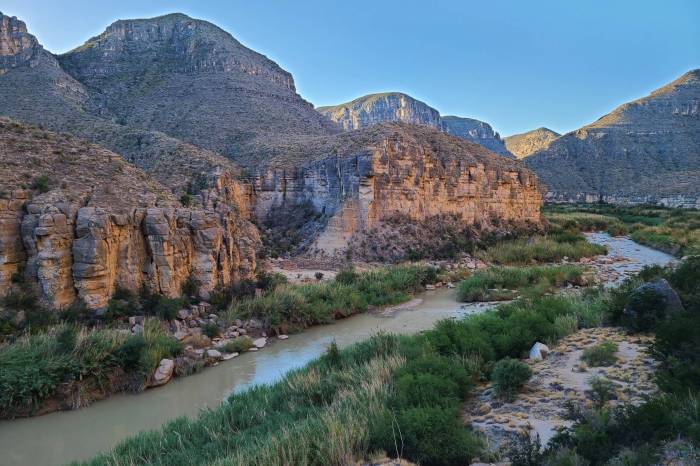
This area is an extremely remote and rugged part of Texas. Much of the planned construction lies along the Rio Grande Wild and Scenic River, a 196-mile stretch of the river that is managed by the National Park Service (NPS). According to the NPS website, it is a “wilderness of stone and water.” The river is federally protected under the Wild and Scenic Rivers Act.
Paddling is a popular recreational activity in the area; (photo/NPS, C. Hoyt)
“For the well-prepared, an extended float trip provides opportunities to explore the most remote corner of Texas and experience the ultimate in solitude, self-reliance, and immersion in natural soundscapes,” the NPS explained.
The Backlash
Conservation nonprofits like the Center for Biological Diversity were quick to oppose DHS’s plans. Laiken Jordahl, the organization’s national public lands advocate, said the construction would ruin the wild, untamed character of the area.
“New barriers, associated infrastructure, and patrol roads through this region would damage roadless canyon country, impede river access, fragment wildlife habitat and flood one of America’s darkest night skies with artificial light,” a press release stated.
There’s also concern that construction could harm the habitat of the Texas hornshell mussel and Salina mucket, two species that are listed and proposed to be listed as endangered, respectively, under the Endangered Species Act.
Local Texas organizations have also criticized construction plans in Big Bend. In March, over 130 local businesses, nonprofits, restaurants, and tourism operators sent an open letter to members of Congress asking them to block federal funding for any border wall projects in the area.