


You launch your drone at the park on a perfect Saturday morning. Fifteen minutes later, a deputy walks over and asks if you heard about the TFR.
What’s a TFR, you wonder? Temporary Flight Restrictions are temporary no-fly zones established by the FAA.
Oh, and a VIP restriction just went active an hour ago. Had you taken a moment to check, you wouldn’t be facing a $16,000 fine.
You don’t want this to happen, trust us. So, let’s go through the seven types of TFRs every pilot should know. We’ll tell you how to check for them before every flight, and what happens if you violate one.
Key Takeaways
TFRs are temporary no-fly zones that apply to all aircraft, including drones.
Seven TFR types exist under different regulations from disaster areas to VIP movements.
Violations can result in fines, certificate revocation/suspension, and federal prison time.
Check FAA tools and your EFB for TFRs before you take off.
What Is a TFR?
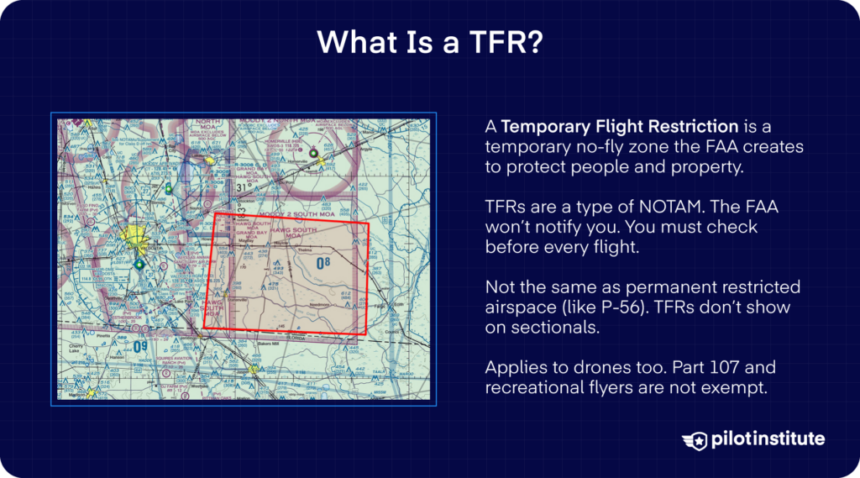
The TFR acronym stands for Temporary Flight Restriction, which is a temporary no-fly zone that the FAA establishes to protect people and property in the area.
It’s like a road closure, in a way. But instead of cones and barricades, the FAA uses its authority to keep you out of specific areas for specific periods of time.
In that sense, TFRs are a type of NOTAM (Notice to Airmen).
And while the FAA publicly broadcasts these restrictions, they won’t send you a personal notification.
What does that mean for you? It’s your responsibility to check for active TFRs before every flight.
What a TFR is NOT
TFRs and permanent restricted or prohibited airspace like P-56 over the White House are not the same thing, so don’t get confused.
Those permanent areas appear on your sectional charts because they’re always there. On the flipside, TFRs don’t tend to show up on sectionals because they’re temporary by nature.
Do TFRs apply to drones, too? Absolutely. Part 107 operators and recreational flyers aren’t exempt from TFR rules.
The 7 Types of TFRs Every Pilot Should Know
Not all TFRs work the same. To help you know what to do, it helps to classify them under the type of situation that calls for them and the rules they operate under.
There are seven types we’ll talk about, starting with:
Disaster and Hazard Areas (14 CFR 91.137)
This is the non-VIP TFR you’ll most likely see. The FAA issues these restrictions for disaster or hazard situations that warrant temporary airspace protection.
These situations can include wildfires, floods, earthquakes, hazmat spills, or any incident where low-flying aircraft would interfere with emergency response.
There are three sub-categories under 14 CFR 91.137:
(a)(1) Protecting persons and property on the surface or in the air from a hazard.
(a)(2) Providing a safe environment for disaster relief aircraft.
(a)(3) Preventing unsafe congestion of sightseeing aircraft.
Of course, there are exceptions. For example, only hazard relief participants can enter TFRs under (a)(1). Check the complete list in the regulation to see if you qualify.
National Disaster Areas in Hawaii (14 CFR 91.138)
14 CFR 91.138 is specific to Hawaii. The FAA tailored it for the inhabited areas within declared national disaster areas in the state.
But all else aside, it works more or less the same as the standard disaster TFR under 91.137. It only exists as a separate regulation for Hawaii’s unique geography.
Emergency Air Traffic Rules (14 CFR 91.139)
After two airplanes hit the twin towers on September 11, 2001, the entire National Airspace System ground to a halt. It is because of this tragedy that the TFR rules under 14 CFR 91.139 exist today.
It gives the FAA the authority to issue emergency rules when something goes seriously wrong with the air traffic control system.
This is the system-wide kill switch when normal flight operations can no longer run safely and efficiently.
Presidential and VIP TFRs (14 CFR 91.141)
These are the TFRs that catch the most pilots by surprise. TFRs under 14 CFR 91.141 can show up frequently and with short notice. The FAA can issue them anywhere the President, Vice President, or any public figure travels.
The FAA’s new DETER enforcement program excludes all TFR violations from reduced-penalty settlements. If you bust any TFR, you face the full enforcement process.
Yes, the FAA takes these things very seriously.
Space Flight Operations (14 CFR 91.143)
Space launches need airspace protections under 14 CFR 91.143. These TFRs segregate non-participating aircraft from launch and reentry operations, including some amateur rockets.
You’ll find them primarily in Florida, New Mexico, and California, where most space activities happen. The altitude limits can extend to the actual altitude of the proposed space operation or rocket launch/recovery.
Aerial Demonstrations and Major Sporting Events (14 CFR 91.145)
When safety or congestion becomes a concern, 14 CFR 91.145 lets the FAA set a temporary flight restriction around airshows and major sporting events. It uses a NOTAM to define the airspace and procedures.
If you’re inside one, you won’t be allowed to operate inside that area unless you are authorized or cleared by ATC.
This is the TFR drone pilots are most likely to accidentally violate. Super Bowl TFR violators have faced fines of $16,000 or more.
Special Security Instructions (14 CFR 99.7)
Special Security Instructions under 14 CFR 99.7 give the FAA authority to establish permanent security-related airspace restrictions. They cover special security instructions that can be either temporary or long-term/permanent.
For example, you may already be familiar with Washington, D.C. Special Flight Rules Area and Flight Restricted Zone, both codified in regulation as permanent restrictions. The DC SFRA replaced the DC ADIZ in a December 2008 final rule, effective February 2009.
Others, like political conventions and papal visits, are event-specific and temporary.
Start with the Right Study Plan
Use the sheet as your roadmap, then reinforce with lessons and quizzes.
Fits any ground school.
Find weak spots.
Test-day essentials.
Extra resources.
How to Read a TFR NOTAM
TTFRs come through Flight Data Center NOTAMs, which means you’ll see them prefixed with “FDC” rather than a regular airport identifier.
Let’s break down a real example from an airshow in Monroe, Louisiana:
FDC 6/5646 ZFW LA..AIRSPACE MONROE, LA..TEMPORARY FLIGHT RESTRICTION. PURSUANT TO 14 CFR SECTION 91.145, MANAGEMENT OF ACFT OPS IN THE VICINITY OF AERIAL DEMONSTRATIONS AND MAJOR SPORTING EVENTS, ACFT OPS ARE PROHIBITED WI AN AREA DEFINED AS 5NM RADIUS OF 323041N0920212W (MLU183000.3) SFC-15000FT MSL EFFECTIVE 2605011700 UTC UNTIL 2605011900 UTC, 2605012100 UTC UNTIL 2605020300 UTC, 2605022100 UTC UNTIL 2605030300 UTC, AND 2605031700 UTC UNTIL 2605032300 UTC. DUE TO HIGH SPEED AERIAL DEMONSTRATIONS AT THE MONROE RED, WHITE, AND BLUE AIRSHOW. THE AIRBOSS, SCOTT DUCK, TEL 574-903-6596, IS THE POINT OF CONTACT. THE MONROE /MLU/ TWR, TEL 318-327-5600, /FREQ 118.9 IS THE CDN FAC.
Okay, what does this mean?
Firstly, the NOTAM number format shows the last digit of the year followed by a three-digit sequential number.
FDC 6/5646 means this is the 5,646th Flight Data Center NOTAM issued in 2026.
ZFW LA tells you that Fort Worth Center issued it for the Louisiana airspace.
This TFR references 14 CFR 91.145 for aerial demonstrations.
The geographic description gives a 5 nautical mile radius around coordinates 32°30’41” North latitude, 92° 02′ 12″ West longitude.
The helpful reference (MLU183000.3) means 0.3 nautical miles along the 183-degree radial from Monroe Regional Airport.
Altitude limits run from the surface to 15,000 feet above Mean Sea Level. That entire cylinder is off limits during active times.
Every TFR time is in Zulu. It’s the Coordinated Universal Time measured from the Greenwich meridian in London.
These NOTAMS use the UTC format YYMMDDhhmm for times. The first window reads 2605011700 UTC UNTIL 2605011900 UTC.
Breaking it down, that’s Year 26, Month 05, Day 01, Hour 17, Minute 00. May 1, 2026, from 1700 to 1900 Zulu.
To convert Zulu to local time, first, apply your UTC offset. Monroe is UTC minus 5, so subtract 5 hours from 1700 Zulu to get noon Central Daylight Time.
Monroe sits in Central Daylight Time at UTC minus 5. So 1700 Zulu minus 5 hours equals noon local time. The first window runs from noon to 2:00 PM.
You’ll notice that this NOTAM lists four separate time windows across three days. Please check every window if your flight passes through Monroe during the airshow.
How to Check for Active TFRs Before Every Flight
According to 14 CFR 91.103, each pilot in command must, before beginning a flight, become familiar with all available information concerning that flight.
TFRs fall squarely under that requirement, and a TFR violation could only mean one of two things. You either didn’t check for restrictions or you checked and intentionally violated them.
Whichever it is, the FAA has grounds for enforcement action.
FAA TFR Website (tfr.faa.gov)
This is the official, authoritative source. Active TFRs are published on the FAA’s TFR list, which is updated in real time.
The easiest way to see if one exists in your area is to filter by state. You can also filter by Air Route Traffic Control Center or view everything displayed on an interactive map.
The graphic overlay shows exactly where the TFR sits on a sectional chart, and the NOTAM text gives you the precise information, like TFR locations and times.
Flight Service (1-800-WX-BRIEF)
Call Flight Service and request a standard or abbreviated briefing. The briefer will include active and upcoming TFRs along your flight route.
They’ll tell you what you need to know and answer questions if the NOTAM language is unclear.
Flight Service also maintains an online tool at 1800wxbrief.com with an interactive map. You can file flight plans, check the weather, and review TFRs all in one place!
EFBs: ForeFlight, Garmin Pilot, FlyQ
All major electronic flight bags overlay TFRs on the moving map. ForeFlight is widely used among general aviation pilots and updates TFR data automatically when you’re connected to the internet.
Turn on the TFR layer in your settings and verify it shows current restrictions before departure.
Just remember, while these tools are convenient, they’re only supplements to the official FAA source. Always verify against publications by the FAA.
Drone-Specific Tools: B4UFLY, LAANC Apps, Aloft
B4UFLY is the FAA’s free app that displays airspace advisories and TFRs based on your location. LAANC providers take this a step further by giving airspace authorizations on behalf of the FAA.
These include Aloft, Airspace Link, AutoPylot, Avision, and UASidekick. They check TFRs as part of the authorization process.
But again, even with LAANC authorization, an active TFR overrides your approval. Always double-check before you launch.
Can You Fly in a TFR? (Exceptions and Authorizations)
Not all TFRs completely lock down the airspace. There are some that let in specific operations with proper authorization.
Disaster TFRs (91.137)
Aircraft participating in hazard relief activities, law enforcement operations, and properly accredited news representatives who file a flight plan and operate above the disaster relief altitude may operate inside disaster TFRs.
The operating word here is accredited. You can’t show up with a camera and claim media exemption. Everyone else stays out.
VIP TFRs (91.141)
Between the outer limit and the inner ring, general aviation aircraft can enter if you’re on an IFR flight plan and communicating with air traffic control.
But please, don’t loiter in this airspace. Flight training, practice approaches, and sightseeing flights are all prohibited, even if you’re IFR.
The inner ring is different. The inner core typically prohibits general aviation operations unless you’re specifically authorized.
Gateway procedures do exist at certain airports, but you’ll need advance coordination with TSA.
For drone operations, VIP TFRs are essentially off limits.
To fly in one, you’ll have to apply through the FAA’s Special Governmental Interest process. Submit an Emergency Operation Request Form to the System Operations Support Center.
You’ll need a Part 107 certificate or existing COA, and approval isn’t automatic. Don’t count on getting clearance unless you have a genuinely compelling operational need.
Stadium TFRs (91.145)
Some authorized aircraft may operate during stadium TFRs. Banner tow operators and aerial advertising aircraft with a Certificate of Waiver or Authorization may be permitted.
Aircraft participating in the event itself obviously have authorization. But casual sightseeing? Absolutely not.
For drone operators, flying in a TFR generally requires direct coordination with the controlling agency listed in the NOTAM text. LAANC does not automatically authorize TFR entry.
When in doubt, don’t fly. Call the controlling facility or ATC listed in the NOTAM before entering any TFR. The few minutes you spend confirming authorization might just save your certificate.
What Happens If You Violate a TFR?
TFR violations carry serious penalties, and they can come at you from multiple directions.
Criminal violations can land you in federal prison for up to one year with fines reaching $100,000, especially if you get charged with a Class A misdemeanor under 18 USC 3571.
Certificate action means the FAA can suspend or revoke your pilot certificate outright. And civil penalties are straight fines with no criminal record, but they’re still going to hurt your wallet.
Okay, but does the FAA actually investigate all reported TFR violations? You bet.
That’s not an exaggeration for emphasis. All means all.
For manned aircraft pilots, egregious violations can lead to outright revocation.
You can also be charged with violating 14 CFR 91.103 for failure to check NOTAMs on top of the TFR violation itself. So you get hit twice for one flight.
Drones and DETER
For drone operators, the stakes just went up in 2024. The FAA Reauthorization Act of 2024 raised maximum civil penalties to $75,000 per violation.
Then, in 2026, the FAA launched the new DETER program.
Remember, the DETER Program applies to operations involving a Temporary Flight Restriction. VIP TFR violations, for instance, always get full enforcement with no chance for a reduced penalty.
No License to Lose?
Wait, so having no pilot certificate at all means you’re safe, right? Well, the FAA can still fine you.
Do you want to hear a real cautionary tale? Two operators were fined $16,000 and $4,000 for operating drones near SoFi Stadium during Super Bowl LVI while a TFR was in place.
Neither one possessed a Remote Pilot Certificate. There was no certificate to suspend, but they weren’t safe from fines.
And if you do hold any FAA certificate, the FAA can suspend or revoke it even if you weren’t exercising those privileges during the violation.
Your certificate status makes you subject to certificate action regardless of what you were doing when you violated the TFR.
Frequently Asked Questions
What is a TFR in aviation?
A Temporary Flight Restriction is a temporary no-fly zone that the FAA establishes to protect people, property, or national security.
TFRs are a type of NOTAM that restricts aircraft operations within a defined geographic area, altitude range, and time window. They apply to all aircraft, including drones, and checking for them before every flight is your legal responsibility.
How do I check for TFRs before a flight?
The official source is the FAA’s TFR website at tfr.faa.gov, which is updated in real time. You can also call Flight Service at 1-800-WX-BRIEF for a standard briefing or use electronic flight bags like ForeFlight, Garmin Pilot, or FlyQ that overlay TFRs on the moving map.
Remember that under 14 CFR 91.103, you must become familiar with all available information before every flight, and that includes checking for active TFRs.
Can you fly a drone in a TFR?
Generally, no, unless you have specific authorization from the controlling agency listed in the NOTAM text.
Under 14 CFR 107.47, Part 107 operators must comply with sections 91.137 through 91.145 and 99.7. LAANC authorization does not override a TFR.
Even if your LAANC request goes through, an active TFR takes priority, and you’ll need to stay out of the restricted airspace.
What is the penalty for flying in a TFR?
You face three potential consequences.
Criminal prosecution can result in up to one year in federal prison and $100,000 in fines, primarily for VIP TFR violations under 49 USC 46307.
The FAA can suspend or revoke your pilot certificate, typically for 30 to 120 days, depending on the severity. Civil penalties can reach $75,000 per violation for drone operators.
How long does a TFR last?
It depends on the type. Disaster TFRs remain active until the hazard clears, which could be days or weeks for wildfires.
VIP TFRs last during the official’s visit, typically a few hours to a day. Stadium TFRs activate one hour before events and end one hour after.
Some TFRs, like those over Disney theme parks, have been continuously active for more than 20 years.
Are TFRs shown on sectional charts?
Not usually. TFRs are temporary by nature and don’t appear on printed sectional charts.
You must check the FAA TFR website, NOTAMs, or an electronic flight bag for current restrictions before every flight.
Conclusion
TFR compliance isn’t complicated, but it takes discipline. Understand what the NOTAM tells you, and stay out of restricted airspace unless you have explicit authorization. The consequences of busting a TFR are serious enough to end your flying career or cost you thousands of dollars.
But here’s the good news. You have the tools and knowledge to avoid violations completely.
Making TFR checks part of your preflight routine takes two minutes and protects your certificate and your wallet. Check once, and keep the skies safe for everyone.
The post What are Temporary Flight Restrictions (TFR) and How to Find Them appeared first on Pilot Institute.