

Aero bikes are widely used in professional racing, and when they’re well designed, the gains are very real. Tube shapes are highly sensitive to the wind, and small changes can make a noticeable difference. With wind tunnel data to back it up, here are the fastest aero bikes you can find in 2026.
If you’re not familiar, aerodynamic drag becomes significant at around 18 km/h and increases rapidly with speed. It’s the dominant resistive force in most real-world riding, and the power needed to overcome it rises roughly with the cube of your speed. This means that doubling your speed requires about eight times the power.
That said, the rider accounts for roughly 75 to 80% of total aerodynamic drag, so the gains from equipment alone are relatively small. If you’re chasing speed, I’d always recommend first optimising your riding position, helmet, and clothing. You’ll almost always find bigger gains there than from an aero bike alone.
Right, let’s get into the wind tunnel data.
Tour Magazine Wind Tunnel Protocol
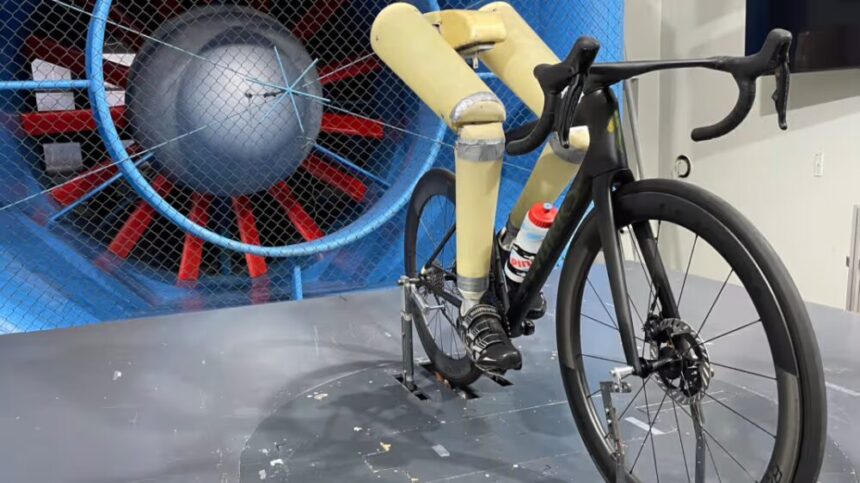
An S-Works Tarmac SL8 in the wind tunnel for testing. Image: Tour Magazine
Tour Magazine tests the aerodynamics of modern bikes at the GST wind tunnel in Immenstaad, Germany, measuring the force acting on a bike at a steady 45 km/h airflow.
Each session begins with a known reference bike to verify consistency with past results and validate the setup on the day. This keeps measurement drift in check, with repeatability of around ±0.3W within a session and roughly ±1W across different years.
A dummy with moving legs and a round bottle is mounted to every bike. TOUR found that adding a torso to the dummy introduced too much noise when comparing frames, while contributing little to the bike-specific aerodynamic differences, so they run a legs-only setup instead.
Much of the lab time is spent precisely positioning this dummy. Using laser alignment from the front and side, they lock in fixed reference points so every bike is tested in an identical position.
Testing spans a wind flow angle (yaw) from −20° to +20°, generating 41 data points in a continuous sweep. Rather than changing wind direction, the airflow remains constant while the bike is rotated. 0° represents head-on flow, while higher angles simulate crosswinds.
In terms of typical results, a non-aero road bike usually comes in at around 220–240 watts under these test conditions. At the other end of the scale, the least aerodynamic bike ever tested was the 2016 Stevens Comet at 241 watts. By contrast, the fastest aero bikes can reduce the power requirement by as much as 46 watts at the same speed.
It’s also worth remembering that wind tunnels operate in controlled conditions. They simplify real-world airflow, so the results are best seen as a model rather than a perfect reflection of on-road performance.
Weighted Average Drag
In the wind tunnel, the Ikarus Faster (204W weighted) holds its own against dedicated aero bikes like the Colnago Y1Rs (199W weighted) at 0° yaw. Image: Tour Magazine
The final watt figure assigned to the fastest aero bikes is a weighted average, built from measurements taken across multiple yaw angles using this specific dummy-and-bike setup. In the real world, total rider drag is typically around 50% higher at 45 km/h.
This weighted drag value is based on a probability model of real-world wind conditions, using a Weibull distribution for wind speed. Combined with assumed wind directions, it produces a distribution of effective yaw angles, with the highest weighting at low yaw (0–5°). Medium yaw (around 10°) carries less weight, while higher yaw angles (around 20°) contribute only a small portion to the final number.
In other words, the result is heavily biased toward straight-ahead airflow (0° yaw) and shallow crosswinds (5° yaw), which make up the majority of riding conditions.
A 10 km/h ambient wind is also factored into the calculations. This isn’t something physically generated in the tunnel, but rather a baseline environmental assumption applied when processing the yaw data.
At certain yaw angles, some wheel and frame combinations can produce a small forward-driving force. This is often referred to as the sailing effect. Because Tour Magazine measures not just drag, but also side forces and steering torque, this effect is included in the net power calculation. The final figure, therefore, reflects overall aerodynamic behaviour, not just pure resistance.
Components That Affect The Results Most
Wheels can make up a large chunk of the aero savings on a bike. Image: Tour Magazine
Wheels can have a big impact on aero performance. Depending on rim depth and shape, the gap between different wheelsets can exceed 15 watts, and that’s before tyres even enter the equation. Among high-end wheels of similar depth and design, the differences are much tighter, usually in the 2–3 watt range.
Tyres are just as important, because the tyre and rim work as a single aerodynamic system. The tyre effectively forms the leading edge of the wheel, so its width and profile play a major role in how airflow attaches. In some cases, tyre choice can create more variation than swapping between similar wheelsets.
Tyres like the Continental Aero 111 are designed to keep airflow attached for longer, particularly at higher yaw angles. This can improve crosswind performance, although the gains are reduced once weighted yaw models are applied. Narrower tyres can sometimes offer small aero savings, but that’s not consistent across all rim and tyre combinations.
The fastest aero bikes have optimised cockpits that cut a significant amount of drag. Image: Stromm Cycles
Aero cockpits are another key factor, as they sit right at the front of the airflow. Both handlebar shape and width make a difference, with narrower setups generally testing faster. In some cases, there’s up to 5 watts to be gained just from refining the cockpit, and that’s before you even consider how a narrower handlebar can help pull your body into a more aerodynamic position.
Drivetrain choice also has a small but measurable effect. 1X systems tend to come out slightly ahead of 2x setups, largely because they eliminate the front derailleur, which is typically worth around 1.5 watts of drag.
Now that we’ve covered the wind tunnel protocol, data weighting, and the components that have the biggest influence on aero performance, it’s time to look at the fastest aero bikes in the world. Tables with the full test specs are included at the end.
Ranking The Fastest Aero Bikes
Cervelo S5 (204W)
The Cervélo S5 is one of the most recognisable aero race bikes, ridden to major victories including the 2022 and 2023 Tour de France with Jonas Vingegaard, and Paris-Roubaix with Wout van Aert.
Cervélo has put a big emphasis on refining the leading edge of the bike, where most aerodynamic losses occur. The visual line from the handlebar, through the V-stem, and into the fork and downtube is designed to act as one continuous surface, smoothing airflow as it hits the bike. The tight clearance between the front tyre and downtube reinforces this “clean nose” concept.
The bayonet-style fork is a standout feature, using a single-piece, hourglass-shaped design with a front fairing. The fork legs are deeper near the crown and shaped to better integrate with modern wider tyres and rims.
Compared to earlier versions, the S5 also gets a deeper head tube and bottom bracket area, along with more aggressive trailing-edge shaping. Even small details (like adjustable bottle cage positions) are designed to optimise airflow and reduce drag.
The main downside is vertical compliance. The Cervélo S5 ranks as one of the harsher bikes on this list, so comfort can take a hit on uneven roads. You’ll need to pay close attention to rear tyre width and pressure to take the edge off.
Canyon Aeroad CFR (204W)
The Canyon Aeroad CFR is built to cheat the wind using deep tube profiles made possible by modern UCI rules, paired with a notably narrow front end to reduce frontal area and smooth airflow. It’s the bike that Mathieu van der Poel and Jasper Philipsen have piloted to countless victories.
Rather than chasing the most extreme shapes, like the Cervélo S5, the Aeroad leans more into usability. There’s room for wider tyres, and the integrated cockpit is particularly clever. Canyon’s PACE bar system fully hides cables and offers up to 40 mm of width adjustment, letting riders fine-tune their aero position without swapping the entire cockpit assembly.
At the rear, the seat tube closely shields the wheel, while dropped seatstays and an aero-shaped seatpost help manage airflow.
Interestingly, despite its truncated profile, the seatpost is engineered to flex more vertically than most aero bikes here, giving the Aeroad a noticeable comfort advantage on rougher roads.
Ikarus Faster (203.6W)
The Ikarus Faster can realistically be considered an all-round road bike thanks to its blend of low weight and high comfort. In fact, it offers the highest vertical compliance of any bike in this test.
Impressively, it still delivers strong aerodynamic performance without relying on extreme or oversized tube shapes. By using truncated airfoil profiles throughout, Ikarus avoids the bulk of traditional aero frames, keeping both compliance high and weight low. The frame weighs just 760 g, the fork around 340 g, and the lightest complete build comes in at only 5.8 kg.
Much of its speed comes from a reduced frontal area, with a narrow sculpted head tube, slim tube transitions, and a compact rear triangle. Airflow is kept clean across the frame, particularly at low yaw angles where most riding takes place. At 0° yaw, it essentially matches the very fast Colnago Y1Rs.
The main trade-off is reduced lateral and bottom bracket stiffness. At roughly 20 to 30% less stiff than other bikes here, it will generally suit lighter or less punchy riders.
Scott Foil RC Ultimate (203W)
The Scott Foil RC Ultimate was one of the first bikes to fully take advantage of the post-2021 UCI aero rules, using deeper tube profiles and more aggressive shaping to reduce drag across the entire frame.
At the front, a deep head tube acts as a fairing, helping smooth airflow onto the bike and feeding it cleanly into the narrow down tube. The ultra-slim aero cockpit and fork follow the same logic, with deeper fork legs and a taller crown designed to reduce turbulence as the air hits the bike.
Airfoil shaping is used throughout the frame, with truncated profiles and carefully refined junctions to maintain attached airflow without unnecessary weight penalties. At the rear, the dropped seatstays are angled inward by around 10°, a design choice that intentionally guides airflow into the rotating spokes to reduce drag, while also neatly shielding the rear brake caliper.
The seatpost is also engineered for vertical compliance, making it one of the most comfortable aero platforms on rougher roads, with significantly more flex than several of the fastest aero bikes in this list.
Ridley Noah Fast (202.3W)
The Ridley Noah Fast is a modern aero race bike clearly shaped around the latest UCI 8:1 tube rules. This is most obvious in its incredibly deep head tube, which dominates the front-end profile.
Up front, a fully integrated cockpit with narrow handlebar options helps reduce frontal area and clean up airflow around the rider–bike system. Small details like a removable front derailleur mount also help reduce drag when running 1X setups (as tested on this bike), while refined tube transitions and aero seatstays guide air more smoothly toward the rear wheel.
Arguably, just as important as the frame design is the “forward geometry”. The Noah Fast uses a long reach, steep seat tube angle, and a notably low front end, effectively positioning the rider in a more aerodynamic posture by default and encouraging a forward pelvic rotation. If you can hold that position, the gains are significant.
Tyre clearance goes up to 34 mm, which helps offset the relatively firm ride quality, as comfort and compliance are on the stiffer side compared to some aero bikes here.
Van Rysel RCR-F (200W)
The Van Rysel RCR-F is currently raced by 19-year-old prodigy Paul Seixas on the Decathlon Team. It features extremely deep aerofoil tube shaping throughout, developed with extensive wind tunnel input from Swiss Side, a company specialising in aerodynamic optimisation for cycling components and apparel.
Like most top-tier aero bikes, the front end is heavily prioritised. A deep, sculpted head tube, fully integrated cockpit, and tightly packaged fork legs all work together to reduce frontal area and smooth airflow around the rider–bike system. The fork itself is deeper than average and shaped to better suit modern wider tyres, while internal routing keeps hoses and cables completely hidden to avoid disrupting the leading edge airflow.
At the rear, aero seatstays and a dropped rear triangle help manage airflow around the back wheel more cleanly.
The RCR-F has the highest lateral stiffness of any bike on this list, making it particularly well-suited to sprinters or riders who prefer a “snappy” feel. The trade-off is comfort. Vertical compliance is minimal, especially through the seatpost, so it’s definitely on the firm end of the aero bike spectrum.
Colnago Y1Rs (199W)
The Colnago Y1Rs is famously ridden by Tadej Pogačar to multiple Tour de France wins as well as major Classics victories. And it turns out to be a very fast race bike in its own right!
Despite its radical design, with a floating seat tube and distinctive Y-shaped cockpit, it sits more in the “subtly aero” category, largely because of the overall reduction in bulk rather than extreme airfoil shaping. The design intent is to reduce drag wherever possible without turning the bike into a chunky aero frame.
A major aero focus is the heavily integrated front end, which is the part of the bike that sees the highest airflow loads. The cockpit is shaped to keep everything as clean as possible, while the bayonet fork is closely matched to the head tube to help smooth airflow around the front of the frame.
At the rear, dropped seatstays and a tightly packaged rear triangle help reduce turbulence around the rear wheel. Even the rear brake is tucked away using direct-mount hardware and concealed positioning to minimise exposed surfaces.
In terms of ride feel, lateral stiffness is lower than that of many dedicated aero bikes. It’s around 20% down in testing, so it’s less suited to very powerful sprinters. On the plus side, vertical compliance is relatively good, so it delivers a more comfortable ride than most ultra-stiff aero platforms.
Simplon Pride (199W)
The Simplon Pride was the first bike to break the 200W barrier in Tour Magazine aero testing, marking it as a pure, uncompromising aero race machine.
Almost everything about the frame is shaped to reduce resistance. The deep head tube acts like a fairing, blending smoothly into the fork and down tube so airflow doesn’t “catch” at junctions. As with other modern aero bikes, full internal routing keeps wires and hoses completely hidden, helping maintain a clean leading edge.
The fork is also very deep, with a streamlined crown designed to manage how air splits around both the fork legs and modern wide tyres. This helps reduce turbulence right at the most sensitive part of the bike’s airflow.
At the rear, low-dropped seatstays are carefully angled to control airflow as it leaves the rider’s legs and moves toward the rear wheel.
Like many ultra-aero designs using stiff aero seatposts, comfort is not its strong point, and riders should expect a firm ride quality in exchange for its very low drag figures.
Storck Aerfast.5 Pro (198W)
The Storck Aerfast.5 Pro is an extremely aggressive aero race bike that, until early 2026, held the position as the fastest bike in Tour Magazine wind tunnel testing. The test was performed with a 1X drivetrain, meaning the figure would likely sit closer to 200 W with a front derailleur fitted.
At the front, the bike is defined by its radical fork design, which actively guides airflow along very deep fork legs (up to around 80 mm) while maintaining very thin cross-sections (around 15 mm) in key areas. The fork also integrates the front disc brake mount, eliminating exposed bolts and small turbulence points that would otherwise disturb airflow.
The cockpit is deliberately very flat, with wide corner platforms and drop sections shaped for ergonomics but with minimal curvature, reducing airflow separation around the rider’s hand positions.
The rest of the frame remains slender and tightly profiled, with the seat tube helping shield the rear wheel and encourage clean airflow toward the back of the bike. As expected from such a highly optimised aero design, vertical compliance is very limited, particularly through the deep aero seatpost.
Merida Reacto One (197.4W)
The Merida Reacto One is the latest evolution of Merida’s full-on aero race platform, and it has been tested by Tour Magazine as the fastest aero bike in their dataset with a 2X drivetrain. In this case, although it appears to be a 1X setup visually, it actually uses a Classified internal gear rear hub that replicates front derailleur shifting!
At the front, a major portion of the aero performance comes from the deep, highly sculpted head tube and fork junction, which is designed to smooth airflow as it transitions from the rider’s hands into the frame. The fork blades are wide and carefully shaped to manage disturbed air around modern 30 mm tyres.
The new ultra-narrow cockpit is a standout feature, measuring as little as 30.5 cm at the hoods, with wing-like shaping that significantly reduces frontal area. Merida attributes roughly half of the aero gains over the previous generation to this cockpit alone, in the region of about 5 watts.
At the rear, dropped seatstays and tight rear-wheel integration help shield the wheel from the frame’s wake, reducing turbulence as airflow detaches from the bike.
The aero seatpost is also carefully tuned, offering a noticeably better balance of compliance than some of the stiffest aero competitors, with roughly twice the vertical flex compared to bikes like the Storck or Simplon.
Factor One (196.8W)
The Factor ONE is arguably the most radical design among the fastest aero bikes, built around a very front-loaded approach to airflow management. It really prioritises how air is first captured and guided around the rider–bike system.
In testing, it recorded under 197W when fitted with DT Swiss ARC 1100 62 mm wheels and a Continental Aero 111 26 mm front tyre, with the front derailleur removed to evaluate its pure 1X configuration. Even with a 2X drivetrain, it still measured around 198.2W.
The fork is unbelievably wide on the Factor ONE.
The most distinctive feature is the ultra-wide, bayonet fork, which uses deeply sculpted legs to actively control airflow around modern wide tyres. This is paired with a forward-projecting fork crown and nose-like fairing that begins shaping airflow earlier than most designs, helping to delay separation at the leading edge.
Forward geometry also plays an aerodynamic role, with a steep seat tube angle placing the rider further forward to improve how they interact with the airflow. The rear of the bike is comparatively conventional but still carefully tuned for wake control.
Comfort is the clear trade-off here. The Factor ONE has the least fork and seatpost compliance of any bike in this group. Wider, more supple tyres are essentially a necessity to offset the harsh ride quality.
Stromm Rakkt (194.9W)
The Stromm Rakkt is the fastest aero bike ever tested by Tour Magazine, built around a simple idea: eliminate every possible source of aerodynamic inefficiency while remaining UCI-legal.
In testing, it went under 195W with a SRAM 1X drivetrain, DT Swiss ARC 1100 62 mm wheels, and a Continental Aero 111 26 mm front tyre. That places it at the very top of the current aero rankings.
At the front, the Stromm Rakkt uses an extremely thin leading edge that transitions smoothly into the top tube and down tube, helping guide airflow with minimal disruption. Stromm claims it features the slimmest head tube on any production road bike.
The bayonet fork itself is highly sculpted, combining a front fairing and deep 8:1 profile aero legs to balance straight-line efficiency with crosswind stability.
The hood width is just 330 mm on the Stromm Rakkt.
The cockpit is also pushed to extremes, with a 330 mm hood width and 360 mm wide drops (and an optional 360/390 mm setup for riders wanting slightly less compromise), making it the narrowest bar configuration in this test. The bar tops are similarly highly optimised, with an exceptionally slim profile that reduces frontal area to less than half that of many conventional aero drop bars.
Despite this integrated approach, the frame is still compatible with standard cockpits designed for a 1.125” steerer, which adds some flexibility or lets you spec the Stromm bars on your bike.
The down tube is around 45 mm wide and uses a truncated profile that more or less shields a standard round bottle (<1 watt penalty for a bottle), and it can even provide a small benefit when an aero bottle is fitted.
According to Stromm, the seat tube is also shaped to take advantage of asymmetric airflow around the rider. The idea is that the rider’s legs create a local yaw condition in the airflow, and the seat tube is designed to interact with this flow in a way that can exploit the sailing effect.
The main trade-off is stiffness: lateral frame and bottom bracket rigidity are significantly reduced. In fact, the stiffness is around 40% lower than the Factor ONE, which already sits on the softer side. As a result, the Rakkt is best suited to lighter or less punchy riders who can benefit from its extreme aerodynamic focus without being limited by its flex.
Summary Tables
Fastest Aero Bikes (1X Drivetrain)
Aero DragBikeWheelsFront TyreHoods Width194.9WStromm RakktARC 1100 65mmAero 111 26mm330mm196.4WStromm RakktZipp 454 58mmAero 111 29mm330mm196.8WFactor OneARC 1100 65mmAero 111 26mm380mm198WStorck Aerfast.5 ProARC 1100 65mmAero 111 29mm360mm202.3WRidley Noah Fast 3.0ARC 1400 65mmAero 111 29mm360mm
Fastest Aero Bikes (2X Drivetrain)
Aero DragBikeWheelsFront TyreHoods Width197.4WMerida Reacto OneARC 1100 65mmAero 111 29mm340mm198.2WFactor OneARC 1100 65mmAero 111 26mm380mm199WSimplon PrideARC 1100 65mmSchwalbe One 25mm400mm199WColnago Y1RsARC 1100 50mmAero 111 29mm377mm200WVan Rysel RCR-FHadron 625 62mmAero 111 26mm370mm202.3WFactor OneBlack Inc 62mmGP5000TT TR 28mm380mm203WScott Foil RC UltimateCapital SL 60mmPro One 28mm380mm203.6WIkarus FasterARC 1100 50mmAero 111 26mm380mm204WCanyon Aeroad CFRARC 1100 50mmGP5000 TR 25mm375mm204WColnago Y1RsVision SC 45mmP Zero 30mm377mm204WCervelo S5Reserve 57/64 57mmCorsa Pro 29mm380mm
The post The 12 Fastest Aero Bikes In The World: Tour Magazine Wind Tunnel Test appeared first on CYCLINGABOUT.com.
Read more:CYCLINGABOUT.com