


The post Respect the 72: Recovery Protocol for Connective Tissue Integrity appeared first on iRunFar.
It’s two days after you’ve completed an ultramarathon. You spent day one dutifully resting, hydrating, nursing sore muscles, and eating.
Now it’s the second morning. Some of your soreness has faded; your energy levels are rebounding; you’re getting antsy; and you convince yourself that a little run won’t do any harm. This is the exact moment to think about the science behind connective tissue recovery after ultramarathon efforts and find something else to do!
Respecting recovery periods can help prevent future connective tissue injuries. Photo: iRunFar/Eszter Horanyi
The first 72 hours after an effort are the most vulnerable window for hidden risks to connective tissues. Even when mechanical issues such as falls, sprains, or acute strains are avoided, the chemical stresses of post-race inflammation can still create problems. This complex series of chemical reactions — designed to detect and repair damage — leaves connective tissues compromised.
Proper respect for this critical period is essential, not only for robust recovery but also to safeguard against future injury stemming from reduced connective tissue integrity.
In this article, we’ll look at different connective tissues and why they heal so slowly, the chemical processes that repair connective tissues in the long term but leave them compromised in the short term, and offer guidelines for full recovery after a long, difficult effort.
Much of it boils down to: Rest strategically now, to avoid paying a steeper price later.
Connective Tissue: The Strongest and Weakest Link
Among self-inflicted running injuries, those involving connective tissue are often the most stubborn and slowest to resolve. Conditions such as plantar fasciitis, Achilles tendinopathy, and patellar tendinopathy rank among the most persistent and difficult to fully rehabilitate.
Two primary factors explain this reality: the effort’s high loads and the connective tissue’s limited blood flow.
High Loads
Connective tissues — including fascia and tendons — are responsible for absorbing and transferring enormous amounts of energy with every stride. During each step, these structures rapidly absorb impact forces and either transmit them through the body or return them to the ground for propulsion. The Achilles tendon, for example, handles a remarkable volume of energy relative to its size. Once compromised, the remaining healthy tissue is easily overloaded, leading to prolonged pain and dysfunction.
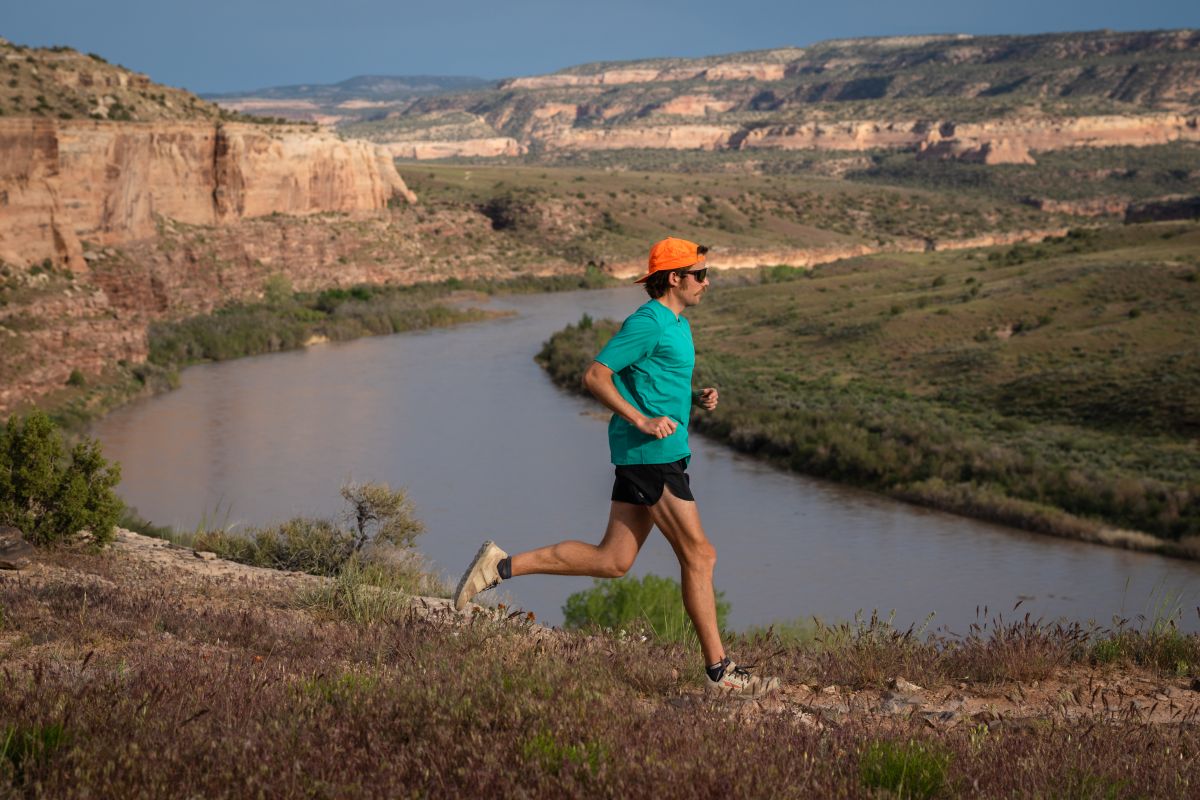
Running puts high loads on connective tissues throughout the body. Photo: iRunFar/Eszter Horanyi
Limited Blood Flow
Perhaps more significant than the sheer volume of work these tissues perform, damaged connective tissue heals very slowly due to limited blood flow. Muscles enjoy rich vascular networks to support their high energy demands, and bones actively produce blood cells. In contrast, connective tissues — composed largely of dense collagen fibers — receive only a fraction of that blood supply. As a result, the raw materials needed for collagen repair arrive slowly, and the healing process is correspondingly prolonged.
Strained muscles may recover in days and broken bones in weeks, but connective tissue injuries frequently require months — and in some cases years — to regain full strength and resilience.
This raises two essential questions for every ultrarunner: How can we best protect this vital propulsive tissue, and how does a typical ultramarathon affect connective tissue throughout the body?
Acute Injury Healing Timeline
The fundamentals of healing for frank damage — partial or complete tears of muscle, tendons, and ligaments, or bone fractures — are well established in Western medicine. These injuries typically progress through predictable phases explored in depth in a prior article. In summary, they are:
Inflammation (0 to 20 days) – A clean-up phase is marked by swelling, redness, heat, and pain; this sets the stage for repair.
Proliferation (10 to 40 days) – Fibroblasts produce temporary scar tissue made of primarily Type III collagen, granulation tissue, and new blood vessels and nerves. This creates a scaffold that offers quick but relatively weak support.
Maturation/Remodeling (30 to 300-plus days) – The temporary scar tissue is gradually replaced by stronger Type I collagen. This phase requires a careful balance of controlled stress and rest. Tissues with low blood flow, such as tendons and ligaments, take the longest to fully mature.
Gradual loading of connective tissue is key to recovery. Photo: iRunFar/Eszter Horanyi
Even when these healing windows are predictable, connective tissue recovery remains particularly challenging. It demands both relative rest and carefully progressed, often uncomfortable loading. This is because connective tissue heals slowly and irregularly. Collagen building blocks form gradually, and when they do appear, they initially organize in somewhat haphazard patterns.
The Research Behind Exercise and Connective Tissues
While the healing of damaged connective tissue has been well understood for a while, it’s only in the past 30 years that research has looked at how a substantial exercise effort — like the enormous mechanical load of an ultra — affects otherwise healthy, intact connective tissue. Two foundational studies in particular have illuminated how heavy — but not acutely injurious — exercise can temporarily sensitize and compromise connective tissue.
Research by Langberg et al. in 1999 (1) and later expanded by Miller et al. in 2005 (2) involved subjects performing strenuous exercise, including protocols that mimic the eccentric loading of downhill running and multi-hour runs. Researchers in the 2005 study sampled fluid around the Achilles and patellar tendons at multiple time points.
Key findings from the two studies included:
Immediately after hard efforts, markers of collagen breakdown rose sharply in the peritendinous fluid.
Collagen synthesis ramped up dramatically and remained significantly elevated for at least 72 hours post-exercise.
A separate study showed that in men, synthesis rates at the 72-hour mark remained markedly higher than baseline, whereas in women, synthesis rates had already returned to normal by that time (3). More recent in-event ultra research using multiomics approaches — the practice of combining data from various body systems for a more holistic view of a process — has confirmed the results of those lab experiments in real life. Systemic pro-inflammatory biomarkers are pervasive in both connective tissues and in the bloodstream following prolonged, stressful endurance events (4).
Connective tissue repair rates are different for men and women. Photo: iRunFar/Eszter Horanyi
Connective Tissue Repair in Practical Terms
The research indicates that following a hard ultra, the body triggers a widespread inflammatory cascade. This response not only repairs micro-damage but also bathes tissues in a “pro-healing” environment. During those first 72 hours, this process — explored in detail in a previous article — temporarily weakens connective tissue as it prepares for rebuilding.
This is the precise window when the body is most actively remodeling connective tissue in response to the extreme eccentric loading and impact forces of ultrarunning.
A Post-Storm Home-Repair Analogy
Imagine a house that largely survives a tornado, with only a few damaged siding panels. To restore full structural integrity, a team of carpenters arrives and systematically inspects every wall. For approximately three days, they remove nails and screws, check each board, replace where necessary, and reinforce with additional fasteners.
During this repair period, the house is far more vulnerable. Should another storm strike while the carpenters are still working, the structure is much more likely to sustain additional — and potentially greater — damage.
The same principle applies to our connective tissue in the days following an ultra.
Respect the 72: Tips for Full Ultra Recovery and Tissue Protection
Even when a runner feels surprisingly good and experiences relatively little soreness after a 50- or 100-mile race, an internal healing cascade is underway. Connective tissue throughout the body is temporarily softened and compromised during this natural and unavoidable repair process.
This reality calls for patience and deliberate respect during the first 72 hours. How one spends this window can significantly influence both short-term recovery and long-term tissue resilience.
Recovering after an ultra should involve more sleep and less running. Photo: Olivia Rissland
Here is a clear guide for what to do — and what to avoid — during this critical period.
What to Avoid
Aggressive running or cross training – Eliminate all impact activities and any non-impact exercises that place substantial load on myofascial and connective tissues.
Hard efforts or high volume – Do not run at all for a minimum of three full days following an ultra, especially after high-intensity or very long efforts of 12 hours or more.
What to Do
Gentle Activity Only – Limit movement to very easy walking and light stretching. These activities promote circulation without overloading the remodeling tissues.
Strategic Rest – Prioritize sleep and overall recovery. The body performs much of its repair work during deep rest. Protect this process by keeping the first 72 hours calm and low-stress.
Targeted Nutrition for Collagen Remodeling – Fuel the repair process with the specific building blocks connective tissue needs. Focus on adequate carbohydrates to support energy demands and sufficient protein for tissue synthesis. For optimal connective tissue support, supplement with 15 to 20 grams of hydrolyzed collagen peptides paired with at least 50 milligrams of vitamin C each day, beginning immediately post-race through day three. This combination has been shown to enhance collagen absorption and incorporation into tissues. Mix some collagen powder into a post-race and breakfast citrus smoothie! Continue to maintain overall daily protein intake at approximately two grams per kilogram of body weight.
Monitor Tissue Response – Pay close attention to the heavily loaded areas, like the plantar fascia, Achilles tendons, and patellar tendons.
Morning stiffness or exquisite tenderness and sensitivity that lasts more than a few minutes after getting out of bed is an important signal that the connective tissues still require additional rest and protection.
Final Thoughts
Ultrarunning demands a lot from our connective tissues. Many parts of us may quickly feel better, but the full depth and breadth of post-ultra healing and recovery is difficult to perceive. Thanks to testing, we now know that tendons and fascia require our utmost patience during the 72-hour remodeling window.
By understanding the science, fueling collagen synthesis, providing judicious mechanical load, and closely monitoring, you can give your body the best chance for a full recovery and a quick rebound toward your next adventure.
Respect the 72!
Proper recovery after an ultramarathon effort will pay off in the long run. Photo: Christin Randall
Call for Comments
Have you returned to running too soon after an ultra and developed a connective tissue injury?
How long does it take you to feel normal after completing an ultra?
Notes/References
Langberg, H., Skovgaard, D., Petersen, L. J., Bulow, J., & Kjaer, M. (1999). Type I collagen synthesis and degradation in peritendinous tissue after exercise determined by microdialysis in humans. The Journal of Physiology, 521 Pt 1(Pt 1), 299–306. https://doi.org/10.1111/j.1469-7793.1999.00299.x
Miller, B. F., Olesen, J. L., Hansen, M., Døssing, S., Crameri, R. M., Welling, R. J., Langberg, H., Flyvbjerg, A., Kjaer, M., Babraj, J. A., Smith, K., & Rennie, M. J. (2005). Coordinated collagen and muscle protein synthesis in human patella tendon and quadriceps muscle after exercise. The Journal of Physiology, 567(Pt 3), 1021–1033. https://doi.org/10.1113/jphysiol.2005.093690
Tendon collagen synthesis at rest and after exercise in women. Benjamin F. Miller, Mette Hansen, Jens L. Olesen, Peter Schwarz, John A. Babraj, Kenneth Smith, Michael J. Rennie, and Michael Kjaer. Journal of Applied Physiology 2007 102:2, 541-546 10.1152/japplphysiol.00797.2006
Clements, C. M., Udovich, C. C., Ludwig, K. R., Cendali, F., Dzieciatkowska, M., Fortis, S. P., Schütz, U. H., Schmidt-Trucksäss, A., Klenk, C., D’Alessandro, A., Seals, D. R., Clayton, Z. S., & Nemkov, T. (2026). Integrated Multiomics Links Metabolic and Inflammatory Remodeling to Arterial Stiffness After the 4,486-km Trans Europe Footrace. bioRxiv [Preprint]. https://doi.org/10.64898/2026.03.12.711477
Respect the 72: Recovery Protocol for Connective Tissue Integrity by Joe Uhan.