

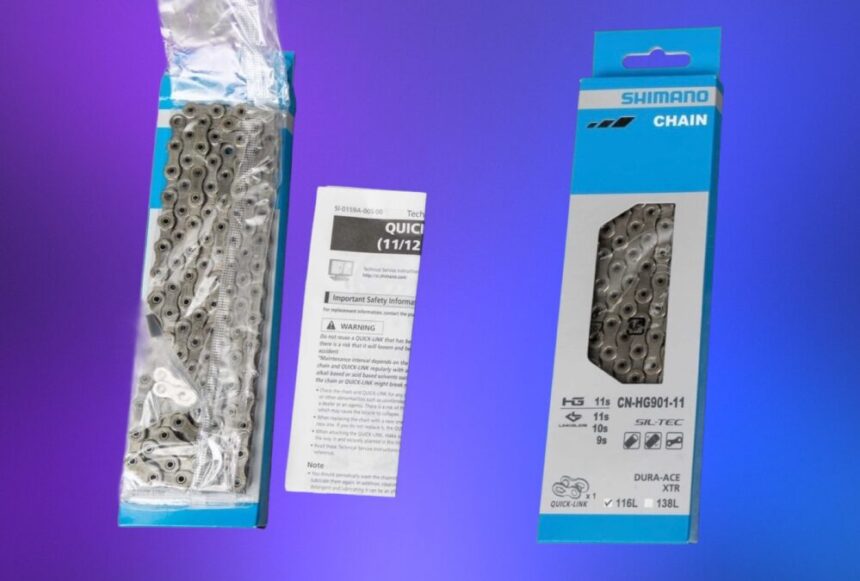
Fake Shimano chains have flooded the market, and unless you regularly buy and inspect genuine Shimano chains, spotting a counterfeit can be surprisingly difficult.
That’s a serious problem because fake chains don’t just wear out faster, but they’re also weaker. This not only increases your drivetrain running costs but can also create a safety concern.
This article is partly a public service announcement: if you’re buying a new chain, you need to be careful. But it’s also an opportunity to see just how poorly counterfeit Shimano chains perform when subjected to controlled laboratory testing.
Let’s get into it!
Real vs Fake Shimano Chains
Genuine Shimano Chain
Chain Wear When New: 0.00 mm
Chain Width: 5.67 mm
Roller Diameter: 7.65 mm
Price: US $64
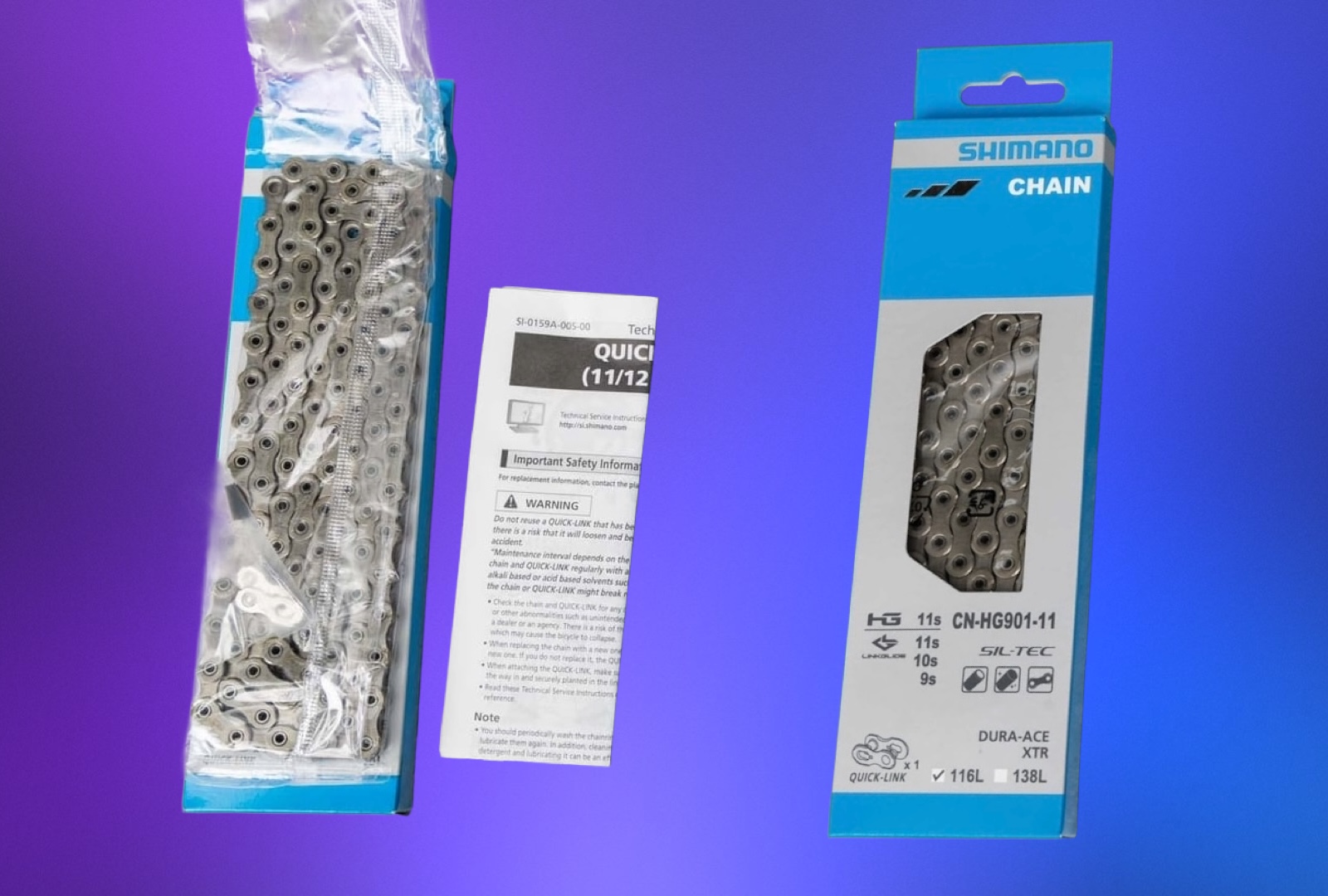
Escape Collective sourced three chains sold as “Shimano HG901-11” models and measured their dimensions. A genuine Shimano HG901-11 chain served as the benchmark for comparison and was, unsurprisingly, the most expensive of the three at US $64.
As expected, the genuine chain showed no measurable wear when new. Its dimensions were exactly where they should be, with no evidence of elongation or manufacturing deviation straight out of the box.
The packaging differed from that of the counterfeit chains. The box had a more matte finish that could be marked with a pen without smudging, and the barcode on the rear was applied as a separate sticker. The master link was also packaged separately from the chain itself.
Fake eBay Chain
Chain Width: 5.68 mm – 0.1 mm wider
Roller Diameter: 7.65 mm – Same size
Chain Wear When New: 0.03 mm
Price: US $40
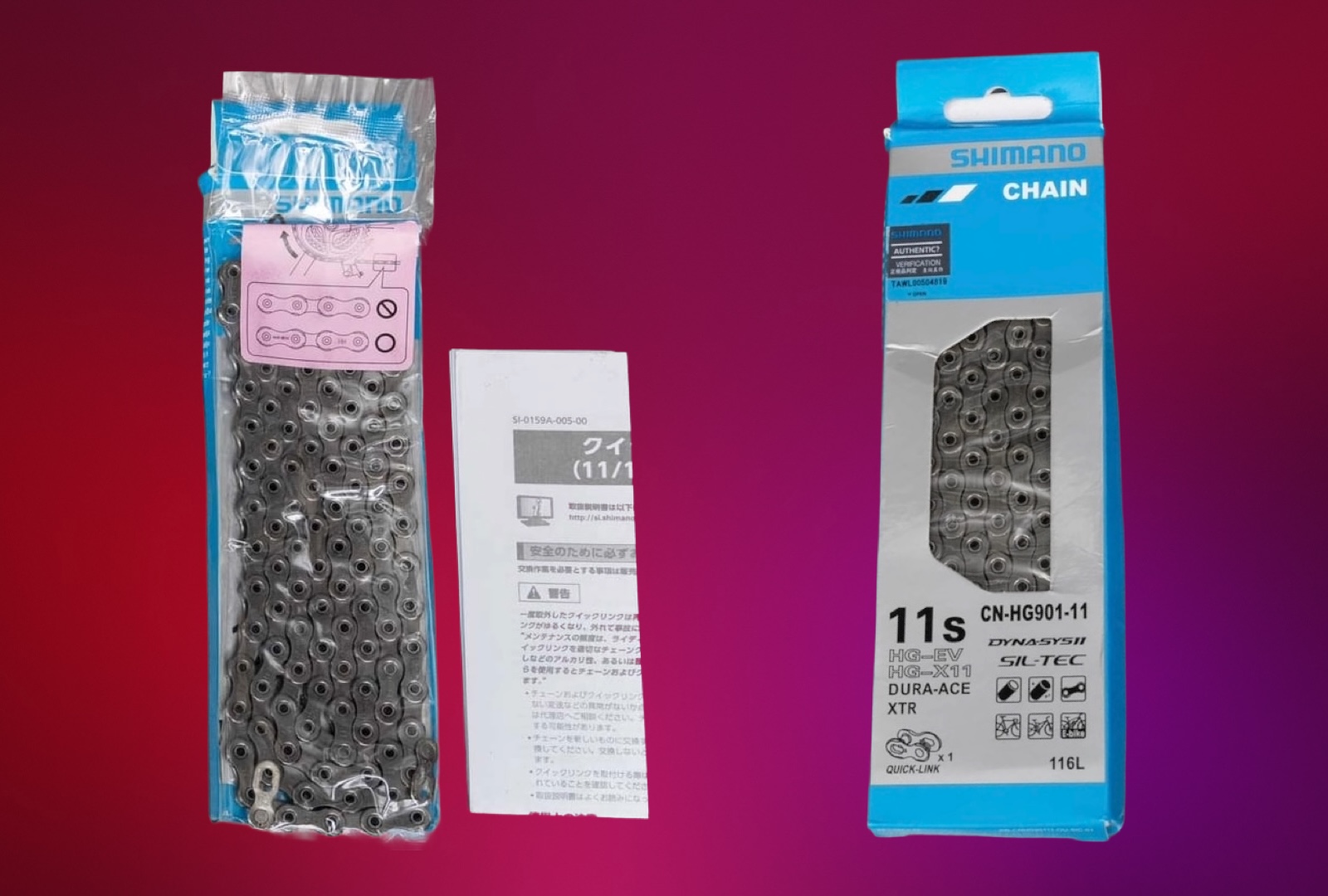
Purchased from eBay, this fake Shimano chain costs roughly 40% less than the genuine Shimano product.
Dimensionally, it was relatively close to the genuine chain. The roller diameter matched exactly, while the overall width was only fractionally larger. However, it already showed measurable wear straight out of the box with an elongation of 0.03 mm.
The packaging contained several clues that it was not real. Ironically, it included a sticker and barcode claiming authenticity, while the genuine Shimano chain did not. The box had a glossier finish that smudged when marked with a pen, and the rear barcode was printed directly onto the packaging rather than applied as a sticker. The master link was also packaged inside the same bag as the chain.
Fake AliExpress Chain
Chain Width: 5.77 mm – 0.1 mm wider
Roller Diameter: 7.7 mm – 0.05 mm bigger
Chain Wear When New: 0.12 mm
Price: US $20
At just US $20, or around 70% cheaper than the genuine Shimano chain, the fake AliExpress version is going to be tempting to many. But its measurements were alarming before it had even been fitted to a bicycle.
The chain was 0.1 mm wider and the rollers 0.05 mm bigger. This might not sound like much, but it matters. Riders who have purchased fake chains like this have reported more drivetrain noise and poorer shifting performance. In addition, the chain already exhibited 0.12 mm of wear straight out of the box.
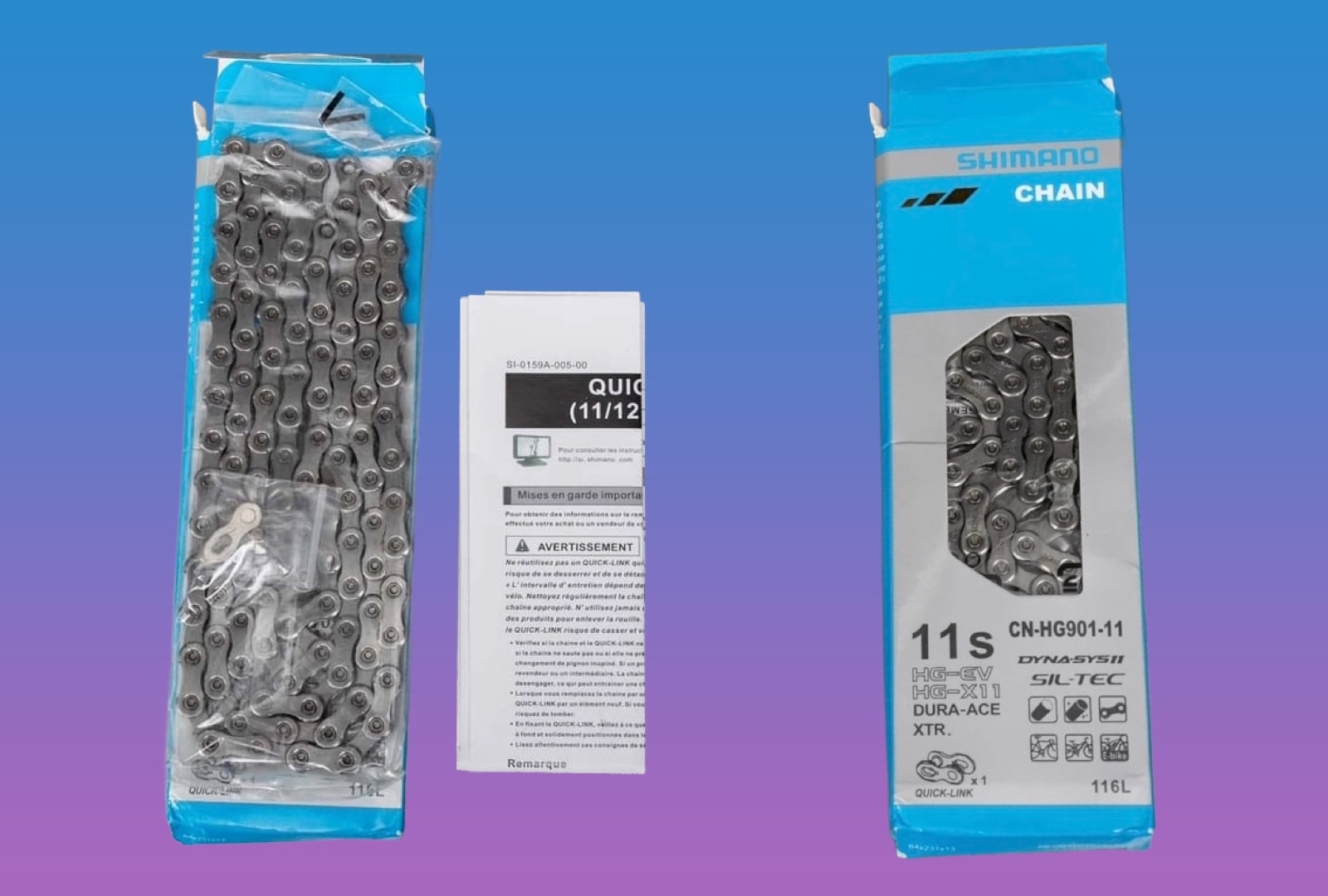
Unlike the other two chains, the AliExpress version did not use hollow pins. Its packaging was similar to the counterfeit eBay chain, featuring a glossy box finish and master links stored inside the same plastic bag as the chain.
Lab Testing Fake Shimano Chains
The controlled wear and strength testing for these three “Shimano” chains was carried out by Adam Kerin of Zero Friction Cycling.
For the wear testing, Kerin uses a purpose-built rig that drives a Shimano drivetrain with a 250-watt motor while mounted on an indoor trainer. The chains are run through a series of 1,000 km test blocks designed to replicate real-world riding conditions as closely as possible in a controlled environment.
Before testing began, all chains were stripped back to bare metal and treated with the control lubricant, Finish Line Dry. While this is a widely used lubricant, it’s known to perform poorly in wear testing compared to many modern alternatives (here’s my list of the best bike chain lubes).
A chain is deemed worn out once it reaches 0.5% elongation, which is the commonly accepted replacement point for modern drivetrains.
Chain strength was assessed using a dedicated test fixture that measures tensile strength under increasing load. In this test, a hydraulic ram applies force to a short loop of chain until permanent deformation or failure occurs. The resulting force is then compared against established industry standards.
Current ISO standards require bicycle chains to achieve a minimum tensile strength of 8,000 Newtons. In some markets, a newer European standard (EN) is also being adopted, raising the minimum requirement to a more demanding 9,200 Newtons.
Wear Test Results
Distance Until 0.5% WornChain Wear Difference vs GenuineGenuine Shimano Chain3500 kmBaselineAliExpress Fake Shimano Chain1000 km3.5x faster weareBay Fake Shimano Chain800 km4.4x faster wear
The wear test results are nothing short of staggering. The genuine Shimano HG901-11 chain lasted between 3.5 and 4.4 times longer than the counterfeit chains tested.
This matters because chain wear doesn’t occur in isolation. As a chain elongates, it accelerates wear on the cassette and chainrings too. In other words, the apparent savings of a cheaper counterfeit chain can quickly disappear once the increased drivetrain wear is taken into account.
The genuine Shimano chain reached 0.5% wear after 3,500 kilometres of testing. Given that the Finish Line lubricant used in this test is generally regarded as a relatively poor performer in wear testing, that result seems quite good.
Interestingly, despite arriving with the worst manufacturing tolerances and already measuring around 25% worn when new, the AliExpress chain actually outlasted the counterfeit eBay chain. That said, a lifespan of just 1,000 kilometres is still exceptionally poor by modern drivetrain standards.
The counterfeit eBay chain delivered the worst result of all, reaching 0.5% wear after only 800 kilometres. That’s an astonishingly short lifespan and highlights just how poor some counterfeit chains can be. Anyone unknowingly buying one of these chains is likely paying far more in replacement parts and drivetrain wear than they realise.
Strength Test Results
Newtons Until FailureForce Difference vs GenuineGenuine Shimano Chain9,370 NBaselineAliExpress Fake Shimano Chain7,960 N15% Less ForceeBay Fake Shimano Chain7,550 N19% Less Force
After being subjected to the hydraulic ram test, the genuine Shimano chain was the only sample to meet the ISO minimum tensile strength requirement of 8,000 N. It was also the only chain to exceed the more stringent European (EN) standard of 9,200 N.
Both counterfeit chains fell well short of these benchmarks. The AliExpress chain required 15% less force to cause failure, while the eBay chain required 19% less force. Neither chain met the minimum safety standard.
The amount of permanent deformation was also measured after applying a 5,000 N load. The genuine Shimano chain showed no measurable deformation whatsoever. By comparison, the AliExpress chain was permanently stretched by 0.11 mm, while the eBay chain fared worst at 0.38 mm.
What’s particularly striking is that these measurements were taken after the wear testing had already been completed. The genuine Shimano chain had accumulated 3.5x more kilometres than the counterfeit chains before entering the strength test, yet it still demonstrated the highest tensile strength and the greatest resistance to permanent deformation.
How Can You Avoid Buying a Fake Shimano Chain?
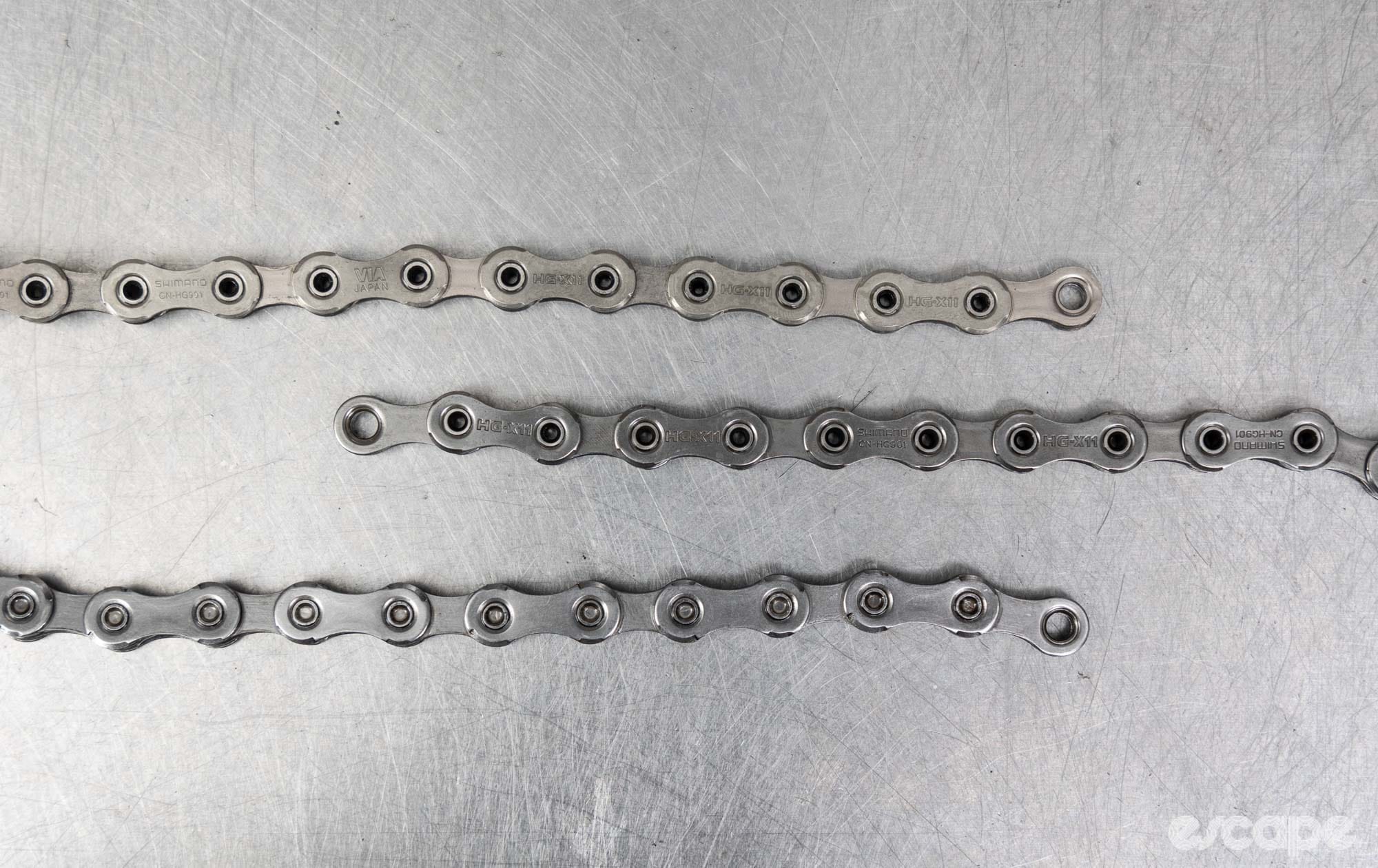
Top to bottom: A genuine Shimano chain, an eBay chain and an AliExpress chain. Image: Escape Collective
Unfortunately, there is no foolproof way to identify a counterfeit Shimano chain from its packaging alone. Counterfeiters have become increasingly sophisticated, and many fake chains now look remarkably convincing at first glance.
That said, there are a few details that may help raise suspicion.
Both the AliExpress and eBay counterfeit chains tested here arrived in boxes with a noticeably glossier finish than the genuine packaging. One simple check is to mark the box with a permanent marker. On the counterfeit packaging, the ink tends to smudge much more easily than on the authentic box.
The UPC barcode on the rear of the packaging was another distinguishing feature. On the genuine Shimano chain, the barcode was applied as a separate sticker, whereas both counterfeit chains had the barcode printed directly onto the box (please note that other genuine Shimano chain models print a barcode on the box).
The packaging of the quick link may also provide a clue. The genuine Shimano chain packaged the quick link separately from the chain itself, while both counterfeit chains included the quick link inside the same plastic bag as the chain.
However, these differences should not be treated as definitive proof of authenticity. Counterfeit products evolve constantly, and packaging details can change over time. The safest approach is to purchase Shimano chains from reputable bike shops and well-established retailers with a direct relationship to Shimano.
Summary
This test examined just three chains, but the results paint a worrying picture of the counterfeit Shimano chains currently on the market. Despite looking very similar to the genuine product, the fake chains performed dramatically worse.
The counterfeit Shimano chains wear out 3.5 to 4.4 times faster than the genuine chain, require 15 to 19% less force to fail, and are likely to deliver poorer shifting performance due to their looser manufacturing tolerances.
If you’re buying a Shimano chain, it’s worth purchasing from a large, reputable bike retailer. I’d avoid marketplace platforms such as Amazon, eBay, AliExpress, and Temu, where counterfeit products are commonly sold by third-party vendors. Be especially cautious of prices that seem too good to be true.
And lastly, stay up to date with the latest signs of counterfeit Shimano products, as counterfeiters are constantly refining both their chains and packaging.
The post Real vs Fake Shimano Chains: Counterfeits Wear Out 4x Faster appeared first on CYCLINGABOUT.com.
Read more:CYCLINGABOUT.com