

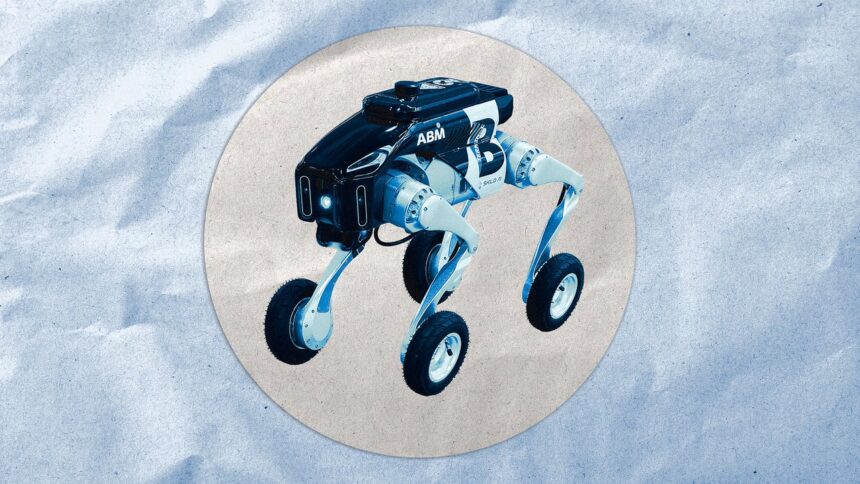
Inside the slick new Terminal B at New York’s LaGuardia Airport, a headless robotic “dog” is beginning to patrol the floors. As bemused airport travelers watch from close by, the four-wheeled device rolls around baggage claim, where it’s been deployed for a demonstration. Its job: sniffing. Well, sort of. The robot is armed with air quality detectors that the airport team says help monitor the terminal for pollutants.
This robot, along with two others, constitutes a fledgling automated fleet that’s been rolled out by ABM, a maintenance and facilities company operating at LaGuardia’s Terminal B and dozens of other airports and facilities. The terminal processes tens of thousands of passengers per week, and is open almost all day, except for a small window in the early morning. It’s a vision of automation that the team argues helps keep the terminal looking new, clean, and shiny, even if some people are still a little unsettled by the idea of new robotic janitors.
For LaGuardia Gateway Partners, which manages the terminal, the appeal of robotics is largely about frequency. Robots can complete some of these tasks three times a day, keeping heavily used surfaces cleaner while improving the economics of the service.
“Our touch points are hard. They really take abuse,” says Jaimie Haviaris, chief technical officer at LaGuardia Gateway Partners. “Instead of doing frequencies twice or three times, can we double it using robotics? And then the [return-on-investment] is heavily increased for us.”
A new sniffer robot
The rolling canine-esque bot is made by a company called Skild AI, which calls itself a generic-purpose robotic intelligence company. The purpose of this robot, ABM says, is to monitor air quality; no one wants the airport air getting stagnant or sweaty, especially when so many people congregate in one place.
But why a moving air sensor in dolly-dog form? ABM argues the air ducts are many feet overhead, and that they can’t capture the reality of the air down below where passengers are actually walking.
In addition to monitoring various airborne particles, the team says the robot can sniff out temperature and humidity. The robot also tracks volatile organic compounds, gases sometimes produced by cleaning products and paint, and nitric oxide and nitrogen dioxide—pollutants sometimes released by aircraft and other equipment. The device most often alerts the team about potential temperature issues. The robot has a job monitoring trash cans, and sends “alerts” back to the airport if it sees one that’s overflowing.
There are important practicalities to consider when deploying robots like these in a public airport. Kids might go up and try to play with them. To deal with that problem, in addition to a “don’t touch” sign, the robot has a built-in safety radius. If anyone comes too close, the device simply stops moving and freezes. What about someone trying to steal the robot? The team says the device’s location is tracked in real time, and that with so many different security staff and teams on-site, it’s a safe environment.
“I think the form factor actually really helps with adoption,” says Kayla Oliver, innovation vice president at ABM. “We prepped our teams with talking points, both ABM staff and airport terminal staff, and things to watch out for.”
There are likely to be some surveillance concerns. The dog resembles the military tech company Boston Dynamics’s robot “Spot,” which has gone viral for its dances and deeply concerned privacy advocates. Skild AI does design surveillance robots for both security and inspection. And the robot deployed at LaGuardia does have a camera installed. Fast Company was able to see how the dog livestreamed what it collected back to an exterior laptop.
When asked about these concerns, the ABM team at LaGuardia says the dog isn’t being used for security and argues that in the already ultra-surveilled airport, people mostly find it cute. When Fast Company visited, many people took no notice of the vehicle, while a few stopped to take pictures and marvel at it. “The Boston one’s big,” says LaGuardia Gateway Partners’ Haviaris. “I think the bigger ones are imposing.”
[Photo: ABM/LaGuardia Airport]
A fleet of robots
The Skild robot isn’t the only airport robot ABM is experimenting with. It also has two cleaning robots (a vacuum and a scrubber robot) patrolling the floors. Those vehicles are powered by lidar and cameras that sense nearby objects and people, and travel around the airport, including jet bridges, sucking up any detritus or messes. These devices, made by a cleaning robotics company called CenoBots, don’t seem to be designed to imitate any living being; the vacuum robot works like a far more powerful version of a home Roomba.
The robots are connected to a shared platform where the team can track where they are, their performance, and whether they might need help. These will all connect, eventually, to a monitoring room just behind the entrance to the airport’s security checkpoint, where the terminal’s team monitors plane arrivals and logistics around the airport. ABM won’t share how much any of the robots cost.
These robots are still in pilot mode for now. ABM is investigating how reliable they are, including how well they integrate into airport operations and how well they clean. At the end of the pilot, the team will evaluate whether to keep the current robots, buy more, or deploy similar robots at other airports.
“Why we do this is to support some supplements to the work that our teams do,” argues Sean Bromfield, president of aviation at ABM. “It allows us to take our team members, our front-line employees, and deploy them to higher-value, more detail-oriented, guest-facing services. And that’s where you really get the ROI.”