

April 26, 2026
Today marks the 40th anniversary of the Chernobyl nuclear power plant disaster in Ukraine.
on the evening of April 26th, reactor four exploded, sending plumes of radiation across Europe in what is still, by far, history’s worst nuclear accident. Prevailing winds saved the capital, Kiev, from disaster, carrying the fallout in the opposite direction, north into Belarus. From there it diffused across northern Europe.
I visited Kiev three or four times, some years ago, when my airline was still flying there. The city surprised me. It’s green and hilly, with parks and museums and onion-dome churches. Nothing of the dour, Soviet-looking city I expected. Our layover hotel was the Premier Palace, an expensive place done up in chandeliers and marble. It was the kind of hotel in which you always felt under-dressed. But it had an edge to it — that unmistakable vibe of post-Soviet decadence. There was a strip club on the sixth floor.
Of the day trips available in and around Kiev, none was more extraordinary than the chance to tour Chernobyl, only two hours away by car. I took one of these tours in October of 2007. At the time, a full-day excursion cost about $250. It included transportation to and from the site, plus all the admission formalities — and a radiation scan on your way out.
A 30-kilometer “Exclusion Zone” surrounds the site, accessible only to researchers, temporary workers, and a small number of villagers — most of them senior citizens — that the Ukrainian government allows to live there. And, at least until the war with Russia got going, to tourists.
A guide accompanied us the entire time, but we were more or less free to wander. We had the site almost to ourselves, walking through apartment blocks, kindergarten classrooms, a high school, a hotel.
The photographs below are from that day. I have not captioned them. They more or less speak for themselves.
Most of them were taken in Pripyat, the abandoned city inside the Exclusion Zone that was once home to 50,000 people. The entire population of Pripyat was forced to flee, leaving everything behind. It exists as a sort of Soviet time capsule, a bustling city in suspended animation, complete with hammers, sickles, and no shortage of radioactive detritus that was once the stuff of regular, everyday lives: kids’ toys, a ferris wheel, a classroom chalkboard. It’s these everyday items that leave the most lasting impressions — a perversion of normalcy that drives home the magnitude of the tragedy.
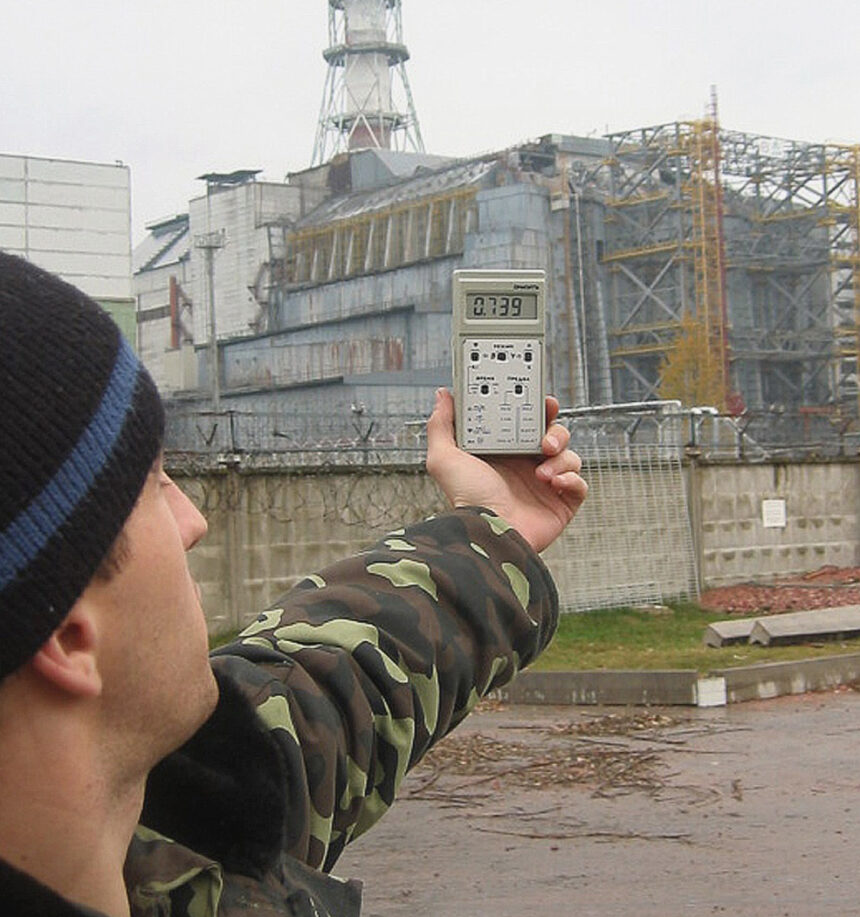
When the reactor blew, Soviet helicopters dumped sand and clay over the exposed core. Later the building was encased in thousands of tons of concrete — a structure that become known as “the sarcophagus.” In the picture above, our guide aims his dosimeter at the sarcophagus. The reading you see on the machine is about sixty times normal background radiation. We were allowed to remain here only for about ten minutes.
I should note that reactor four no longer looks like this. In 2016, authorities completed the installation of a mammoth protective dome, concealing the remains within a 25,000-ton shell, made of steel, that looks like a cross between a football stadium and an airship hangar. What you see today is a much more sterile, less jarring aesthetic.
ALL PHOTOGRAPHS BY THE AUTHOR
The items below are souvenirs, I guess you’d have to call them, scavenged from Pripyat. Among them are a 1984 copy of Pravda, the Soviet state newspaper; some vintage postage stamps, and what appears to be a school report card, found inside the Pripyat high school.
Perhaps a Russian or Ukrainian speaker out there can help translate some of this. I’d love to know more about the report card — names, dates, anything.
The bottom shot is from a roll of exposed film, found on the floor near the high school gymnasium.
Hopefully these things haven’t turned my apartment radioactive.
Two decades before my trip to Chernobyl, I’d been to the Soviet Union, visiting both Moscow and Leningrad (as St. Petersburg was known at the time). This was March of 1986, about a month before the reactor accident. Among the highlights of that trip were my flights aboard Aeroflot. I got to ride a Tupolev Tu-154 from Moscow to Leningrad, and then a Tu-134 from Leningrad to Helsinki.
Apple juice. I remember the Aeroflot flight attendants serving apple juice in plastic cups.
It dawns on me, too, that my travel habits are at times decidedly macabre. In addition to Chernobyl, I’ve been to the Auschwitz-Birkenau complex in Poland, and to the various Killing Fields sites around Phnom Penh, in Cambodia. Some people make a hobby of such trips. They call it “disaster tourism,” or some such. Everyone has their own motives, but I like to believe there can be a more respectable purpose to these visits than morbid thrill-seeking.
The post Letter From Chernobyl appeared first on AskThePilot.com.