


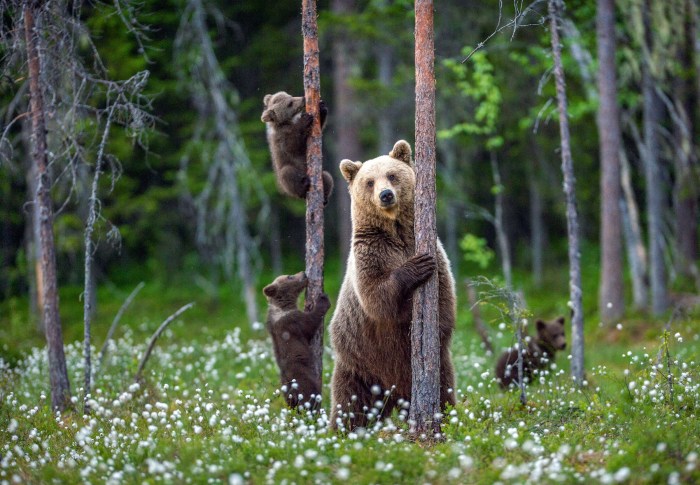
Grizzly bears are one of America’s most iconic species. Whether it’s fear or awe, few animals spark more visceral reactions. And it’s the animal that’s at the heart of a raging political debate in California.
A bill recently introduced to the California Legislature would start the process of bringing back grizzly bears to the state, after an absence of nearly a century. The effort is leading to questions of just how proactive conservation should be.
The History of Grizzly Bears
Grizzly bears were once widespread in the state. According to estimates from the National Park Service (NPS), before the Gold Rush (1840s), the population numbered around 10,000.
“The mild Mediterranean climate throughout much of California fostered a great environment for these bears in the Central Valley and along the coast and because these bears did not need to hibernate (bears hibernate based on food availability), they were indeed huge,” the NPS explained.
(Photo/Adam Van Spronsen via Shutterstock)
To protect development, settlers, and the growing ranching industry, people hunted and killed the animal, rapidly diminishing its population. The last grizzly seen in California was in 1924.
In 1993, U.S. Fish & Wildlife (USFWS) launched a recovery plan to help restore the animal’s numbers in six areas, including Yellowstone, northern Washington, and much of Montana and Idaho. The animal is currently listed as “threatened” under the Endangered Species Act in the Lower 48, with a population of 1,923. The population is highest in Alaska, with estimates of around 30,000.
The Bill
Back in February, California Senator Laura Richardson introduced SB-1305, or the California Grizzly Recovery Assessment Act. The bill would begin the long process of reintroducing grizzly bears.
It would mandate that the California Department of Fish and Wildlife (CDFW) “develop and make publicly available a roadmap that evaluates whether, and under what conditions, reintroduction of the grizzly bear is feasible and advisable, and the extent to which the ecological functions once provided by the grizzly bear may be restored through human-mediated landscape restoration, including through reintroduction of the species,” the bill reads.
CDFW would have to deliver this roadmap by 2030. This document would include an analysis of several key areas, including:
How the removal of the grizzly bear from California affected other native species and ecologies, and how they could benefit if the animal were reintroduced.
Potential areas for reintroduction of the bear, based on “ecological criteria, land ownership, habitat connectivity, landscape permeability, conflict risk, existing and needed coexistence infrastructure, [and] community support.”
Potential populations that could be used in reintroduction.
Communication and consultation with Native American tribes.
The logistics, costs, regulations, and timeline of a possible reintroduction plan.
If passed, the law would not require reintroduction to occur: “The bill would prohibit reintroduction of the grizzly bear in the state until the department or others have carried out various actions, including, among other things, completion of the roadmap, determinations, based on the best available science, that establishment of a self-sustaining grizzly population in the state is biologically viable, and a consultation with California Native American tribes and engagement with communities.”
The bill has had hearings in the Committee on Natural Resources and Wildlife, and is now with the Committee on Appropriations. It is set to have a hearing on May 4.
The Rationale
There are several reasons why politicians and conservationists wish to bring the species back to California. Scientists argue that there’s compelling evidence that reintroduction is feasible. A 2025 study from the California Grizzly Alliance identified three areas of California where bears could potentially thrive: northwestern forests (Klamath Mountains and Trinity Alps), the Sierra Nevadas, and the Transverse Ranges (the area from San Bernardino to Santa Barbara).
A map showing historical and proposed populations of grizzly bears; (map/CGA Feasibility Study)
Grizzly bears could affect native ecosystems in several ways. The animal is a prolific digger, and “clearing surface vegetation can open up forest floors, increase habitat complexity, enrich soil nitrogen levels, regulate nutrient deposition into streams, and improve soil airflow, water infiltration, and water holding capacity. Soils tilled by grizzlies may improve conditions for some rare and native plants, including geophytes with subsurface growth organs,” the study explained.
Grizzlies could also help reduce wildfire risk, a perennial problem in the state. “By creating forest gaps, eliminating ladder fuels, and raising the minimum crown height of many trees, grizzlies may have helped moderate fire behavior in some systems,” researchers said.
Supporters
The measure has the support of several key stakeholders. The grizzly bear is important to many Native American tribes, including the Yurok and Tejon, which are backing the measure.
“To our ancestors, the grizzly bear was a revered relative, who kept the natural world in balance,” Yurok Tribe Chairman Joseph L. James said in a press release. “Our people feel the same way today. In the Yurok worldview, all native wildlife species play important roles in healthy ecosystems.”
Nonprofit environmental groups like the Center for Biological Diversity have also endorsed bringing back the grizzly. “The grizzly bear is far and away the most ecologically and culturally significant species that we have lost from California,” Brendan Cummings, conservation director at the Center for Biological Diversity, said. “Going forward, whether or not grizzlies return to the state comes down to our political leaders and wildlife managers having the boldness of vision to make it happen. I believe they do.”
There are several cases of effective wildlife reintroduction in California. USFWS successfully launched a recovery program for the California condor in 1987 and brought back the species from the brink of extinction.
Efforts to bring back the California Condor have proven productive; (photo/Shutterstock)
CDFW has been managing a bighorn sheep reintroduction program since the 1980s, and has established several large herds.
Opposition
Several lawmakers and groups have criticized the bill, including the California Cattlemen’s Association.
Republican Sen. Megan Dahle said reintroduction was not practical. “Modern California lacks the habitat and prey base to support these bears; the risk to the safety of recreational hikers and hunters out in the woods is real; and livestock owners in Northern California are already dealing with legally protected gray wolves feeding on their herds, and adding a new predator is just too much,” she wrote on Instagram.
A grizzly bear; (photo/Shutterstock)
State Assemblywoman Heather Hadwick also objected. “California is not adequately managing the wildlife we already have. State capacity to monitor and responsibly manage existing populations (i.e., mountain lions, black bears, and wolves) is strained. Before considering another apex predator, we must ensure our wildlife management strategies are modern, science-driven, and properly funded,” she wrote in a statement.
The Larger Context
Reintroduction of predator species has long been a hot-button topic in conservation and state politics. Since it began in 2020, Colorado’s gray wolf program has led to fights between state and federal agencies and outrage from livestock owners. California recently listed the mountain lion as an endangered species in certain parts of the state, and the hearing about the matter was highly contentious.
Elsewhere in the Mountain West, grizzly bears are a major issue. In Jan. 2025, USFWS decided not to delist the animal as threatened, despite objections from Idaho, Montana, and Wyoming, who then tried to take action on the state level.
As state and federal agencies continue to try to balance economic and environmental interests in conservation, no animal looms as large as the grizzly bear.