


This month has seen two serious bear encounters involving hikers in American national parks, and the unfortunate incidents have now become a political talking point. Following an apparent fatal bear encounter in Glacier National Park and a separate grizzly bear attack in Yellowstone National Park, Congressman Ryan Zinke (R-Mont.) has renewed the call to delist the grizzly bear as a protected species.
What Happened
After a May 4 bear incident on Yellowstone National Park’s Mystic Falls Trail, the National Park Service (NPS) announced temporary closures on May 5 and said on May 7 that those closures remained in effect. Two male hikers, aged 15 and 28, encountered a likely female grizzly bear with two or three cubs-of-the-year, and both hikers were injured. Emergency responders transported the hikers by helicopter to receive medical care.
Then, on May 7, the NPS announced that a missing hiker had been found dead in Glacier National Park with injuries consistent with a bear encounter. NPS later identified the hiker as Anthony Pollio, 33, of Davie, Fla. It was the first bear-related fatality in the park since 1998.
Grizzly bears in the Lower 48 have been listed and protected as threatened under the Endangered Species Act (ESA) since 1975. On May 12, Rep. Zinke posted on X that the grizzly should be delisted.
“Last week, two grizzly bear attacks claimed the life of a hiker in Glacier National Park and seriously injured two others in Yellowstone National Park. These tragedies are a sobering reminder that grizzly bear populations have recovered well beyond sustainable levels, and it is past time for the federal government to delist them and give states the management tools they need to protect both people and wildlife. Delist the grizzly,” he wrote.
The Debate
In Jan. 2025, the U.S. Fish and Wildlife Service (USFWS) proposed an update to the grizzly bear’s ESA listing and management framework. The agency proposed keeping the bear’s designation as “threatened,” a status that comes with protections meant to shore up the species’ population. It also found petitions from Montana and Wyoming to delist certain grizzly bear populations were not warranted.
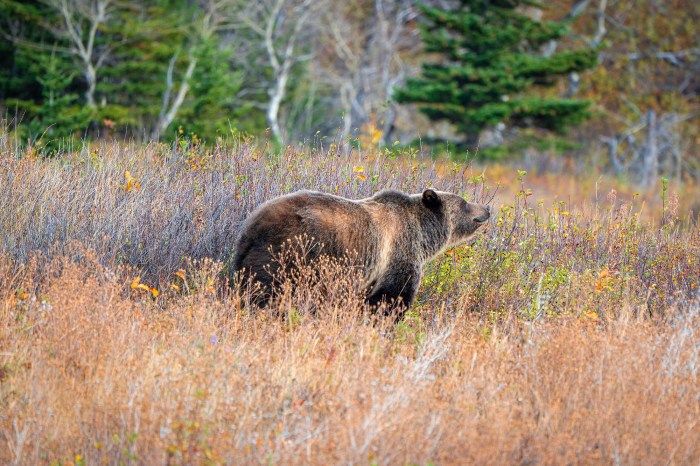
Greater Yellowstone area grizzly bear; (photo/Shutterstock)
This sparked anger and outcry from state officials in Wyoming, Montana, and Idaho, who have called for the bear to be delisted for years.
State officials, like Wyoming Governor Mark Gordon, have argued that the population is fully recovered and that individual states can better manage their populations. There are currently around 2,000 grizzlies in this part of the country.
The Stats
According to BearVault, the manufacturer of bear-safe food containers, from 1974 to 2024, there have been 66 fatal black bear attacks and 82 fatal grizzly bear attacks in the U.S. In most of these cases, the bears were startled or food-conditioned.
“Food-conditioned bears are those that have sought and obtained non-natural foods, destroyed property or displayed aggressive non-defensive behavior towards humans, and are removed from the wild,” the NPS explains. Bears that are used to accessing human foods are considered potentially dangerous to humans.
Since the early 2000s, Yellowstone has averaged one injury due to bears per year, only recording a total of nine deaths (eight grizzly, one black bear) since 1872. Since 1910, there have been 11 fatalities from grizzlies in Glacier National Park.