

We found this two-layer jacket to be perfect for low level walks
Diriksons, in case you don’t know them, are a brand hailing from the western coast of Sweden and they started out all the way back in 1913 by making jackets that were, at the time, groundbreaking for the amount of weather protection they were able to provide. Fast-foward to today and the brand is still very much focussed on producing kit for the elements, but at more affordable prices than you tend to see across the outdoor market.
The Didriksons Dario jacket exemplifies this. It’s a waterproof shell from a reputable brand that has an RRP of just £110. How does it perform though? I’ve been putting it to the test through spring conditions, taking it up two hills in the Yorkshire Dales and out on some wet country walks – here’s my verdict.
Didriksons Dario Jacket: The Top Line
A 2-layer shell that offers enough protection for country walks and that can do the job for summer hikes when the weather isn’t too brutal. Like most 2-layer shells, it has its limitations. One of the standout aspects of it for me was the cut.
Performance: Is It Waterproof?
The Dario’s waterproof system involves a membrane that’s protected by a DWR-treated fabric on the outside. On the inside, there’s an inner polyester lining that’s not actually attached to the membrane. It’s a typical 2-layer construction which you tend to see on lower cost wet weather gear.
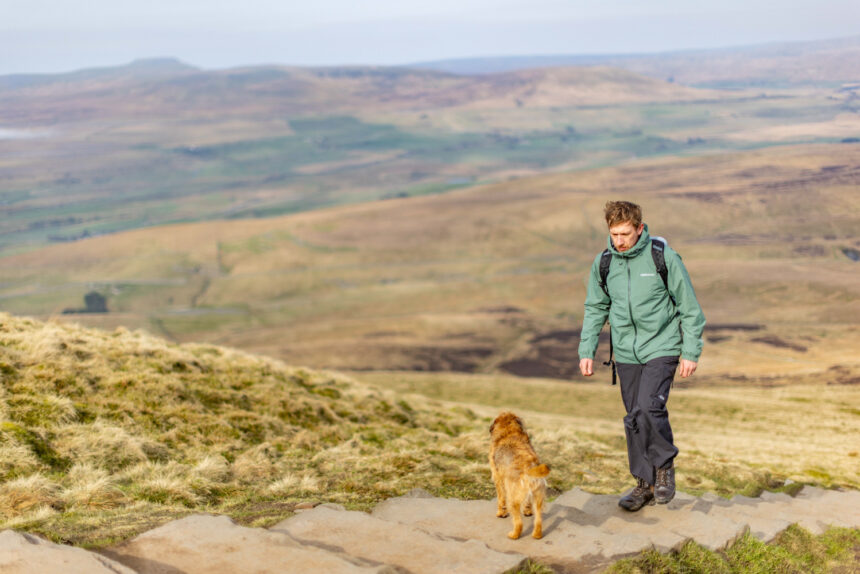
OM editor Will using the jacket in the Yorkshire Dales. Photos: Dave Macfarlane
The first time I wore it was on a long hike in the Yorkshire Dales where we climbed up to about 700 metres. It was a blowy day but there was plenty of sunshine and temperatures of around 15 degrees. In these conditions, I was impressed by the jacket’s ability to keep off wind chill and I didn’t overheat during the ascents, so the breathability seemed good. I’ve since used the jacket in the rain and I have found that moisture does hinder the breathability a bit, which is to be expected from a 2-layer jacket.
And the protection it offers in the rain? I’ve worn this on multiple rainy dog walks in the Wiltshire Downs and it’s served me very nicely, keeping all moisture out, even in some breezy conditions. The seam taping has all done its job and the same can be said for the waterproof coating on the main zip. It has a casual look to it that doesn’t really look out of place in urban settings, so I’ve been wearing it often as a daily jacket and it serves that purpose nicely.
The hydrostatic head rating is 10,000mm which is quite low. For perspective, Gore-tex has a rating well above 20,000. This, therefore, isn’t a jacket I’ve wanted to wear into rough conditions where I might be faced with heavy, wind-driven rain. I also wouldn’t recommend wearing it in rainy conditions with a heavy backpack as there’s a risk that water can be pushed through from pressure from the straps. I haven’t tested the jacket out fully in these scenarios just yet – I’ll come back to update this when I’ve got some real findings there.
Regardless of the fabric’s performance, there are some aspects of this jacket that don’t make it suitable for very rough conditions. The hood, for instance, isn’t stormproof and the cuffs are only elasticated – I tend to find Velcro cuffs much more reliable. Still, I haven’t had any issues with these two aspects on wet, low-level walks.
Features
The hem has two toggles for adjustment. The hood has toggles on the front, positioned around the cheeks, that let you cinch in the opening. This helps to reduce excess volume and stop the hood from feeling too loose in windy conditions, giving it a slightly more secure, wrapped fit around the face. It’s a simple system and it does improve things a bit, particularly when you’re walking into a breeze, but it’s not quite as effective as a fully adjustable mountain hood. There’s no rear volume adjuster, so you can’t properly dial in the fit around the back of the head, and I found that the peak can feel a little loose as a result.
There’s a Velcro tab on the back of the hood and a loop inside the jacket, allowing you to roll up the hood to form a collar if you don’t like having a hood flapping when it’s not in use. This forms a collar that’s quite heavy and comfortable.
I really like that the main zip has a glove-friendly zipper tab on it. I also like that there’s a press stud tab halfway down the zip that you can use when you want ventilation while still retaining a degree of wet weather protection. For me, having an extra press stud tab at the base of the zip would be an improvement as it would prevent the jacket from flapping like a cape when you’ve got it opened up for venting.
The lack of pit zips is a downside to me too. On membrane lined jackets, I always prefer to have pit zips for ventilation.
There are two zipped handwarmer pockets. The zips aren’t waterproof and rely on storm flaps for protection. From my experience, these types of pockets don’t tend to be reliable as safe places for keeping a mobile phone protected from the elements. There’s an internal pocket that’s quite large – I’ve found it to be the ideal size for an OS map.
Unfortunately, none of the textiles or components are derived from recycled materials. It’d be good to see Didriksons looking to keep up with its compatriots in the Scandinavian outdoor market here. Strangely, it looks like the women’s equivalent of this – the Varja – is made from recycled fabrics.
Weight and Packability
At 850g, it’s not the lightest jacket out there, which is to be expected from a 2-layer shell. That being said, I’d say it’s at the lighter end of the scale for that category, and it’s got good packability too; I’ve found I can bundle it up to about the size of a small loaf of bread.
Fit
I’m 5 foot 10 and the version I’ve been trying is a medium. I’m a little between an M and an L these days but the size I’ve got works for me. It looks good when worn just over a baselayer and also accommodates a thick layer underneath. I’ve found it combines really nicely with my Passenger Ashland down jacket.
Verdict
This isn’t a shell for high mountain use – a three-layer shell is what you need there. If you’re after something for less serious stuff, however, it’s a decent performer from a trusted brand with heritage, and all at a fair price. From my experiences with it, it’s perfect for country walks, valley walks in national parks or a summer hike up Scafell Pike where the conditions look kind enough. And, from my experience, it’s ideal as a daily jacket for wearing out and about or on the daily commute.
Pros: Price, cut, durability, versatile aesthetic
Cons: No stormproof hood, no adjustment at cuffs, no waterproof phone pocket, no recycled materials, no pit zips.
Price: £110
Weight: 850g
Didriksons Dario