

Kona has always done things a bit differently. Over the years, they’ve produced everything from klunker mountain bikes to full-on choppers, along with radically shaped downhill frames, and more recently, a drop-bar mountain bike. The new 2026 Kona Unity bikepacking bike continues that tradition as an unconventional machine.
With its unusual frame shape, heavily raked fork, integrated front rack, mixed wheel setup, and a half-decade-old 11-speed drivetrain, a lot is going on here. So, I wanted to take a closer look at the design choices of this ground-up off-road touring platform.
Let’s dive in.
Features of the 2026 Kona Unity
Monstrous Frame Design
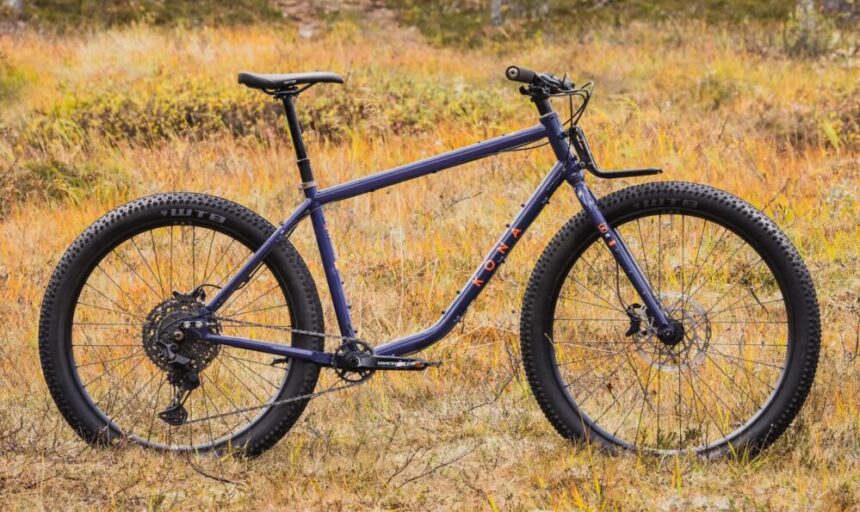
The most noticeable thing about the steel Unity frame is its cavernous front triangle. It’s so large you can literally climb through it. A deeply curved downtube, paired with a relatively long head tube (thanks to the shorter fork), creates a frame that’s clearly been designed with maximum internal storage in mind. This is a bike built to swallow a seriously big frame pack.
That’s a contrast to most modern hardtails, which are now designed around longer-travel suspension forks and long dropper posts. Those trends shrink the available space inside the main triangle, often leaving even taller riders with surprisingly limited room for gear.
And that’s a bit of a missed opportunity, because the frame triangle is arguably the best place to carry weight. Keeping mass low and centred has very little impact on bike handling, and that’s exactly what you want on a loaded bike. The bag doesn’t rattle, and it’s also one of the easiest storage areas to access, particularly with roll-top frame packs, which let you rummage through your gear quickly without worrying about broken zips.
Kona has also included multiple mounting points inside the triangle, making it easier to secure a custom frame pack without relying heavily on straps. The result is a cleaner-looking setup that’s kinder to your paint.
Built-In Front Rack
The integrated front rack is one of the Unity’s great features. Because it’s mounted to the frame rather than the fork or handlebars, your steering stays completely independent of whatever weight you’re carrying on it. This makes the steering light and predictable. Plus, you don’t get that sluggish, side-to-side “flop” at low speeds that often comes with bar-mounted bags.
This concept is well established in the folding and cargo bike world, and we’ve also seen it before on bikepacking bikes like the Trek 1120.
Modern front racks with luggage perched above the wheel are a bit of a pet peeve of mine. When that weight sits in front of the steering axis, it swings in a wide arc rather than tracking directly with your inputs. This results in heavier, floppier steering, especially at low speeds.
And at higher speeds, having the weight too far forward can even trigger speed wobbles or “weave” as the front wheel is more likely to suddenly veer when disturbed, creating oscillations. By fixing the rack to the frame, Kona has sidestepped this issue entirely.
You can also say goodbye to crushed cables from handlebar bags, along with wobbling loads or bags sagging into the front tyre. The rack is rated for up to 6kg, and it includes mounts on either side for water bottles or accessories like pumps.
On a side note, if you like the sound of a rack decoupled from the steering, check out the Pedal Stoke Orbiter. This product does the same thing and retrofits to a wide range of bikes. ToxicWorks and Steco also make headtube-mounted retrofit racks, which aren’t quite as neat but do the same job.
Long Offset Fork Design
The Unity uses a slack head tube angle, combined with a very wide front tyre. That creates a lot of what’s known as trail.
High-trail bikes tend to feel incredibly stable at speed, holding their line with minimal input, but the trade-off is at low speeds, where the steering feels like it wants to flop from side to side. It’s something you can get used to, but it’s not exactly a refined steering characteristic.
A wide handlebar helps counteract this to some extent, giving you more leverage over the front end. But Kona has also addressed the issue more directly through the fork design. The Unity uses a longer-than-usual fork offset, which reduces trail and wheel flop and brings some lightness back into the steering.
It’s a well-established approach. Brands like Jones and Stooge have been using long fork offsets for years. And combined with the built-in front rack supporting your luggage, the steering will feel sharper than you’d expect.
That longer offset also pushes the front wheel further out in front of the bike, increasing the front centre. In practical terms, this gives you a larger “endo angle,” making it less likely that you’ll pitch over the bars on steep descents. Considering the added weight of front luggage, which naturally wants to rotate you forward, longer front centres are a welcome addition off-road.
Mixed Wheel Sizes
You’ll also notice that the rear wheel is smaller than the front, a setup commonly referred to as a mullet. On most mountain bikes, this configuration is used to improve clearance on steep descents, reducing the chance of the rear tyre buzzing your backside, while also making the bike feel a bit more playful and easier to lift over obstacles.
But the rigid Unity isn’t really aimed at aggressive trail riding, so what’s the thinking here?
If you’re running both a dropper post and a seat pack, you’ll often find the bag fouls on a 29″ rear wheel, especially on smaller frames. Switching to a smaller rear wheel creates the clearance needed for both to work properly. It also opens up the option of fitting a lower-mounted rear rack with a dry bag on top.
That said, I suspect a 29″ rear wheel could’ve easily fit on the large and extra-large frame sizes, where clearance is less of a concern. Personally, I would’ve preferred to see that option offered. Kona does note that a 29 x 2.5″ wheel and tyre will fit, so there’s still some flexibility for riders who want to go that route.
You might think that using a smaller rear wheel would halve the “angle of attack” advantage of using larger diameter wheels. But in reality, the penalty is much smaller. When you hit a bump, the front wheel lifts your centre of mass onto an upward trajectory. By the time the rear wheel arrives a fraction of a second later, your mass is already elevated, so the wheel doesn’t have to lift your weight from ground level, reducing the importance of rear wheel diameter.
As a bonus, smaller rear wheels are typically a bit stronger and lighter, which isn’t a bad thing for a loaded bike. And in case you were wondering, your spare 27.5″ tube will fit into the front 29″ wheel just fine.
3.0″ Plus Tyres
When it comes to tyres, it turns out that plus tyres aren’t dead yet!
These 3.0” tyres offer a huge amount of air volume, which translates into extra comfort on a rigid bike. You can also run very low pressures for soft terrain like sand or snow, dramatically improving traction and float.
And despite how they look, plus tyres aren’t necessarily slow, in fact, they can be surprisingly efficient. After years of riding Schwalbe G-Ones on a rigid touring setup, I’ve found they offer a sweet spot between comfort, grip, and rolling speed.
Low Gear Ratios & Long-Lasting Drivetrain
To help winch you up steep climbs, Kona has specced a 28-tooth front chainring. That drops the gearing by roughly 10% compared to most mountain bikes. That’s exactly what you want when you’re hauling a loaded bike up long, steep gradients.
And if that’s still not low enough, Race Face also offers chainrings as small as 24 teeth. The trade-off is that these smaller options are aluminium rather than the more durable steel found on the stock ring.
Speaking of which, long-distance bikes should have long-lasting drivetrains. Nobody wants to be burning through chains and cassettes halfway through a big bikepacking route. That’s why it makes sense that Kona has gone with Shimano Linkglide components.
If you’re not familiar, LinkGlide is Shimano’s high-durability drivetrain standard, originally developed to handle the added torque and wear demands of eBikes. To achieve this, it uses thicker, more square-profile teeth with wider spacing between them, improving wear life by 300%. And should you wax the chain, the data suggests drivetrain longevity can increase significantly again, potentially doubling overall lifespan on top of that.
Interestingly, the Unity sticks with an older derailleur model. It’s Shimano XT 11-speed setup rather than the 12 or 13-speed systems you’ll see on most modern mountain bikes. But that’s not really a downside here, as fewer gears get you thicker, longer-lasting cassette teeth.
Kona hasn’t cut corners on the shifter either – something many brands quietly do. The inclusion of an XT shifter makes a noticeable difference in shift quality, offering more precise gear changes compared to lower-tier options.
And the same attention to durability extends to the wheels. The bike comes with DT Swiss 370 hubs, which are more reliable than most.
Sliding Dropouts
One overlooked feature is the sliding dropouts at the back of the bike. They enable you to fine-tune your chainstay length or run the bike singlespeed if that’s your thing.
But what’s more interesting to me is the potential for an internal gear system, such as a 14-speed Rohloff hub. For big expedition builds, that will give you low-maintenance gearing that’s well-suited to remote areas.
Better Braking
It’s also great to see Kona fitting large 203 mm rotors paired with four-piston brakes on the Unity.
Once you start adding luggage, braking demands increase significantly, and having extra power on tap makes a big difference. Especially on long, steep descents where heat build-up and hand fatigue can quickly become limiting factors.
Summary
Overall, the Kona Unity is packed with neat details that make it a compelling bikepacking plus bike. The huge frame triangle, integrated front rack, long fork offset, and ultra-durable drivetrain are purpose-driven choices that just make sense.
For most riders, it’s probably more bike than they’ll ever need. But for those who want to load up and disappear into the backcountry, this is exactly the kind of machine that can take things up a notch.
The post Why Kona’s WEIRD Bikepacking Bike Might Actually Be Better (Kona Unity Analysis) appeared first on CYCLINGABOUT.com.
Read more:CYCLINGABOUT.com