


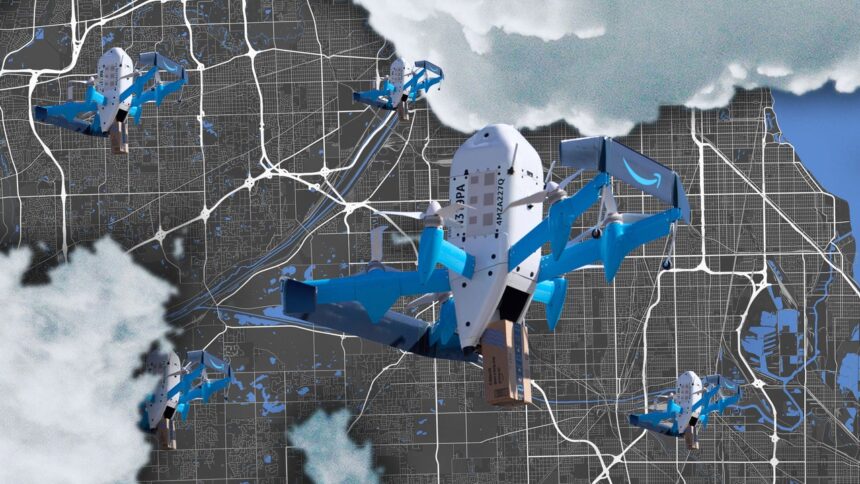
The next frontier in drone delivery? The airspace above your community.
Amazon’s CEO, Andy Jassy, said recently that the company intends to continue developing its Prime Air drone delivery program, with the goal of expanding drone delivery to 500 million packages a year worldwide over the next decade. To achieve this, Amazon has started operating Prime Air drone delivery and conducting pilot tests in eight U.S. cities, with four more to be added soon. One of these cities is Chicago, whose south suburbs are next on the list for a trial expected later this spring or early summer.
For people who live within an eight-mile radius of Amazon’s Matteson and Markham warehouse locations near Chicago, their neighborhoods will be part of the next Amazon Prime Air drone trial. Participants will be able to order small packages through Amazon Prime to be delivered via drones. Those who choose not to participate will still need to prepare themselves for delivery drones flying above their sidewalks, streets, and homes—and what that may entail.
Amazon’s MK30 delivery drones are approved by the Federal Aviation Administration, and have six sets of propulsors. Each weighs 80 to 85 pounds, operates autonomously using onboard AI systems, and can carry a 5-pound payload. A 2025 FAA document describes the drones as using rechargeable lithium-ion batteries and being able to fly up to 400 feet above ground level at a maximum cruise speed of 73 mph. There may be some initial thrill in seeing delivery drones zipping through neighborhood skies.
But, as prior accidents suggest, that thrill may quickly give way to alarm should these drones lose power, collide with birds, structures, or each other, and randomly plummet down. The momentum of a loaded 85-pound drone, or even a 5-pound payload dropping from a drone at 400 feet while traveling 73 mph, generates a great deal of force. In a dense community, this is a risk. To be fair, the accidents that have been documented seem to have mostly affected people only indirectly, but the risk rises as the number of drones and drone vendors increases.
Delivery drones have had both minor and more serious accidents. In January 2026, an Amazon Prime Air drone crashed into an apartment building in Richardson, Texas, where it ricocheted off the exterior, plummeted to the sidewalk below, and started to emit smoke. Fortunately, no one was hurt—but they could have been. In 2025, two Amazon Prime Air drones crashed into a crane, sending a man to the hospital from fume exposure caused by the accident. Even though the crane had a flag to warn aircraft, the drones did not navigate around it.
In 2022, in Brisbane, Australia, an Alphabet food-delivery Wing drone flew into power lines and caught fire. Although no one was directly injured, the accident still affected the public when power had to be shut off for 2,000 Energex customers while crews removed the drone—and that could have had implications for temperature control, medical devices, food safety, work, and other needs. Amazon’s FAQ offers mostly general information about what could happen and what precautions it has taken to protect the public.
The likelihood of drone accidents depends on a number of factors:
the drones’ composition, speed, and position, which determine how fast the drone or its payload might fall;
how thoroughly company workers inspect and load the drones to ensure they adhere to safety processes and regulations;
the honesty of customers about whether they have a suitable delivery site;
whether existing low-altitude traffic management systems are mature enough to safely coordinate large numbers of drones, birds, aircraft, and other aerial obstacles sharing the same airspace;
how well the drones can communicate with themselves, others, and us; and
how strong public opinion is for or against delivery drones.
Amazon is far from alone in its skyward ambitions. Other companies are dispatching their own drones and conducting trials, such as Wing partnering with FedEx, Walgreens, and Virginia’s Sugar Magnolia ice cream, candy, and gift shops. Flytrex acts as an aggregate drone delivery company for regional businesses, UPS has been experimenting with drone delivery, and the skies are also tempting for “air taxi” companies such as Joby Aviation, which has started to inch its way into New York airspace.
It’s going to get crowded, and the challenge extends beyond preventing crashes to building interoperable systems, communication standards, and public accountability mechanisms capable of handling constant low-altitude drone traffic across cities and suburbs. Drones will be flying at multiple heights, ascending and descending to deliver packages, and heading toward depots in different places. They will need some form of air traffic control.
Transportation of any sort is highly social. We negotiate who goes and who yields and, over the centuries, have created rules for navigation and oversight for ships, trains, cars, planes, and bicycles, while also developing cultural rules for pedestrians. To function, drones also require that sociability. Air adds a vector that differs from truck delivery, which has an oversight network of policy, law enforcement, and the sociability of other drivers who generally have the agency to yield to avoid accidents.
Drone sociability requires communication between drones, drones and their depots, drones and us, and drones with other drones or vehicles from other vendors. Amazon’s delivery drones do not seem to have obvious sociability infrastructure with the communities they intend to serve. How customers and citizens will report incidents also does not seem to have been addressed, unless Amazon and others are relying on public emergency responders.
The insular automated customer service processes Amazon uses will make it difficult for people to report an errant drone—unless Amazon provides a special number to everyone in the test communities. We also have no way of knowing how Amazon intends to apply its package security protocols to drone delivery. The Amazon website offers no specific details on how the community will be kept safe. Currently, delivery drivers require a phone code before dropping off a high-value package. Are drones going to hover disruptively in neighborhoods waiting for codes before releasing their iPhone payloads?
What does it mean for the public when private companies and the government decide to run pilot tests on communities? The upcoming Chicago drone delivery program is being run by Amazon with assistance from the FAA’s Office of Advanced Aviation Technologies, which does not appear to have a web presence under that name. The office is relatively opaque and does not offer specific information on individual trials.
The FAA Advanced Operations website hosts a video and a series of basic diagrams that convey little specific information about what will actually happen in neighborhoods with multiple delivery drones. Each example shows one drone delivering to one large house. Realistically, people in cities without cars may be more likely to embrace delivery drones, but many of them live in buildings that have only balconies as access points. And more than one drone is going to be flying to more than one house at a time.
Considering that the delivery drone program is set to begin in the next several weeks, it is concerning that there is no updated, specific information on this test available to the public from either the FAA or Amazon. This is especially odd since the FAA has had a mandate since 2023, within its “Innovate 2028” initiative, emphasizing how important public support is to the success of any delivery drone program. The initiative states not only that it is important for FAA offices to know details of these programs (some do not seem to), but also that it is important “that the public understand how these new aircraft operations will impact their communities.”
As a nearly 30-year-old company with a startup mentality and culture, Amazon appears to be looking to disrupt its own logistics model with Prime Air drones in order to utilize a perceived “greenfield” in the skies. Although the skies may look spacious to Amazon, many other companies are seeing a greenfield too. The FAA should not easily yield the safety of the nation’s air traffic control system to any company’s desire for faster delivery times over public safety—and neither should the public.
With many companies pursuing drone ambitions, combined with what’s already in the air, the skies are about to become very crowded. The FAA can only do so much, and AI still isn’t capable of managing the air traffic nightmare required for all of these drones to navigate safely together. The current drone tests are small, controlled experiments. The real test will come when these drones are all flying at once.