


Imagine walking into your elementary school library and finding it transformed overnight into a forest at dusk. Mossy green canopies arch over the bookshelves. Glowing mushrooms create a path between display cases. Twinkle lights flicker through the leaves like fireflies.
This is the Everglow Forest, one of the recent book fair themes produced by Literati, a startup that currently runs about 4,000 book fairs a year. At some schools, librarians and PTA volunteers build it out into something approaching an art installation, creating a hand-crafted world that children want to wander through for hours.
Jessica Ewing [Photo: Wikipedia]
For a seven-year-old, clutching a crumpled twenty-dollar bill, the message is that books are magical and worth celebrating. “I view kid’s books as an art form,” says Jessica Ewing, Literati’s founder and CEO. “I want to make sure that we’re giving these books the treatment they deserve.”
Ewing left a job at Google to launch Literati a decade ago. While hundreds of thousands of children’s books are published every year, Ewing realized many parents struggled to find high-quality books tailored to their child’s interests. Literati uses data to pair a child with the right books. It first applied this approach to subscription boxes, but three years ago, it expanded into book fairs, quickly becoming the biggest competitor to the Scholastic Book Fair.
Last month, Literati was acquired for an undisclosed amount by Trustbridge, a private equity firm that owns many children’s book publishers, including Candlewick and Holiday House. With this infusion of capital, Ewing wants to grow the book fairs by expanding from the Midwest and South, into the Northeast and the Pacific Northwest.
“The book fair is an experience that 33 million kids get every year,” says Ewing. “It’s such a cultural institution that no one had really taken an interest in changing it, so there hasn’t been meaningful competition in decades.”
Ewing is betting that the kids—and their librarians—are ready for something different. And after a decade of building toward this moment, she finally has the resources to deliver it.
[Photo: Literati]
Stitch Fix for Storybooks
To understand how Literati ended up here—going toe-to-toe with the Goliath that has dominated the school book fair since most of us were in elementary school ourselves—you have to go back a decade.
Ewing has always believed that pairing a child with a book they love could be a transformative experience, spurring a lifelong love of reading. From her career in tech, she had a sense that algorithms could help with this process. After all, we live in an age when Netflix, Spotify, and Stitch Fix use technology to help consumers find the next movie, song, or outfit they will love.
Her original vision was to create a curated monthly subscription box, personalized to the child’s age, reading level, and tastes. She brought on a head of data science from Stitch Fix, and raised more than $100 million in venture capital.
“We built a tremendous amount of tech and data science to be able to personalize the box to every child,” Ewing says. “We were building tech to make a very analog experience more magical.”
But as the subscription business was growing, Ewing realized it was possible to bring Literati’s expertise to book fairs, which haven’t changed much over the years.
[Photo: Literati]
Rebuilding the Book Fair From the Shelf Up
As she gathered intel about Scholastic Book Fairs, she discovered that many librarians and volunteers found it laborious to set up the tables and books. (Scholastic has not responded to our request for comment.) Schools often didn’t raise much money from the event.
And more importantly, Ewing found that the quality of products on sale wasn’t as good as it could be. There were lots of best-selling books, featuring popular characters and series, like the Dog Man, the Diary of a Wimpy Kid, Captain Underpants, and the Babysitters Club.
Literati has these books too, but Ewing felt that there were many other great books coming out of children’s publishing that weren’t making it onto the tables. And interspersed among the books were many plastic toys and keychains.
“I remember thinking this is a big opportunity,” Ewing recalls. “The book fair, to me, should be a work of art. This is the first—or maybe the only—bookstore experience many kids will ever have. It should be about book discovery, not toys and trinkets. And it should be beautiful.”
In 2022, Ewing spotted her opening. Follett Book Fairs, which had launched five years earlier, was shuttering under the weight of pandemic losses. Literati swooped in, buying Follett’s entire book fair operation—the infrastructure, the inventory, the distribution centers, and the thousands of school relationships it had built. Overnight, the fairs were rebranded as Literati Book Fairs.
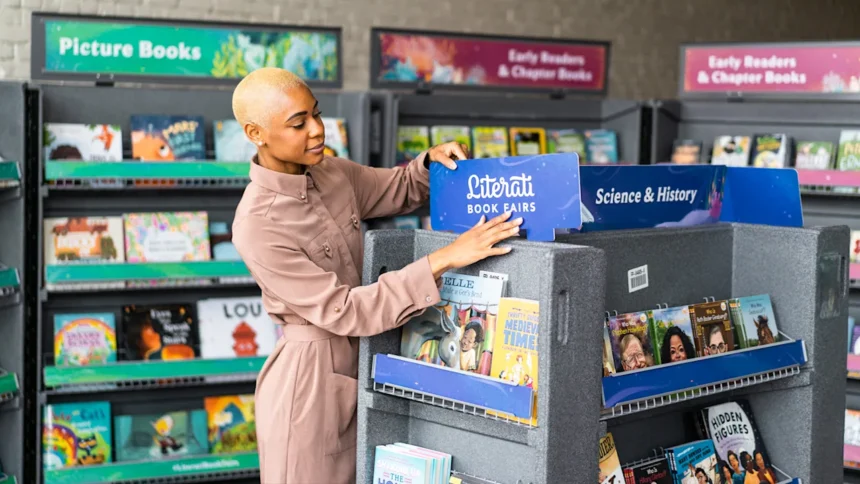
Ewing set out to build the most elevated book fair experience possible. To take the pain out of setup, Literati designed roll-out cases that arrive prestocked with books—the whole fair unfolds in 45 minutes flat, sparing librarians and PTA volunteers the hours of unboxing and shelving that the job has traditionally demanded.
[Photo: Literati]
Literati creates a seasonal theme for each book fair, which the company incorporates into its bookcases and signage, and schools can choose to add to with their own decorations. Recent ones have included Under the Sea, Everglow Forest, and Story Arcade. Ewing has been delighted—and a little astonished—by how far some schools run with it, treating the theme less as decor and more as a license to build. At the Texas Library Association’s recent annual gathering, Literati threw an Oscars-style awards ceremony for book fair coordinators, handing out trophies to the librarians and PTA parents who had built immersive installations on shoestring budgets.
But the real star is the books themselves. Literati sells real trade editions—the same ones you’d find at your local indie bookstore—not the cheaper paper reprints that have long been a book fair staple. And every fair is curated. Literati’s software scans millions of titles, surfacing thousands that might work in a given school. From there, a human team hand picks the assortment that ships out, tailoring the selection to the community.
There are many considerations shaping the books that are chosen, but the goal is for the stories to resonate with the life experiences and preferences of the students. Communities with students of South Asian heritage may see more books with South Asian protagonists, for instance, and more urban students might find more books in urban settings. Literati also offers books at a wide variety of price points, and makes sure the book selection maximizes students’ budgets. And after Literati has had a fair in a school, it will use sales data to parse what kinds of book did well there previously.
“The book fair that would work for the Upper West Side is not the book fair that works for a Title 1 school in Texas,” Ewing says. “Those are two totally different experiences in terms of what both parents and kids want.”
One thing you won’t find at a Literati fair: plastic tchotchkes. No pencil toppers, no slime kits, no erasers shaped like hamburgers. Ewing wants the books to do the work.
[Photos: Literati]
The Economics of a Book Fair
Literati has also rebuilt the economics of the book fair. Like other book fairs, Literati doesn’t charge to host an event and gives schools a portion of sales in cash or credit to use on the Literati website. Companies’ margins for book fairs tend to be quite low, and the business model only works at a large scale. This is why Scholastic has maintained its dominance for so long.
But Literati’s innovation has been to layer online tools onto the in-person event—teacher and librarian wishlists, plus a direct-donation system—that let the broader community chip in toward a school’s library while the fair is running. As a result, schools using the new tools are pulling in roughly five times what they made before. One school that historically netted $2,000 from its fair recently brought in $13,000, thanks to additional donations from parents and the community.
[Photo: Literati]
Ewing is especially proud that a large share of Literati’s clients are Title 1 schools, where high concentrations of students come from low-income families and where the library’s annual budget is often funded almost entirely by whatever the book fair brings in.
Some librarians have asked why Literati doesn’t sell plastic toys—the junk, after all, drives revenue that can be funneled back into books. Ewing’s answer has been to keep building better fundraising tools, so schools can hit their numbers selling only what they’re proud of.
“I don’t think schools should have to choose between raising money and raising readers,” she says.
The strategy is working. The company has drawn partners like Steph Curry’s Eat. Learn. Play. foundation, which this year is funding a Literati fair at every school in the Oakland Unified district. Literati is approaching profitability. And in a category where competitors keep folding—Follett, plus the beloved Southeast regional player Bedford Falls—it has carved out a credible alternative to Scholastic.
[Photo: Literati]
Decades, Not Quarters
Now, Literati is ready to go bigger, and Ewing thinks Trustbridge is exactly the partner to get her there. The Hong Kong-based firm already owns a portfolio of acclaimed children’s publishers, including Candlewick and Holiday House, with winners of the Newbery and Caldecott medals on their shelves.
“They have this thesis around children’s books,” she says. “They believe in the enduring value of quality over time, which is interesting from an investor perspective. They think in decades, not fund cycles or years.”
Trustbridge took on Literati’s debt, refinanced the business, and made clear it was investing for value creation, not value capture. Literati, Ewing is quick to add, will stay an open platform—no favoritism for the Trustbridge publishing houses, no closed door to anyone else.
The contrarian nature of the bet isn’t lost on her. “Book fairs is not where the hot money is flowing,” she says with a laugh. “It takes a long-term thinker and a big-picture thinker to get past the CapEx and think about what this can become.”
Her own answer is starting to take shape: a year-round literacy partnership with schools that reaches well beyond the once-a-semester event, powered by personalization tech, data science, and fundraising tools that actually move the needle.
For Ewing, the deal isn’t an exit. It’s an accelerant. “I’m not cashing out,” she says. “I’m doubling down.”