


Stick your hand out a car window at highway speed. Tilt it slightly upward and feel the air push it up.
Your hand, for all intents and purposes, has now become an airfoil. That upward force you feel is lift.
An airfoil is any shape designed to produce lift when air flows over it. Wings, propeller blades, helicopter rotors, and even the horizontal stabilizer on your aircraft’s tail.
We’re going to cover what an airfoil looks like and how it creates lift through both pressure differences and changes in momentum. Then, let’s bust some persistent myths and see where pilots get into trouble when they misunderstand these principles.
Key Takeaways
Bernoulli and Newton both explain lift correctly from different perspectives.
Doubling airspeed quadruples lift because velocity is squared in the lift equation.
A high density altitude requires higher takeoff speeds to generate the same lift.
Steep turns increase stall speed, and a 60-degree bank raises it by 41 percent.
What Is an Airfoil?
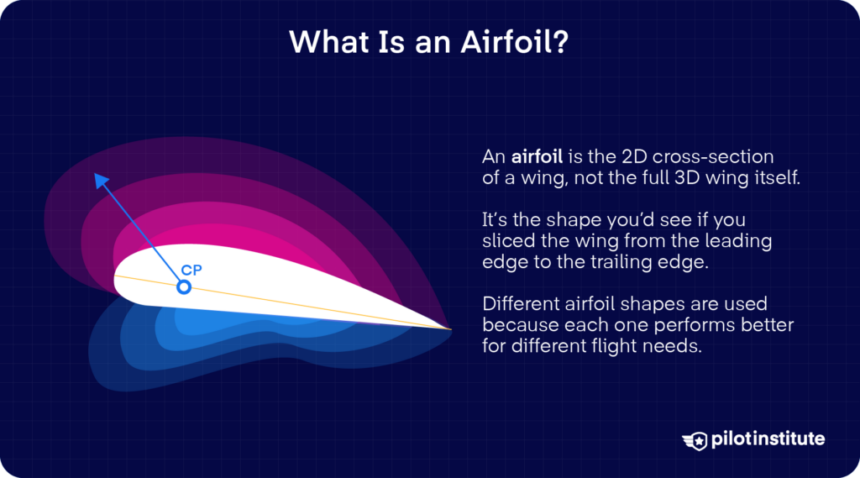
The airfoil is the two-dimensional profile of that wing at any given point along its span. Not to be confused with the wing itself, which is the entire 3-D structure attached to the fuselage.
If you were to take a slice of your wing from leading edge to trailing edge, the airfoil is the shape of that slice. It’s that teardrop-shaped cross-section that makes flight possible.
You might notice that airfoils come in many different forms. That’s because certain shapes are better for some operations than others.
A high-speed jet needs a thin, sharp airfoil that minimizes drag at supersonic speeds. A slow-flying trainer benefits from a thicker airfoil that generates more lift at lower airspeeds.
And even with all this optimization, designers and engineers still have to make trade-offs in performance.
Airfoil Basics
The Geometry of an Airfoil
But despite their diversity, airfoils share the same basic anatomy. We use these terms to make sense of how an airfoil works.
The leading edge is the part of an airfoil that meets the airflow. It’s the front of the wing, where air initially strikes the surface.
The trailing edge is the portion of the airfoil where the airflow over the upper surface rejoins the lower surface airflow.
The camber of an airfoil is the characteristic curve of its upper and lower surfaces.
The maximum distance between the upper and lower surfaces gives you the thickness of the airfoil.
When you draw an imaginary straight line through the airfoil from leading edge to trailing edge, that’s called the chord line.
And there’s another reference line running from leading edge to trailing edge, but this one sits perfectly in the middle. At every point along the airfoil, the mean camber line stays equidistant from both the upper and lower surfaces.
Why the Airfoil Shape Matters
No single airfoil design works perfectly for every aircraft. Engineers have tested thousands of different shapes, but each one has its own strengths and weaknesses.
What’s the best airfoil for your flight? It depends entirely on what you need the aircraft to do. Weight, speed, and mission requirements all dictate the final shape.
For example, a concave design with a scooped-out lower surface generates tremendous lifting power. But even so, as a fixed design, it creates too much drag for high-speed flight.
The opposite extreme has its own problems, too. An airfoil that’s perfectly streamlined with minimal wind resistance sounds ideal, but it might not generate enough lift to get you off the ground.
So, modern aircraft strike a balance between these extremes. The final shape depends on the specific airplane’s mission.
Free Private Pilot Study Sheet
Grab a printable PDF that highlights must-know PPL topics for the written test and checkride.
Airspace at-a-glance.
Key regs & V-speeds.
Weather quick cues.
Pattern and radio calls.
The Physics of Lift: Two Complementary Stories
You’ve probably heard people argue about whether Bernoulli or Newton explains lift. The truth is, they’re not really competing explanations. They describe the same phenomenon from different perspectives.
Bernoulli View: Energy Exchange
Let’s start with Daniel Bernoulli’s principle. Picture an airfoil in a wind tunnel or in actual flight. You’re looking at a streamlined object sitting in a moving stream of air.
If that airfoil had a perfect teardrop shape, the air flowing over the top and bottom would behave identically. Same speed, same pressure on both sides. Nothing interesting happens.
Now, let’s cut that teardrop in half lengthwise. What you’d get resembles the basic airfoil section you see on many wings out there.
Take that shape and tilt it so the airflow strikes at an angle. The air moving over the upper surface now travels faster than the air sliding along the bottom.
Low Pressure Above
What happens when air speeds up over the top? The increased velocity creates a drop in pressure above the airfoil.
To help you visualize it, just think of the upper surface getting “sucked” upward, which adds to the total lift.
High Pressure Below
The airfoil’s lower surface also generates significant lift, particularly at higher angles of attack.
Positive pressure builds underneath the wing, which pushes upward and contributes to total lift.
Newton’s View: Action/Reaction
And that’s just one piece of the puzzle. We’ve now got Sir Isaac Newton to complete our picture.
Push a wall while you’re wearing roller skates. You push the wall backward, you roll forward. Every action has an equal and opposite reaction. Third law of motion.
Now, an airfoil is shaped to cause an action on the air, and forces air downward. That creates an equal reaction from the air, forcing the airfoil upward.
The wing pushes air down. Air pushes the wing up.
That upward push is lift.
As a side note, this downward-moving air behind the wing is called downwash. It’s real, and it’s why you don’t want to fly a Cessna 172 directly behind a departing 747.
Breaking Myths and Misconceptions
There are some explanations of lift that you might have heard, and you might assume some of them to be true. Some even show up in training materials.
“Equal Transit Time” Fallacy
Here’s one. You may have been told that air splitting at the front of the wing has to “meet back up” at the trailing edge at the same time. Since the top path is longer, the air on top must go faster. That supposedly creates lift.
Well, it’s wrong. According to NASA, the actual velocity over the top of an airfoil is much faster than that theory predicts. Particles moving over the top arrive at the trailing edge before particles moving under the airfoil.
NASA has thoroughly debunked this theory. If you see it in a textbook, the material is outdated.
Myths and Misconceptions
Even brilliant minds stumble, you know. In 1917, Albert Einstein designed an airfoil based on incomplete lift theory. The test pilot reported the aircraft “waddled around in the air like a pregnant duck.”
Einstein later called it a “youthful folly.”
Here are a couple of others, so let’s put them to the test.
“Only Cambered Wings Create Lift”
Well, many lifting airfoils don’t have an upper surface that’s longer than the bottom. Symmetrical airfoils have identical top and bottom surfaces, yet they produce lift just fine.
You’ll find these on high-speed aircraft and on the rotor blades of many helicopters. Both surfaces are exactly the same shape and length. How do you explain that?
The only difference is the relationship between the airfoil and the oncoming airstream. It’s the angle of attack doing the heavy lifting.
Consider a paper airplane. It’s essentially a flat plate with top and bottom surfaces that are identical in shape and length. And yet, it flies. These airfoils produce lift, and flow turning is partly or fully responsible for creating that lift force.
“Lift Is Mostly Suction Over the Top”
We can’t really assign specific percentages to how much lift comes from the upper surface versus the lower surface.
How come? These aren’t constant values that you can memorize and apply universally. They change depending on your flight conditions.
Angle of attack, airspeed, and wing design all tilt the balance between upper and lower surface contributions.
Different wing designs also perform differently. A highly cambered airfoil might generate lift differently from a symmetrical one.
What works at cruise speed is different from what works at a slow flight configuration with flaps extended.
The percentages are dynamic values that respond to how you’re flying and what you’re flying.
Controlling Lift in Practice
Things are about to get technical, but don’t worry. We’ll talk about every variable.
We can define the lifting force on your wings using this formula:
Where:
CCL is the coefficient of lift
pp is the air density
VV is the airfoil speed
CC is the wing surface area
Every variable in this equation has a direct impact on your aircraft’s lift. But what can you actually do with them?
Coefficient of Lift
Let’s go back to that hand out of a moving car analogy. Hold it flat, and there’s barely any force. Tilt it up at an angle, and you feel the air forcing your hand upward.
You just increased the angle of attack, and as a consequence, the lift.
Angle of Attack
Going back to airfoils, the angle of attack is the angle between the chord line and the direction of the relative wind.
That also brings us to the first variable: the coefficient of lift, CL.
Above, you’ve got the lift curve of your standard airfoil. Notice how the coefficient of lift rises as you increase your angle of attack? Well, up to the CLMAX point.
What does this tell us? The coefficient of lift will continue to rise as you increase the angle of attack. Eventually, it will peak.
That highest point is the maximum coefficient of lift. The AOA it aligns with is the critical angle of attack.
Once you go past that peak, your coefficient of lift will start falling fast. In other words, you will stall. That’s why it’s not a good idea just to keep pulling on your yoke to add more lift.
Flaps and Slats
Now, what’s interesting is that you can get an entirely new airfoil with the same wing.
Plain flaps, for example, increase camber, which completely changes the airfoil.
This new airfoil will give you more lift at the same angle of attack, just as you can see in the graph above.
What about slats? These are leading edge segments that ride on tracks at the front of the wing.
At low angles of attack during normal cruise flight, they stay flush against the wing. But as you increase the angle of attack, you can move them forward and create a slot between the slat and the main wing.
In essence, slats increase the camber of the wing. And with an increase in camber comes greater lift.
This is also why we consider flaps and slats to be high-lift devices.
Airspeed and Density
Out of every variable in our formula, the airfoil speed, V is the only one that’s squared. That should tell you just how much it affects lift.
Double your speed, and you get four times as much lift. If the AOA and other factors remain constant, an airplane traveling at 200 knots will have four times the lift as the same airplane traveling at 100 knots.
Lift also varies directly with the density of the air, .
Hot air is thinner than cool air. High-altitude air is thinner than sea-level air. Moist air is less dense than dry air.
That means on a hot, humid day, you’ll have to fly at a greater true airspeed for any given AOA than on a cool, dry day.
Thinner air gives you less lift, which means you need more speed or a higher angle of attack to generate the same lifting force.
Wing Surface Area
Flaps and slats are like your wing’s shape-shifting tools. They let you reconfigure the airfoil on demand depending on what you need.
Fowler flaps, for example, drop down and move rearward. That rearward motion increases both the camber and the actual wing surface area, S. And as a result, the lift also increases.
Real-World Applications and Case Studies
If you know where to look, you’ll find airfoils everywhere, even in places you wouldn’t expect. Airfoil theory connects the first flight at Kitty Hawk, the downforce on Formula 1 tracks, and the thrust from your backyard drone.
Wright Flyer vs. Modern Jetliner
In 120 years, airfoil design has traveled an extraordinary distance.
The Wright brothers used very thin airfoils. That’s because their wind tunnel tests suggested that very thin shapes resulted in lower drag than thick airfoils.
Both the upper and lower surfaces were curved, which made for a highly cambered shape. They controlled their aircraft through wing warping, literally twisting the wing to change lift on each side.
Modern jetliners take a completely different approach. They use supercritical airfoils designed to delay shock wave formation at high speeds.
Leading-edge devices like movable slats have segments that move on tracks. Fowler flaps increase both the camber and the wing area.
What do you get? Modern aircraft achieve lift-to-drag ratios far higher than what the Wright Flyer could manage.
Concorde’s Delta Wing and Vortex Lift
The Concorde took a completely different approach to generating lift. This supersonic airliner used a slender ogival delta wing that created a strong conical vortex over its leading edge.
What makes this so different? When lift is generated this way, the wing won’t stall in the conventional sense. The lift keeps increasing as you increase the angle of attack, all the way up to around 40 degrees!
On a conventional wing, you’d be deep into a stall long before reaching those angles. But the Concorde’s delta wing thrived on what would normally be considered separated flow.
Sailing, Race-Car Wings, and Drone Propellers
A sailboat’s keel is a vertical wing moving through water, which generates side force to let the boat sail upwind. An F1 rear wing is an upside-down airfoil. Essentially, instead of lift, it creates downforce, pushing the car onto the track for better grip.
Every blade on your drone’s propellers is a tiny airfoil spinning thousands of RPM. It generates thrust through the same principles that lift a jetliner.
The physics doesn’t change. Through air or through water, whether you want lift or downforce or thrust, you’re working with the same physics.
Common Pilot Errors Related to Lift
Now, things are about to get real. These are actual mistakes pilots make because they didn’t fully understand how lift works.
Density-Altitude Overload
Let’s say you’re at an airport with a density altitude of 9,000 feet. Short runway, hot day.
You rotate at your normal sea-level speed, and the aircraft refuses to climb. You run out of runway.
Due to high altitude, high temperature, or both, your aircraft takes a considerable hit from reduced air density. Takeoff distance, power available, and climb rate are all affected.
The air is thin. Your wing needs more speed to produce enough lift. Your engine produces less power. Everything works against you.
How can you make sure you don’t get caught in this mess? Always check performance charts for actual conditions.
At a density altitude above 5,000 feet, it’s essential to lean normally aspirated engines for maximum power on takeoff. Reduce weight if possible.
And if the numbers don’t work, just don’t go.
Accelerated Stall in Steep Turns
In a 60-degree bank turn, the load factor doubles to 2 G. The stalling speed of an aircraft is also higher in a level turn than in straight-and-level flight.
What else? The horizontal component of lift needed to maintain the turn adds to the total load on the wings.
The wing will have to produce sufficient additional lift to counterbalance the load. That means your wing has to produce twice the lift.
To do that, the angle of attack increases. But remember, the stall speed also goes up by about 41 percent. That’s too tight a margin to be flying in, and one wrong move can make all the difference.
Flap Mis-Management on Final
Adding flaps too quickly can cause the aircraft to balloon as the sudden increase in lift pitches you up. Then, the nose pitches down as the aircraft tries to maintain its trimmed speed.
You need to manage the angle of attack throughout this transition.
Remember that flaps change the lift characteristics, but they don’t fly the aircraft for you. Anticipate the pitch change and counter it with smooth forward pressure on the yoke.
Conclusion
Contrary to popular belief, Bernoulli and Newton aren’t at odds with each other in their explanations for lift. They’re describing the same phenomenon from different perspectives, and both are correct.
One explains the pressure difference, the other explains the reaction of the air. Together, they give you the complete picture of how lift works.
You understand the physics that keeps hundreds of tons of aluminum airborne. Watch the flaps extend during takeoff and landing on your next flight.
As those Fowler flaps slide backward and downward, you’ll know exactly what’s happening.
The post What Is an Airfoil? How Lift is Generated appeared first on Pilot Institute.