

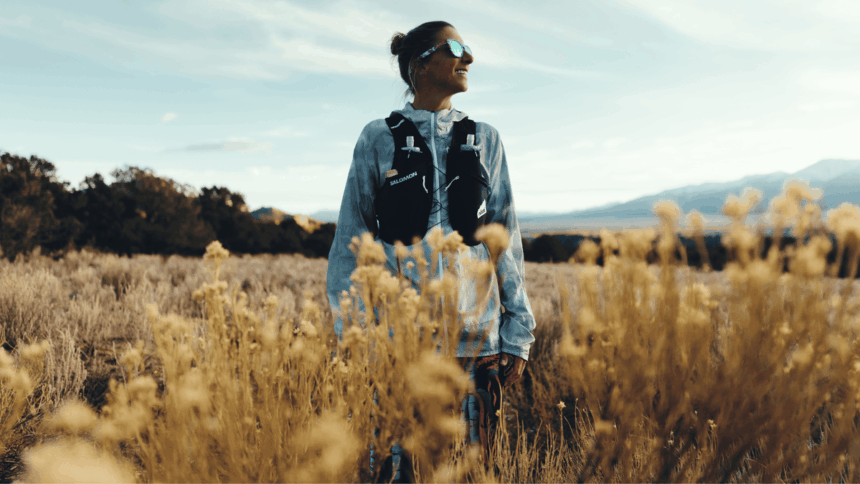
I can think of precisely one time I’ve spoken with Courtney Dauwalter when she wasn’t flashing her dazzling smile. It was at the finish line of UTMB in 2023. She had just notched her third 100-mile win in two months and her lips were purple. It was a short chat.
Today she’s back to her radiant self, beaming through the computer screen from across Colorado. I’m catching her near the end of her prep for yet another ultramarathon, the Cocodona 250, on May 4. She kicked off the morning with a bowl of Cinnamon Toast Crunch and two cups of coffee before heading out to the garage to do her daily 30 minutes of pre-run activations, in silence. Next came a run with her husband, Kevin; strength work; and another run, solo, before spending some time in their spanking new sauna. It’s 3 p.m.
A lot has changed since that finish line in Chamonix, and even since a rare DNF at Cocodona last year. She went on to eek out the win at the Laverado 100K in June, and looked well on her way to securing her third dub at UTMB—until, in uncharacteristically Courtney fashion, the wheels fell off and she walked it in for 10th place with a determined smile. A brief respite, and she was in her road marathoning era, running a personal best 2:49 at the Twin Cities Marathon in October and lowering that to 2:39 at the California International Marathon in December.
We’re here to talk about ultra-ultrarunning, I guess, but I’m particularly intrigued by the marathoning bit. After what was, by her standards, a tough year on the trails, why would the greatest ultrarunner of all time—someone who’s eschewed a coach, training plan, and numbers throughout her career—put herself out there in what is essentially a foreign, highly data-driven sport?
For those of us prone to narrativize, pounding the pavement seems too risky, with not enough glory. While 2:39 is a very respectable time, it’s far from world class. But the focus on footspeed seemed to pay off. In March, Courtney blew by Cocodona defending champ Rachel Entrekin and super speedy Yngvild Kaspersen over the final hour of the Chianti Ultra-Trail 120K to take the win in a race she had entered just a few days prior.
Or maybe it was the fueling that did the trick.
“Normally in an ultra, I wouldn’t take in any fuel really in the last hour or maybe even two hours depending on how it’s going,” she says. “But in the last section, probably the last 10K of Chianti, I did two gels, which I was pretty psyched on because I was like, ‘Wait, we’re doing it!’”
If 2025 was the year we questioned whether the reign of this now 41-year-old was coming to an end, 2026 has laid all doubts to rest. But what I gleaned from our conversation is that Courtney doesn’t care about narratives or legacy. She also doesn’t recommend you take her advice: “I am making no claims to know anything that should be the secret to anyone’s success.”
She’s a gamer, and this whole running thing is just one giant puzzle. Lucky for her, spending time tinkering with each piece just makes her better and better.
Courtney Dauwalter hugs her niece and nephew after a bittersweet 10th place at the 2025 UTMB. (Photo: Jacob Zocherman)
Optimization in Moderation
Courtney and her basketball shorts broke onto the ultrarunning scene in 2016, back when trail runners worshipped at the altar of vibes. Mileage? Run as much or as little as you want. Carbs? Probably overrated, but you do you. Heat training? Maybe sit in your hot car until you feel like you’re going to pass out. Grittiness and problem-solving were the name of the game, and it was a game Courtney nailed.
Meanwhile, the sport has jetted toward professionalization and optimization. High carb, bicarb, heat training, cross-training—the list of data-driven training modalities being adopted at the pointy end of the field are endless. For a runner who is so clearly driven by a genuine love of running, how, if at all, has she come to terms with this new era?
The road marathon stint provides a clue.
“Marathon training was so cool,” she says. “I enjoyed it so much and learned a ton through doing it. I was trying to be like a sponge: What are the workouts people are doing? How do I figure out pace? How do I keep trying to strive for a pace that’s a little bit faster? How do I find that speed within my legs? And what does it look like in Colorado at altitude?”
Some would view training for a road marathon at 10,000 feet daunting. Not Courtney Dauwalter. (Photo: Simon Dugué/Naak)
She fully embraced marathon training during those three months, aside from a week or so leading a trail running trip up volcanoes in Ecuador. She dropped her mileage way down, capping her long run at around 17 miles, and way upped the intensity, incorporating multiple speedwork sessions a week.
“I became really psyched on the data,” she says. “I’ve never looked at my watch more in my life, and I was loving it.”
It’s a surprising about-face for a runner famous for heading out the door without a plan and coming home two to eight hours later. But if there’s one thing I am learning about her in this interview, it’s to not put Courtney Dauwalter in a box.
“It felt like a completely new sport to me after years of ultrarunning,” she says. “I’d love to keep those elements in my training—they’re fun and valuable.”
Joy Is in the Driver’s Seat
That brings us back to ultrarunning. In the pantheon of ultrarunning greats, Courtney is a renegade. Sure, she’s won all the Big Important Races like Western States, Hardrock, and UTMB more than once. In fact she took the gamble of racing (and winning) them all in one season. But unlike, say, Jim Walmsley, Ann Trason, and Scott Jurek, she hasn’t returned to States year after year to cement an indomitable legacy. She’s elected to run goofball events like the Moab 240 and Big’s Backyard Ultra—both of which she won outright—resume be damned.
Those are most certainly my words, not hers. But Courtney has such a kingmaker, or should I say queenmaker, effect that essentially every race she enters turns to gold. Now we view 200-mile races like Cocodona as marquee events in the ultrarunning calendar. For her, they’re just another adventure.
“My hope is always to just be able to say yes to whatever adventure,” she says. “Until I’m 100 and whatever years old, I want to be a person who is always ready.”
Her joy compass pointed her to Tenerife Bluetrail 110K, the random UTMB race Courtney was supposed to run in March until a tropical storm forced race organizers to cancel and she bopped over from the island to race in Italy. The Tenerife race goes up and over Mount Teide, a 12,198-foot volcano engulfing the island. It’s a mountain she’s wanted to run for years thanks to staring at it from the neighboring island of Gran Canaria while on Salomon team training trips.
“I’m still intrigued by getting my feet on that mountain, and just the whole concept of crossing an island is always really fun: starting on a beach, ending on a beach with a whole adventure in between.”
Courtney Dauwalter smiles after completing her historic Triple Crown of winning Western States, Hardrock, and UTMB in one summer. (Photo: Luke Webster)
Surely, she was also motivated to earn her way back into UTMB Mont-Blanc, just in case she wants to run it in August. (One change she’s made since her historic Triple Crown is only planning out half a year of racing at a time—“I think just becoming a little bit more fluid with it since that big year has been helpful in making sure that we’re not burning all the matches all the time.”) But that calendar, or lack thereof, isn’t driven by trying to win end-of-year awards. It, like everything else, from her basketball shorts and wayfarer sunglasses to her training, comes down to the same thing:
“Joy is sitting in the driver’s seat. Joy is driving the car. Joy is in charge, fully.”
Enjoy. Sounds simple. If you’ve ever trained for a 100-mile race, you know it’s not. Now tack on being the most popular trail runner in the world, and doing these races for a living. That ability to find joy is one of her superpowers, and it’s visible in every little decision she makes, like riding her bike, as she’s prone to do.
Adding in extra aerobic work on two wheels is what most runners would call “cross training” or simply “training.” And yet: “When I’m on the bike, I would never say the word training,” she says. “It’s adding in joy … doing something a little bit different.”
There’s a 7-mile loop where she mountain bikes with Kevin. He’s much faster, she laughs, while she completes the loop slower on two wheels than she does on two feet.
“I just want the wind in my hair and some sunshine.”
The Kevin Factor
The dream team: Courtney’s husband, Kevin, plays an instrumental role in her career, from crewing aid stations to figuring out race logistics. (Photo: Courtesy UTMB World Series)
Speaking of Kevin, though, I’d be remiss to overlook the role he plays in Courtney’s success—as evidenced by her use of the first person plural when talking about her running. Not only does Kevin crew Courtney at all of her races, he also offloads and optimizes the parts of ultrarunning that she doesn’t love, like travel, logistics, and race spreadsheets, which are conveniently Kevin’s strengths.
“Our brains are very, very different, so things that I find tedious or overwhelming he is just locked in on,” she says. “He just knocks it out in a pro way.”
Before a race, Kevin figures out what each section of the course looks like, projects Courtney’s splits, and comes up with a nutrition gameplan based on the terrain, time of day, and historical splits from Courtney and others. He’s remarkably accurate. “Post-race we’ll look and it’ll be like, you basically predicted all of these splits,” she says.
This logistical work is also a giant mental burden off her shoulders.
“I’m very thankful for him and just having him as a partner and teammate through all of this for my entire going through ultras is pretty special.”
Curiosity Is in the Passenger’s Seat
Joy is the most important piece to the puzzle, but the former middle school science teacher also clearly loves to learn. “Joy is in charge of this car,” she says, “but curiosity has always been a major passenger in there as well.”
I think feeding that curiosity is how she tricks herself into doing things she might not assume she would inherently love, like strength training. That’s something she never did until hip pain forced her to DNF Western States in 2019.
That injury was a wakeup call that strength work was a massive opportunity for growth. And, she would say, growth is fun! She started working with a strength coach, who implemented the 30-minute pre-run activation routine, as well as regular strength workouts.
“It’s like this whole world,” she says. “I can actually feel the difference when I run.”
“It all is just a fun experiment on myself.” Courtney Dauwalter en route to winning the Hardrock 100 for a third time. (Photo: Peter Maksimow)
This approach extends to her new sauna and getting into heat training, and also fueling.
Lately, she’s been inspired by the high carb movement and is pushing herself to fuel more—but in a way only Courtney can. “It’s not as fun of a number for me to obsess on,” she says. “So I’m not as keen on trying to hit 80 or some amount of carbs per hour. I’ve just been trying to take in one more thing than I think I can. Because I think I previously was more on the low side and I’m seeing that it could be a growth area. Just more fuel in the tank.”
For races under 24 hours, she keeps it simple: gels, chews, drink mixes, “stuff that I don’t have to think about … just ingesting this fuel as quickly as possible.” It gets wonkier over the 24-hour mark, like at Cocodona. “I’m still fully open to whatever sounds good,” she says. “Mashed potatoes or pizza or pancakes, all of those are going to be options that will be ready to utilize if need be.”
Her fueling plan for a 200-plus mile race is an apt metaphor for her approach to the sport in general: “It all is just a fun experiment on myself,” she says, “a fun game and puzzle to play with. I’m just really open to seeing what’s possible.”
And with that, it’s time for Courtney to turn her attention to dinner. I’m curious what’s on the menu.
“We’re kind of on the last gasps of what’s in our fridge,” she says. “This is actually where I shine … in these last bits of Tupperware. You can make anything out of whatever’s in the fridge.”