

It’s 4 a.m. on Friday, May 8, and Rachel Entrekin is back at the Cocodona 250 finish line in Flagstaff, Arizona. Thirty-eight hours prior, hundreds of people were crowded around Heritage Square to cheer on her finish, the first time a woman had ever won the 250-mile race across Arizona.
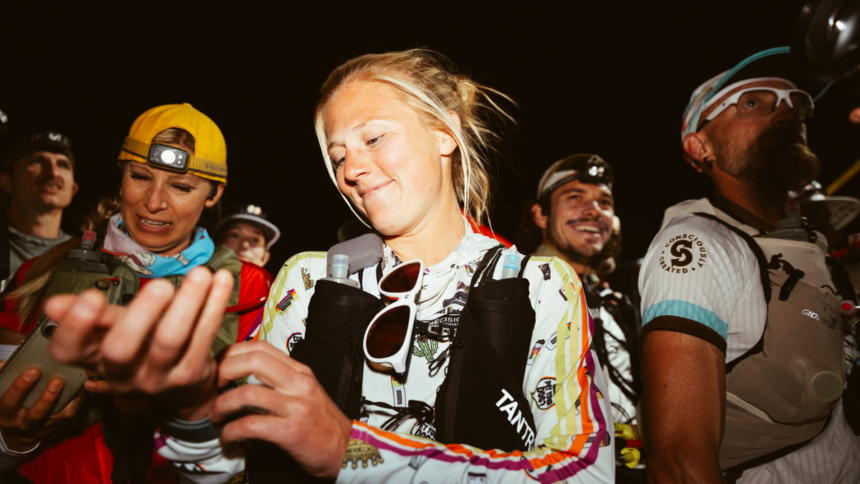
The area is now comparatively quiet as Entrekin’s friend Sally McRae crosses the line in the pre-dawn darkness, having battled for 95 hours to the finish. McRae’s eyes widen as she sees Entrekin on the sideline.
“What are you doing here? Why aren’t you in bed?” McRae exclaims as they hug.
In total, Entrekin has gotten about eight hours of sleep since the race began at 5 a.m. on Monday, she tells me later that afternoon back near the finish line. The night before, she was up late visiting Heather Jackson, the fourth woman to finish the race. And then she opened her phone.
“I didn’t even go to sleep until 2:30 because I fell down the Instagram rabbit hole,” she explains. “I have 9,000 DMs, and I am trying to figure out how I’m going to do anything with them.”
Still, she made sure that her friend Tim Tollefson gave her a 4 a.m. wake-up call so she could see McRae finish, sleep be damned. As she is explaining all this to me at a quiet picnic table, a middle-aged man in a bucket hat and sun shirt slowly walks up to us, and Entrekin smiles as she turns to him.
Thanks to her positive energy and bubbly personality, Entrekin is well-equipped to chat with new fans. (Photo: Somer Kreisman for Norda)
“Excuse me, I know you’re busy, but you’re such a fucking badass,” he says.
He explains how his wife, daughter, friend running the race, and family back home are inspired by Entrekin’s performance, and repeats the adage that she kicked ass. She thanks him no fewer than a dozen times, congratulates his friend running the race as he walks off, then turns back to me.
“I imagine this has been…”
“My life. Yeah,” Entrekin says. “Which is fine. I wouldn’t want to be anywhere else.”
Entrekin’s past two days have been a balancing act. She has been there to cheer on the other runners in this insane, historic race, from runner-up Kilian Korth to second-place woman Courtney Dauwalter to McRae and all the other women following in her literal footsteps. She can’t go more than a few feet around Flagstaff without being stopped for a selfie, a signature, or a story. All the while, she’s done interviews with the BBC and ABC News, and tried to keep up online as her Instagram follower count exploded by six digits.
Mind you, this is a woman who just ran 253 miles with nearly 39,000 feet of elevation gain at an average pace under 13:30 per mile. Her closest competitor, Korth, was on crutches the day after the race. But Entrekin’s energetic, bubbly self is perfectly suited for this moment, and she’s soaking up every minute.
Reclaiming Running
Growing up in Alabama, first in Birmingham and later in Madison, just outside of Huntsville, Entrekin’s mother, Karen, says Rachel “always did her own thing.”
“If she wants to do something, accomplish something, whatever, she’s determined to get to the end of it,” her father, Robin, adds.
That one-track mindset helped her excel academically, but it also meant that her first relationship with running wasn’t a healthy one. As a teenager, she used running as a means of control, part of an eating disorder for which she entered an inpatient program during high school. Despite the unhealthy associations, though, she always loved the way running made her feel. And as she recovered, she wanted to get back to that.
“When I was going through rehab, you’re not allowed to do jack shit,” Entrekin says, referring to the limitations of physical activities placed on ED patients in recovery. “Once I got out, I was like, ‘I’m going to figure out how to do this. I’m gonna figure out how to do this safely, and I’m going to figure out how to do this without killing myself.’ And it took me probably four years to figure that out.”
Twelve years later, in May of 2022, Entrekin had dozens of ultras under her belt as she took on the Malibu Canyon Trail Races 100-Miler. But after a fall led to a bleeding hand that led to a tight wrap job that led to a spiked heart rate, she had to drop from the race at mile 35. Jake Vail DNF’d at the same spot, pulled by an aid station volunteer for his deteriorating condition. The two found each other in the parking lot, heading home.
“She walks over and she’s like, ‘Hey! Well, that was bullshit, right? Do you want to do this again?’” Vail recounts. “And I’m like, ‘Well, I’m not running 100 miles.’ And she’s like, ‘Well, let’s have a redemption run. Let’s just run half the course.’”
Their friendship was cemented by the 50-mile adventure, which preceded long days exploring the high peaks of the Eastern Sierra over the summer. LA wasn’t the place for her, with traffic and sprawl sapping motivation from her trail-loving heart.
But Entrekin has never been afraid of moving and made her way up to Conifer, Colorado, in the mountains outside of Denver, at the end of 2024. This January, she made her latest move to Salida, about 100 miles southwest, which she describes as “paradise.” The Burrito League, a competition to run as far as possible for free burritos, provided a group of like-minded friends willing to partake in the same crazy adventures she loves.
Through all the moves and life changes, her parents have watched her journey from back home in Alabama with the quiet understanding that their daughter’s adaptability will get her through.
“She’s learned that hard things happen, and it’s really about your response to it,” Robin says. “You get to dictate how that impacts you throughout your life.”
The Sponsored Effect
From the outside, a story like Entrekin’s can seem like a linear progression: Start running, start racing, start winning, get sponsored.
But behind the scenes, Entrekin has been trying for years to make running her full-time pursuit. While working 50-plus hour weeks as a physical therapist, she would get up before dawn to fit in 20 milers, and she was racing half a dozen times per year. Her race wins attracted attention from brands, but false leads left her feeling dejected.
“I remember I called Jake a lot of times being like, ‘I actually don’t think this is gonna work out.’ Because Brand A has been leading me on, and then suddenly they were like, actually just kidding, and then Brand B did the same thing,” Entrekin says. “I didn’t expect to go into negotiations and leave them feeling worse about myself.”
After her finish at the 2025 Cocodona 250, Entrekin finally got what she had been searching for—at least partially. Precision Fuel and Hydration, a British brand, signed her as an athlete in June of 2025, and she quit her job. The sponsorship alone wasn’t quite enough to live off of, but Entrekin decided to bet on herself.
“I was hopeful that with them and somebody else, I could make a number that made sense,” Entrekin says. “Financially, I was in a spot where I could wait on the right person.”
Entrekin eats Ramen during the 2025 Cocodona 250. (Photo: David Gleisner)
As the year went on, the right people appeared: Tantrums for her pack, then Coros for her watch, then Norda for her shoes. When it came time to train for her 2026 season, the full-time workweeks were replaced with training time, and her running benefited from it. Her weekly mileage made its way into the triple digits, not because of a strict training plan, and not because she’s seeking control, but because Entrekin loves to run and finds joy in doing it alongside friends old and new.
“My strategy for training has always just been to say yes to anything at all times when you can,” Entrekin says. “I love running, so it’s easy to run every day, and I want to run every day. It’s hard to not get 100 miles [per week]. Even with a day off, it’s hard not to now.”
Entrekin leaves Wildcat Hill aid station, mile 234.9, en route to her record-setting result. (Photo: David Gleisner)
Entrekin’s friend and neighbor Addie Bracy, a professional mountain runner with Nike, introduced her to speedwork over the winter via a weekly “speedwork class.” It was the first time that Entrekin, who usually couldn’t care less about data and often runs without a watch, had added interval workouts to her training.
“I hated it every week, but when it was over, I was always stoked that I went,” Entrekin says. “I do think it showed me that I have a gear that I don’t usually use.”
The speedwork proved necessary at the Chianti 120K, a Golden Ticket race featuring a star-studded women’s field including Courtney Dauwalter. It was Entrekin’s first overseas race, and she was looking to make a splash.
Early in the race, Entrekin put herself in good position behind the women’s leader, Norwegian ultrarunner Yngvild Kaspersen. She nailed her fueling, thanks to crewing from her nutrition coach Emily Arrell, while holding her second-place position over the race’s endless rolling hills. Until, less than 9 miles from the finish, Courtney Dauwalter came flying past her.
“I am hauling ass—she is just hauling better ass,” Entrekin wrote in her post-race blog. Dauwalter went on to win the race, but Entrekin’s third-place finish granted her an auto-entry into August’s UTMB Mont Blanc.
Yngvild Kaspersen, Courtney Dauwalter, and Rachel Entrekin at the 2026 Chianti Ultra-Trail 120K. (Photo: Courtesy UTMB World Series)
“There was a moment during that race at Chianti that Rachel kind of realized that she was human, and Courtney was human,” Vail says. “To be able to go up against someone like that, put them on the ropes for almost the entire race, and only get beat in the very end was just such a performance boost.”
For the first time since July 2022, Entrekin wasn’t the first-place woman. But she knew she could put up a fight against the best in the world. After a few more weeks of training, maxing out at 140 miles with 35,000 feet of climbing, Entrekin came into Cocodona more prepared, and more confident, than ever before.
The Race
Less than an hour after Cocodona’s 5 a.m. start, Entrekin watched the first of three sunrises she’d see during the race. She was positioned well, running the race’s first big climb out of the Sonoran Desert with the lead group. By sunset that day, she had taken the overall lead of the race and had more than 80 miles under her belt.
Entrekin came into this race with more pressure than ever before, as the returning two-time champion on the women’s side and fourth-place finisher overall, with a recent second-place finish at the Mammoth 200 to boot. But she didn’t waste energy thinking about that. She was too focused on dialing in her execution.
“I have this really weird skill of just turning off feelings when I’m running,” Entrekin says. “I don’t have enough energy to also spend it worrying about possible outcomes. All I can do is my best in the moment that I’m in.”
Entrekin and her crew had the aid station routine down to a science at Cocodona. (Photo: Somer Kreisman for Norda)
From the jump, she was focused and efficient through aid station stops. Of course she still took time to pet dogs, to crack jokes with her crew, to shoot hoops at the Mingus Basketball Association. But her years of ultramarathon experience came into focus in the 5 minutes she took to reset and prepare between sections: come in, shed her vest, sit down, begin eating mashed potatoes or oatmeal or rice, take shoes off, get blisters taped or sunscreen smeared on her face (when applicable), put shoes back on, don vest, and get back out running. The whole act flowed like a Cirque du Soleil performance, with Entrekin swinging off the trapeze and being thrown around by her six crew members before landing safely back on course.
“It’s just a 250-mile puzzle,” Vail says, “and I think the people who do well here are people who can figure out that puzzle.”
Behind her, Kilian Korth, who took a five day camping and training trip to Utah with Entrekin in February, was working his way into a steady second place. Over the course of night one, he put some distance on the chase pack featuring Joe McConaughy, Courtney Dauwalter, and Heather Jackson. On day two, his sights were set on Entrekin. At Dead Horse aid station, mile 133.3, he was 34 minutes behind her as they crossed the relatively flat, low elevation Verde Valley. Coming out of Sedona Posse Grounds, mile 156.9, where Entrekin says she was at her “physical lowest,” he was 33 minutes behind. Heading into night two out of Munds Park, mile 190.6, her lead was less than 20 minutes.
“It was this slow process of growing admiration for her,” Korth says. “I already admired her a lot, but I’m working so hard, and she is just outworking me, or at very least working just as hard.”
The second night of the race began with cold rain, muddy trails, and a shooting pain down Korth’s leg. At Munds, he told his crew his glute wasn’t working, and leaving the aid station, he was hobbling as his headlamp illuminated the steady rain. By 1 a.m., when Entrekin came through Fort Tuthill, mile 211.7, puddles outside had frozen solid. Still, she was in and out in 10 minutes. Korth came in over an hour later, and left two hours after Entrekin, having taken a nap and still nursing his painful leg.
As Entrekin watched her third and final sunrise, she still didn’t allow herself to accept her lead, or the fact that she was hours ahead of course record pace. Korth was still on her heels, and she had yet to crest the race’s highest point, Mount Elden. But she felt good, running up much of the climb despite having 240 miles in her legs. By the time she descended into Flagstaff, she knew something special had just happened.
“I could have tripped and fallen down, Kilian could have caught me, like, anything’s possible,” Entrekin says. “Then to come into freaking town and just like, holy bananas. I don’t think I can really believe that what I just did is that big of a deal. Obviously, it must be. But it just feels unbelievable that it’s happening to me.”
Hundreds of cheering fans lined the streets of Flagstaff to welcome Entrekin home. Last year, she made her final few turns in the fading light of dusk. This year, the midday sun was high overhead as she mustered a sprint finish to break the tape in a time of 56:09:48, two hours, 37 minutes, and 30 seconds faster than anyone had run the race before.
With tears of joy behind her sunglasses, she hugged Jake, her crew, her parents, the fans crowding the barricades. After she got her belt buckle and completed a post-race interview on the race livestream, she met a line of fans ranging from elementary schoolers to retirees waiting with T-shirts and hats for her to sign. She took the time to write personal messages and take photos as she stood in the hot sun, sweat still caked on her smiling face.
Steven Palmer (left) and Jake Vail (right) tend to Entrekin’s feet. (Photo: Somer Kreisman for Norda)
If she can mean something to somebody, Entrekin says, she owes it to them to be there. She’s the first to do a lot of things at Cocodona, to win the overall race and break the course record and become a three-time women’s champion. But she hopes she’s not the only one for long.
“I don’t really want this to be about me. I want this to be about all the women who haven’t done this yet,” Entrekin says. “There are more of us, and I hope that what I did proves that there are more of us.”
What’s Next
Entrekin is taking UTMB seriously, she insists. She’s going out to Europe six weeks early this summer to prepare for the alpine terrain. But as much as she’s looking forward to the high-budget, high-profile international competition, she also can’t wait for the “hairball adventures” to come with her friends from the Salida Burrito League.
As for her newfound fame?
“I don’t really think it’s going to change much. I think I’m just going to have more people watching,” Entrekin says.
She is, like many ultrarunners, a purist. As the sport around her has professionalized, she’s adapted, but what keeps her going aren’t the stats and finishes and times.
“You’ve got to remember, this is the girl that ran without a watch. This is a girl that doesn’t talk about data. She just started doing speedwork, like, yesterday,” Vail says. “She just wants to go and run really far in the mountains and be with people she cares about, who like doing fun shit with each other. That’s Rachel, you know? She just happens to be really good at doing it.”
At the center of a historic performance and its associated media frenzy, Entrekin is just trying to soak it all in. She has a road trip back to Salida coming up, where she hopes to respond to at least some of the messages that have flooded in. In the meantime, as she waits to hand out a belt buckle to the final finisher of the race before the 125-hour cutoff, she’s just happy she made it to the finish with people she loves.
“I haven’t had a second to grasp anything,” Entrekin says as she begins to tear up. “But it’s been really fun to have everybody be so positive and be so encouraging. I’m just thrilled that we stuck the landing.”