

Many local government leaders across the country know the types of street designs that reduce the number of severe crashes, but they keep delaying the changes because they’re waiting for money. Waiting for a big federal grant. Waiting for a full reconstruction project. Waiting for the perfect, permanent solution. But while Americans wait, people keep getting hurt.
There’s a better way, and it doesn’t require tearing up a single road. Road diets repurpose space that already exists. By narrowing or reducing car lanes on overly wide streets, cities can carve out protected bike lanes, pedestrian refuges, and calmer traffic conditions—without major reconstruction.
But here’s the real choice cities face: Act now with quick-build methods to establish a safe network across dozens or even hundreds of blocks, or wait decades for funding to deliver premium concrete infrastructure on just a handful of blocks.
This isn’t an argument against quality. Bike lanes protected by concrete or landscaped islands are excellent. But a gold-standard lane on one street does nothing for the person trying to bike safely 10 blocks away. Coverage matters, and quick-build methods make coverage possible right now, within a single generation.
Capture the territory first, and harden it over time.
What road diets do
A road diet reorganizes street space by narrowing and/or reducing regular car lanes to add protected bike lanes without major reconstruction. Road diets deliver measurable improvements beyond bike lanes. Federal Highway Administration and U.S. Department of Transportation data and studies show they benefit drivers, pedestrians, and the overall street environment:
Overall safety benefits. Road diets reduce total crashes by 19% to 47% on average when converting a four-lane undivided road to a three-lane configuration with a center turn lane. This includes reductions in rear-end, left-turn, and sideswipe crashes due to fewer conflict points and better separation of turning traffic. An analysis of 45 road diet sites in California, Iowa, and Washington found a 29% reduction in total crashes.
Driving benefits. Narrower lanes and fewer through lanes encourage more consistent speeds, reduce aggressive passing/weaving, and minimize “accordion” stop-and-go patterns. This can improve traffic flow for drivers in many cases, with dedicated turn lanes easing left-turn delays. Reduced speed differentials also lower crash severity.
Walking benefits. Fewer lanes to cross means shorter exposure to moving traffic and reduced crossing times. Road diets create opportunities for pedestrian refuge islands, which can cut pedestrian crashes by up to 46%. They also support curb extensions or wider sidewalks for added safety.
Two types of protection, same space
The two main protection types below use the same amount of physical space.
1. Concrete-protected bike lanes
Use raised concrete curbs or buffers (typically 6 to 8 inches high) for separation.
More durable and effective at preventing vehicle incursions.
Require more equipment, forming, pouring, and intersection work, so costs are higher.
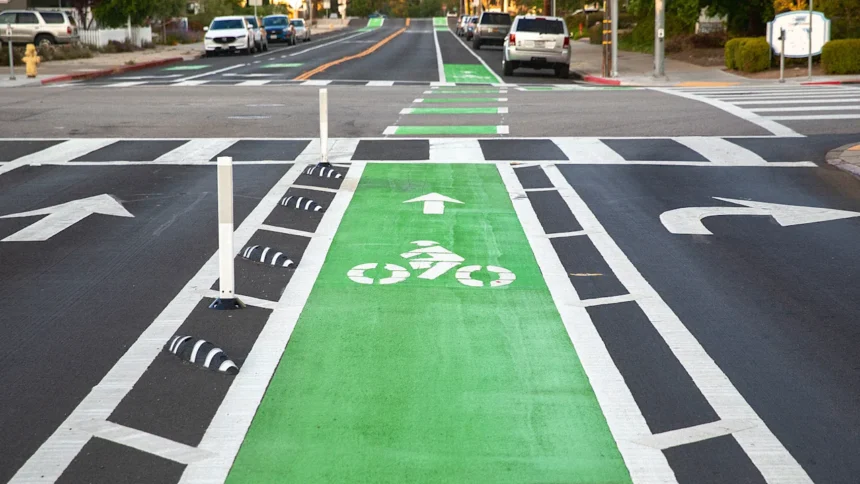
2. Paint and flex-post bike lanes
Use painted buffers with flexible delineator posts (usually spaced every 20 feet).
Quick to install (often in weeks), inexpensive, and adjustable or removable if needed.
Provide good visual and physical separation for lower speeds/traffic volumes.
What your budget can buy
Below are three different budget examples to show the difference in coverage, based on recent project costs in places like Richmond, Virginia. These assume protected bike lanes on both sides of the street and a typical city block length of about 300 feet:
With a $50,000 budget:
Concrete: 1 to 2 city blocks
Paint and flex posts: 15 to 20 city blocks
With a $200,000 budget:
Concrete: about 5 city blocks
Paint and flex posts: about 50 city blocks
With a $1,000,000 budget:
Concrete: roughly 20 to 40 city blocks
Paint and flex posts: about 300 to 500 city blocks
Quick-build approaches enable generational improvements within a single generation. Premium-only strategies can take generations to achieve meaningful coverage.
Cities can start with paint and posts to establish a basic network quickly, demonstrate usage, and then harden high-priority segments with concrete as funding allows. This staged approach gets more streets safer for everyone sooner rather than delaying everything for premium designs.