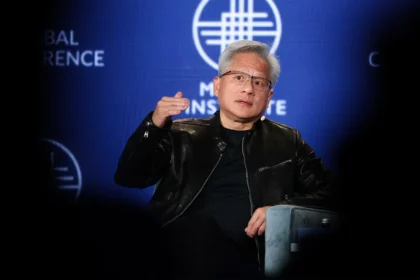


Jensen Huang left Carnegie Mellon University’s class of 2026 with a message that pushed back against graduation season anxiety: There’s no better time than now to start a career.
During a commencement speech on Sunday, the Nvidia CEO told the new grads that “the timing could not be more perfect.”
“Your career starts at the beginning of the AI revolution,” he told the crowd of 5,800 undergraduate and graduate students.
This sentiment landed better with Carnegie Mellon grads—the university widely recognized as the birthplace of artificial intelligence and robotics—than it did with others. Last Friday at the University of Central Florida, humanities department commencement speaker Gloria Caulfield, VP of strategic alliances at Tavistock Development Co., was booed after touting AI as the “next industrial revolution.”
The dissatisfaction with that view points to the broader anxiety that new grads are facing as AI changes entry-level hiring. A new survey of 1,000 U.S.-based business majors by the AI agent company 11x found that 80% of graduating seniors believe AI has reduced entry-level job opportunities. However, another recent ZipRecruiter survey showed that new grads are feeling optimistic about their futures, even if they feel unprepared to enter a job market that has been reshaped and redefined by AI.
In recent public speeches, Huang has maintained a spirit of optimism about young people starting their careers while the job market shape-shifts because of AI.
That was no different during his commencement speech at Carnegie Mellon, during which he said that AI should not be feared, but rather utilized optimistically and responsibly. He doubled down on his belief that while AI might not displace or replace people from their jobs, someone who knows how to use AI better than them might.
While Huang acknowledged that AI has created uncertainty for many people, he said that “every major technological revolution in history created fear alongside opportunity.”
“Like every transformative technology before it, it will bring both great promise and real risks,” he said. “The responsibility of our generation is not only to advance AI, but to advance it wisely.
“History shows that societies that retreat from technology do not stop progress,” he continued. “They only surrender the opportunity to shape it and to benefit from it. So, the answer is not to fear the future. The answer is to guide it wisely, build it responsibly, and ensure that its benefits reach as many people as possible.”
Huang also touched on the trillions of dollars and enormous amounts of energy needed to power what he calls a “new industrial era.” Data centers are projected to require close to $7 trillion in investment by 2030. This year alone, Nvidia has poured $40 billion into investments and partnerships tied to AI infrastructure.
Now that anyone can ask AI to build a useful tool or product, Huang said, anyone can be a programmer. At the end of his address, the billionaire CEO told the new grads to “run, don’t walk,” toward that democratization of capability.
“AI will change every job,” he said. “But the task and the purpose of a job are not the same. Many tasks will be automated. Some jobs will disappear. But many new jobs and entire new industries will be created.
“AI does not replace human purpose,” he added. “It amplifies human capability.”