

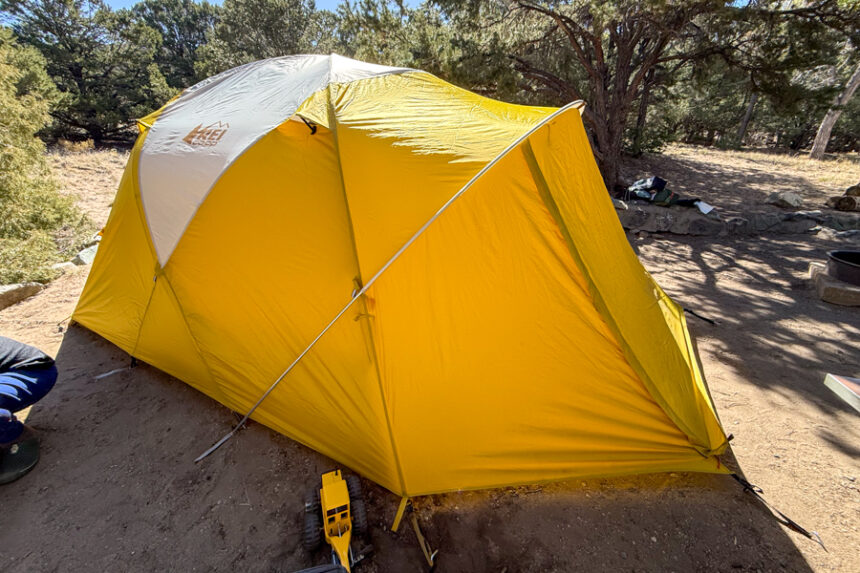
The Base Camp is weather-ready with a full-coverage rainfly and quality build. – Photo credit: Ben Dawson (CleverHiker.com)
Bottom Line
The REI Base Camp 6 is a storm-worthy tent with tough materials, a practical floor plan, and more interior storage than any other six-person tent we’ve tested. One thing to know going in: The 74-inch peak height sounds tall on paper, but the ceiling tapers toward the walls, so actual standing room is mostly concentrated in the center. At 6 feet 2 inches, one of our analysts was just grazing the peak with his head.
This is one of the more involved tents to pitch. It goes a lot better if you slow down and follow the system instead of trying to wing it. Between the five poles, dead-end sleeves, and eight stakes just for the tent body, there is a lot going on. We also learned the hard way that the blunt end of the pole goes in first. Once you get the sequence down, though, the color coding helps a lot, and subsequent setups feel much smoother.
The dual vestibules are one of the best parts of this tent. With 27 square feet up front and 17 in the rear, they provide useful covered space for gear, shoes, camp chairs, or just some breathing room outside the tent.
Fully guyed out, the Base Camp 6 handles wind better than most six-person tents we’ve tested. Our main hesitation is still the poles. Even though they’re aluminum, they bend more easily than we’d expect for a tent at this price. We’ve seen similar concerns in user feedback.
For more options, check out our guide to the best camping tents.
How We Tested
We packed up the kids and hauled the REI Base Camp 6 to Great Sand Dunes National Park. The winds there are no joke, and setting up a five-pole tent in that environment gave us a clear picture of how the system performs under pressure. We also tested it at other Colorado campsites, pitching and breaking it down on warm afternoons and cooler evenings, deploying both vestibules fully, and thoroughly evaluating ventilation with the doors and vents open and closed.
Quick Specs
REI Base Camp 6
Best Tent for Internal Storage
CleverHiker Rating:
4.5/5.0
Price:
$569
The size we tested feels:
Luxurious for 2-3, comfortable for 4-5, and tight for 6
Weight:
20 lb. 11.5 oz.
Dimensions (LxWxH):
110 x 110 x 74 in.
Pros
Exceptional storage Dual vestibulesFull-coverage rainfly Pole sleeves for added wind resistanceTwo large doors for easy accessFour roof vents plus two low side vents
Cons
Very flexible polesComplex setup Not the easiest to pack Potential quality control issues
With the vestibule set up, the Base Camp 6 Has a genuinely useful covered area outside. – Photo credit: Ben Dawson (CleverHiker.com)
Comfort
The Base Camp 6 feels pretty roomy once you get inside. With 84 square feet of floor area, it fits a queen air mattress or three wide sleeping pads without feeling crammed. We also like the square shape more than a lot of six-person domes. It’s less tunnel-like and tends to fit better into imperfect campsites, which is one of those characteristics you appreciate as soon as you start setting up.
Headroom is a little less impressive than the 74-inch peak height makes it sound. The walls angle in quickly, so standing room is mostly in the center. At 6 feet 2 inches, our taller analyst’s head was brushing the top, and a step or two in any direction required ducking. There’s enough room to stand up to change, but it’s not the kind of tent where tall campers can walk around upright.
REI used just about every bit of wall space for pockets, loops, and storage. This makes a huge difference once you’ve been at camp for a day or two. Instead of everything ending up in a pile on the floor, there’s actually a place for headlamps, layers, and all the little things that tend to disappear at bedtime. The two huge doors make the whole tent feel even more open. They unzip wide and tuck away cleanly instead of hanging awkwardly in the way.
Ventilation is decent, but you do have to work with it a little. The roof vents and low side vent help, and we like that you can adjust them from inside the tent. If you’ve got the doors, vestibules, and vents open with a breeze moving through, it feels pretty comfortable. On hot, still afternoons, though, it definitely warms up.
Our 6’2″ analyst shows off just how roomy this tent is. – Photo credit: Ben Dawson (CleverHiker.com)
Durability
The Base Camp 6 feels like it’s built for moderate to heavy use, not just a handful of fair-weather weekends. One of our analysts still uses a 15-year-old REI Half Dome, which says a lot about the brand’s track record. That same level of quality shows up here. The fabrics feel nice, the zippers run smoothly, and most of the tent gives off that solid, confidence-inspiring feel. After several nights of camping, including a windy stretch at Great Sand Dunes, the tent body, floor, and hardware all held up without any real issues.
The poles are the one part that gave us pause. Even though they’re aluminum, they seemed easier to bend than we’d expect for a tent at this price. We found ourselves handling them a little more carefully from the very first pitch. That same concern shows up pretty regularly in user reviews, so it does not feel like a one-off. It’s worth being patient during setup and teardown instead of forcing things.
We also had one zipper pull come off during testing. At this point, that feels more like an isolated issue than a larger durability red flag. Still, it feels worth mentioning on a tent in this price range.
Outside the tent, the multi-pole hub holds the poles in place. – Photo credit: Ben Dawson (CleverHiker.com)
Weather Resistance
Of all the family camping tents we tested this round, the Base Camp 6 is the one we’d most want to be in when the weather turns. The dome shape, full-length pole sleeves, and full-coverage rainfly give it a more secure, storm-ready feel – reminiscent of burlier four-season designs. Fully guyed out at Great Sand Dunes National Park, it handled high winds impressively well. The caveat is that it must be fully guyed out and staked down. Otherwise, the poles will begin to flatten in high winds.
The rest of the weather protection feels solid, too. The seams are fully taped, the rainfly effectively sheds water, and the 150-denier floor is beefier than what we see on a lot of camping tents. We also really liked that the roof vents and side vents can be adjusted from inside the tent. That kind of thing matters when the weather changes and nobody wants to climb outside to fuss with vents.
The main annoyance here is the guylines, which are included but don’t come pre-attached. This is something you’ll want to deal with before your trip, not when the wind is already picking up. We’d absolutely attach them at home and toss a few extra stakes in your kit, too. The tent body uses eight stakes, so if you want to fully guy it out, it helps to be prepared.
The Base Camp 6 makes for an excellent play room during the day. – Photo credit: Ben Dawson (CleverHiker.com)
Ease of Setup
Give yourself some extra time with this tent, and bring a second person if possible. This is not a hard tent to pitch once you know the system, but it is definitely more involved. There are four poles and eight stake-out points just for the tent body, along with a square footprint (sold separately) that takes some attention to orient properly. The first pitch is not especially intuitive. Ours involved a bit of standing around, looking at each other, and realizing we needed to slow down and actually follow the system.
The color coding helps a lot. REI did a nice job matching the poles, sleeves, and webbing. Once you understand how it all goes together, setup becomes much more reasonable. The biggest thing to note is that the two main body poles need to go into the sleeves blunt-end first. If you feed them the wrong way, you’ll need to pull the whole thing back out and start over, which we learned the hard way.
The fly is also a lot of fabric to wrestle with, so having another person there helps quite a bit. The vestibule adds one more pole after that. By the second or third setup, the process feels a lot more dialed. Still, this never becomes a grab-it-and-throw-it-up kind of tent.
Packing it back up takes a little patience, too. Five poles means a lot of sections, and getting everything back into the storage sack is a bit of a squeeze. The shoulder strap on the bag is nice, though, especially when you’re hauling it across camp.
The included stakes and guylines ready to go before pitching the Base Camp 6. – Photo credit: Ben Dawson (CleverHiker.com)
Features
This is one of the most organized tents we’ve tested. REI loaded the interior with 14 mesh pockets along the lower walls, making it easy to stash the little stuff that usually ends up scattered all over the floor. Headlamps, phones, glasses, layers, snacks, kids’ random treasures – there’s room for all of it. The overhead gear loft helps, especially on longer trips when things can start to feel chaotic fast.
The vestibules are another big win here. The front one is large at 27 square feet, easily fitting a couple camp chairs, boots, bins, or a healthy pile of gear if the weather turns. The rear vestibule is smaller at 17 square feet but still useful for shoes, bags, and other items you want close by. Together, they add a lot of covered space and make the tent feel much more livable.
We also like the doors. They unzip wide, which makes getting in and out easy, and the panels tuck up into handy roof pockets. Both doors have half-moon mesh windows, which help with airflow. The roof and side vents are adjustable from inside, which is especially nice once everyone is settled in for the night.
There are a few things we wish REI had done differently. The footprint costs extra, the guylines are not pre-attached, and there are no extra stakes beyond what you need for the main body. None of that is a dealbreaker, but on a tent this dialed, those omissions stand out a little more.
The low vent system helps improve airflow when the tent is fully closed up. – Photo credit: Ben Dawson (CleverHiker.com)
Should You Buy the REI Base Camp 6?
The REI Base Camp 6 makes sense for campers who want a weather-ready shelter and are willing to deal with a more involved setup. If you camp often, get out in mixed conditions, and prioritize stability and organization, this one has a lot going for it. Interior storage is some of the best we’ve seen, and the dual vestibules make longer trips a lot more comfortable.
However, if you want something quick and easy to throw up at the end of a long drive, the five-pole setup may be too involved. And if most of your camping happens in mellow summer weather, this is probably more tent than you need. We also think the pole durability concern is worth taking seriously. For a tent at this price, we’d like to feel a little more confidence in that part of the build.
Setup turned into a family project as our little gear analyst helped haul poles into place. – Photo credit: Ben Dawson (CleverHiker.com)
What Other Camping Tents Should You Consider?
If the Base Camp 6 sounds like more tent than you need, here are a few other quality options from our guide to the best camping tents:
The North Face Wawona 6 Review: The Wawona 6 is our top pick and the one we’d point most families to first. It feels more open and easier to move in, and the massive vestibule adds a ton of livable space. However, the spacious design and partial fly mean it isn’t as buttoned-up as the Base Camp 6 in rough weather.
Kelty Wireless 6 Review: If budget is the priority, the Wireless 6 is more affordable but still gives you lots of room. It is easier to pitch, has a tall interior, and costs a good bit less. However, it’s not as weather-ready or as refined as the Base Camp.
REI Westward 6 Review: The Westward 6 is a nice middle ground if you like REI’s quality but want something easier to live with in warm weather. It has better airflow, a simpler setup, and a huge vestibule, although it’s not as protective in prolonged storms.
The kickstand vents are a nice touch but only help a little when the tent is fully buttoned up. – Photo credit: Ben Dawson (CleverHiker.com)
The post REI Base Camp 6 Tent Review appeared first on CleverHiker.