

Will Renwick gives his verdict on the Osprey Duro Pro 7, a lightweight and breathable running vest that’s “ideal for runs of up to four hours”.
For me, when it comes to choosing a running pack, there are a few basic things that need to be covered. First of all – and this is a bit of an obvious one – it needs to be the right size for the kit I need for my run. Then it needs to be secure and stable. Then it needs to be comfortable. Ultimately, it needs to support my run, not hinder it in any way.
The Osprey Duro Pro 7 gets all of those things right, and then delivers on a multitude of other features too. I’ve been testing the 7-litre version, but there’s also a 10-litre option. For me, the 7-litre size has been ideal for everything from short pavement runs through to four-hour trail runs in the mountains.
How I Tested It
I’m a fairly experienced runner and tend to do most of my running in the Welsh mountains and on the downs of Wiltshire. I sometimes take part in ultramarathons, but I’ve only used the Osprey Duro Pro 7 for training so far.
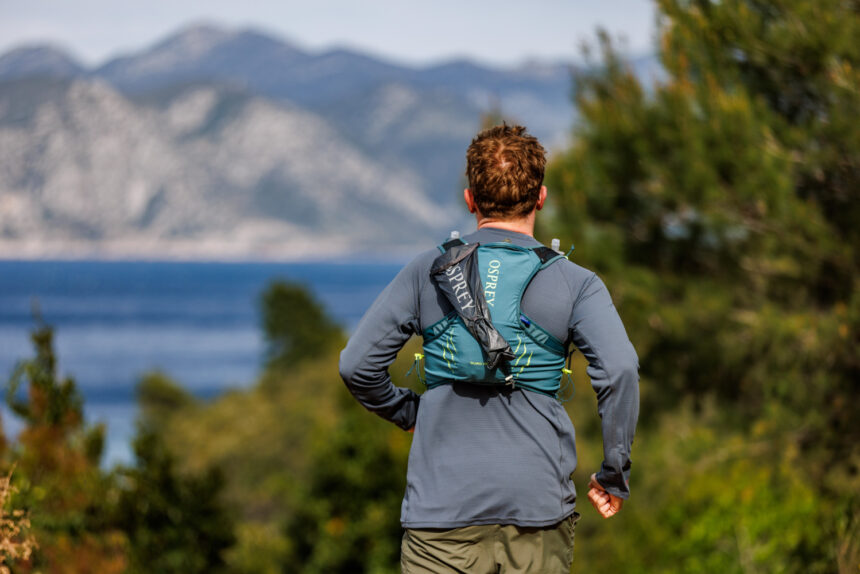
OM editor Will using the Osprey Duro Pro 7 in Croatia. Photos: Dave Macfarlane.
A lot of the testing has been on short runs where I’ve only needed it to hold my phone and house key, but I’ve also used it on several trips to the mountains. Most recently, I used it on a run in the wild Rhinogydd range of North Wales, where I carried the following: a Montbell Rain Trekker 2.0 waterproof jacket, a down jacket, an emergency blanket, two litres of water, a pack of Jelly Babies, a mini tripod, a map, a headtorch, and a power bank. I also took it with me to Croatia on a short haul flight and it was very handy for this as it bundles up to about the size of a pint glass, making it easy to fit into luggage.
Price: £140
Weight: 200g
Pros: Comfortable and stable, very breathable, light, lots of useful storage options, good for runners who use poles.
Cons: Fabrics won’t protect valuables in wet weather, chest straps are a little fiddly, poles are difficult to stash in the quiver without removing the pack.
Comfort: 5/5
Quality: 5/5
Stability: 5/5
Overall: 5/5
Osprey Duro Pro 7
What’s It Best Suited To?
One thing I like about this running vest is that, while it can hold a fair amount of kit, it doesn’t look oversized or sag or flap about when I’m only carrying my phone and water. When fully loaded for a morning or afternoon in the mountains, it still feels very comfortable, balanced, and stable.
In terms of racing, for me this is the kind of running vest I’d take on anything up to marathon distance – or just over. For longer events, you’d likely be better off going for the 10-litre version. I’ve tried it with what I’d usually need for a mandatory ultramarathon kit list, and it’s a bit of a squeeze.
Sizing
This comes in three different sizes. I tested the medium, which fitted perfectly around my 100cm chest. Osprey deserve credit for offering multiple sizes, as not all brands do. The brand also has a strong track record of catering for a range of body shapes and sizes.
Pockets and Storage Options
This hits all the right notes for me on the storage front. There are zipped pockets for security, large pockets for bulky items, and open pockets that make it easy to access or stash items on the move. My favourite pocket is the large one on the lumbar, which I’ve found ideal for storing a rain jacket.
On one particular run, there was intermittent rain throughout. Normally this would be frustrating, leading to lots of stopping and starting, but I found I could put my jacket on and take it off without stopping.
For hydration, you can either hang a bladder in the main compartment or use the two 1-litre soft flasks that come with the pack. These are excellent. They feature plastic ‘wing stays’ that give them enough structure to slide smoothly into the harness pockets, no matter how full they are. Most runners will have experienced the frustrating moment after an aid station when you have to faff around getting flasks back into pockets – that’s not an issue here.
Osprey have also added smart bungee cinch cords at the top of the flask pockets, which provide extra reassurance that your flasks won’t bounce out when you’re moving quickly over rough ground. This was a major issue with a Camelbak vest I used to own.
Trekking Pole Options
Trekking poles come in different designs and weights, and runners have different preferences for how they carry them. Osprey deserve credit for offering multiple attachment options on the Duro Pro.
You can carry poles on the front, secured under the armpits – a good option for telescopic poles. You can also secure them across the lumbar, or store them in the supplied quiver, which can be configured diagonally or vertically across the back.
From my experience, storing poles on the lumbar is a bit tricky on the move, and I usually have to stop. Carrying them under the armpits is easier and can be done while running.
With the quiver, I found the diagonal configuration the most practical, as it made grabbing poles quick and easy. However, I haven’t been able to replace the poles into the quiver without taking the vest off. This is something many running vests struggle with, although the Dynafit DNA 8L is one that does it particularly well.
Fabrics
This pack has bluesign approval, meaning it’s made using materials and processes that meet strict environmental, chemical safety, and worker protection standards set by bluesign technologies.
It’s mainly made from polyester (100% recycled), with some spandex to provide a close, body-hugging fit. Overall, the fabrics are comfortable, breathable, and wick sweat effectively. I’ve run in warm conditions with this pack, and it’s one of the best I’ve used for breathability and moisture management.
It looks like it could be machine-washed, but Osprey recommend hand-washing only.
It’s also worth noting that the fabrics don’t provide waterproof protection. If you need to keep items dry, you’ll need to use dry bags.
Verdict
Overall, this is the best running vest I’ve used recently. I’ve really enjoyed testing it, and it will be my go-to for future trail races. I’m eyeing up a 32-mile spring ultra next year, and I think this will be ideal.
It’s light, breathable, and very comfortable, with excellent stability and balance. The Salomon Adv Skin used to be my favourite running vest, but this edges ahead – it’s slightly more comfortable, lighter, and more sustainably made.
While the chest straps are a little fiddly, especially with cold or gloved hands, that’s the only real drawback for me.
Osprey Duro Pro 7