

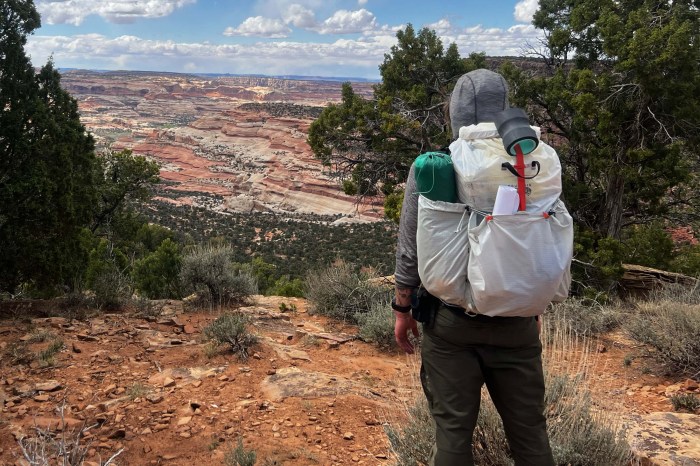
I was on the second day of my Canyonlands backpacking trip, and I didn’t have a small daypack. This forced me to use my massive 60L Mountain Hardwear Alakazam for just a few snacks and supplies for a day hike to Angel Arch — an absolute overkill for the trek.
But when I closed the roll-top and cinched the brand’s patented GiddyUp Compression System, I was shocked. The ultralight pack “shrank” to a reasonable size for a short hike. Alakazam. It was like magic.
Mountain Hardwear (MHW) released the Alakazam pack in spring 2026, and I tested an early prototype. Ultralight UHMWPE fabric packs are popular, and I assumed MHW was just jumping on the bandwagon. After using this pack on a 3-day backpacking trip covering 40 miles, I’ve been convinced otherwise.
In short: The Mountain Hardwear Alakazam 60L Backpack ($575) is a 1-pound, 14-ounce backpack that can carry 40-45–pound loads comfortably. It expands and compresses significantly depending on what volume you need. It’s made from ALUULA fabric, which is durable, light, and resistant to delamination. The frame and hip belt are removable to shave weight, and the roll-top design, paired with this pack’s immense side and back pockets, offers plenty of space for multi-night fast-and-light backcountry adventures.
Check out GearJunkie’s guide to the Best Backpacking Backpacks and the Best Ultralight Backpacks.
Specifications
Pros & Cons
Pros
Extremely light
Comfortable to carry
Very durable build
Volume expands to 55+ L of storage
Compresses to size of daypack
Cons
ALUULA material is noisy
Not a slim/trim silhouette
Can sometimes feel stored items through the back panel
Alakazam 60L Backpack Review
The Alakazam 60L easily swallowed everything pictured; (photo/Will Brendza)
I don’t pretend to be an ultralight backpacker. When I’m packing for a trip, I’m not afraid to take more food than I’ll need. I’ll usually bring a sleeping liner (just in case), load up with beer, and lug a book along. The packs I tend to gravitate toward are burly enough to handle bigger loads. I usually avoid ultralight packs because they don’t generally bear weight quite as well.
That was not the case with the Alakazam. The night before our trip into Canyonlands, I shoved as much as I could into this pack, approaching a total weight of 45 pounds. When I shouldered the pack and clipped the belt, I was genuinely taken aback by how well the load was distributed. It felt like a much heavier, burlier pack than I knew it was.
Materials
Closeup of ALUULA fabric and Giddyup Cinch System; (photo/Will Brendza)
The Alakazam uses two main materials: nylon and (the star of the show) ALUULA Graflyte. Unlike other Ultra-High Molecular Weight Polyethylene (UHMWPE) fabrics, ALUULA uses a proprietary, glue-free process that fuses fibers to create extremely durable, lightweight composites. According to the website, this type of UHMWPE fabric is eight times stronger than steel and is fully waterproof.
ALUULA claims that its Graflyte UHMWPE fabric is lighter and, due to its fusing process, more resistant to delamination than competitor fabrics such as Ultra 200.
The material has a plastic-like hand-feel. It isn’t quiet, either. I found the pack makes a fair amount of crinkling noise when you use the roll-top, and, as I discovered, as you’re hiking. (More on that below.)
Weight & Price
My small/medium Alakazam weighs a mere 1 pound, 14.3 ounces. Next to other ultralight packs, it’s competitive weight-wise, but not price-wise.
Looking at GearJunkie’s guide to the Best Ultralight Backpacks, the Mountain Laurel Designs’ Exodus 55L ($325) weighs 1 pound, 2 ounces; Hyperlite Mountain Gear’s Southwest 55L ($420) weighs 1 pound, 15 ounces; Outdoor Vitals’ Shadowlight Carbon 60L ($300) weighs 1 pound, 15 ounces, and Gossamer Gear’s Mariposa 60L ($315) weighs 1 pound, 13.2 ounces.
At $595, the Alakazam 60L is almost double the price of some of those alternatives. In the ultralight space, where people are already paying out their ears for equipment, the Alakazam’s price could work against it.
Layout
Compressed, the Alakazam barely looks like a 60L pack; (photo/Will Brendza)
I love roll-top bags. Zippers are easier to use, of course, and offer faster access. But usually, roll-tops let you adjust the volume of your pack to some degree. The Alakazam shines in that regard. It’s billed as a 60L pack. But if you really loaded it to the maximum volume allowed by the roll-top design, you could fit 65 L, potentially even 70 L. It expands to a huge capacity. You’d probably exceed the weight capacity before the volume limit.
The sides of the pack use MHW’s GiddyUp Compression System. These let you quickly expand or compress the pack’s body — even on the move. You just reach up and pull the end of the colorful paracord to tighten it up. Or release the compression system’s plastic lock to increase internal volume.
With the roll-top and the GiddyUp Compression System, this pack has a large effective volume range. That made it easy to switch from full-sized backpacking mode to a smaller, more day-hike–friendly volume.
Pockets
Side access to the water bottle pockets made it easy to drink on the move; (photo/Will Brendza)
On each side of the Alakazam, MHW included massive water bottle pockets with front and top access. That made it easy to grab my water bottle on the go, without having to pause and remove the pack.
When I say these pockets are massive, I mean massive. I was able to fit my oversized 2L Nalgene, a Smartwater bottle, and two beer cans in one. The other swallowed my tent and my portable foam roller.
On the outside of the pack, there is another large dump pocket. I kept emergency layers (rain jacket, fleece, sun hoody) inside there for easy access.
The inside only has one unzippered dump pocket. I used it to keep my snacks separate from my other gear on our day hike. It could also fit a journal, a map, a hat, gloves, or other small items. However, it is not compatible with a hydration bladder. Besides that, the inside of the pack is very minimalistic.
Each hip pocket also has a zippered pocket big enough for keys, snack bars, and other small items. And each shoulder strap has a small elastic sleeve for a water bottle as well.
Frame
The Alakazam has a V-shaped aluminum frame. It’s attached to the “Hoverbelt” hip belt and inserts into the back panel from the bottom. If I had wanted to cut even more weight on our day hike, I could have removed this piece and left it at camp.
From the first moment I shouldered the Alakazam, I was impressed with this frame’s ability to distribute weight to my lower body. It didn’t feel flimsy like other ultralight packs I’ve worn. With nearly 45 pounds of gear and supplies loaded in the backpack, it felt as solid and poised as my go-to backpacking pack, the Pingora Outro 40L. That pack is 2 pounds heavier than the Alakazam and has 30 L less volume.
In the Field
Look at how much extra space that roll-top offers; (photo/Will Brendza)
As already mentioned, this ultralight pack impressed me with its ability to comfortably carry a heavy load. The Hoverbelt hip belt moves with my hips very naturally, and independently of the pack’s main body. It was also really useful to have a pack that compressed to a more manageable day pack size for mid-backpacking trip excursions.
At one point in our hike, we got caught in an on-and-off rainstorm for several hours. Since the pack is fully waterproof, I never had to worry about my spare layers, food, or other supplies getting wet. I didn’t have to fuss with a pack cover, either.
I was concerned I would get the white pack extremely dirty right off the bat — and I did. However, it cleaned off fairly easily. It’s not quite as clean and white as it was out of the box. However, I haven’t permanently stained it yet. Time will tell if and how much that changes.
While hiking, I noticed that the ALUULA material crinkled as the pack shifted weight. It wasn’t loud or overly annoying. Over the miles, though, it became tiresome. I readjusted the pack a few times to mitigate this, and I was able to reduce the noise, but not entirely.
Durability-wise, I believe ALUULA’s claims of having a higher tensile strength than steel are valid. I scraped, banged, poked, dragged, and was generally abusive to my Alakazam. At one point, it tipped over during a water break and rolled 20 feet, bouncing and sliding down uneven sandstone.
By the end of the trip, I was purposefully ramming the top of the pack into overhanging branches as I passed under them. Still, there is absolutely no sign of wear or tear on the pack so far.
While the Alakazam felt very ergonomic and comfortable to carry while loaded with gear, I did notice at one point that a poorly placed water filter was digging into my back through the back panel. A simple adjustment solved the problem, but it’s something to keep in mind when packing.
A Note on Aesthetics
MHW has a classic, almost retro aesthetic, and the Alakazam pack follows that trend. The colorful paracord cinch system and zipper pulls add some fun flair to the largely minimal design.
However, the Alakazam doesn’t have the most appealing backpack silhouette. It’s wide thanks to those oversized water bottle pockets, and kind of squat. That didn’t bother me, but I could see some people gravitating toward a differently shaped pack.
Finally, the ALUULA (like most UHMWPE fabrics) has a specific look. When my hiking partner saw my Alakazam loaded up before our trip, he told me, “Your pack looks like a trash bag.”
Fair enough.
Mountain Hardwear Alakazam 60L Backpack: Who It’s For
If you’re a backpacker who wants to travel light and fast over long distances, the Alakazam 60L is worth considering. You could easily fit enough for a 4-5–day trip (possibly more if you pushed the pack’s true volume limit). It weighs next to nothing, has impressive carry comfort even with heavy loads, has ample storage options, and is thoughtfully designed for easy on-trail adjustments and access.
Is it worth the $595 price tag? That’s hard to say. ALUULA Graflyte is an amazing space-age material. However, with such limited testing, I can’t say for sure whether it will outlast similar packs made with Dyneema or Ultra200 fabrics. If it is more resistant to delamination and lasts longer than those packs, then the answer is a resounding maybe.
I loved using this pack. Especially as someone who tends to bring more luxury items and supplies, having 60 L of available volume was pretty rad. The pack’s layout suited me very well, and I thought it was one of the more comfortable packs I’ve used in recent years. The more I wore it, the more I found to like about it. I’ll definitely be taking the Alakazam 60L on future backcountry adventures.