


President Donald Trump signed H.J. Res. 140 into law Monday, officially ending the 20-year federal mining withdrawal on 225,504 acres of Superior National Forest land near the Boundary Waters Canoe Area Wilderness.
The White House confirmed the signing on April 27. The resolution disapproves Public Land Order 7917, the 2023 Bureau of Land Management order that withdrew National Forest System lands in Cook, Lake, and Saint Louis counties from mineral and geothermal leasing for 20 years.
That means the Biden-era land protection is now overturned. It also means the fight over mining near one of the country’s most visited wilderness areas has moved from Congress back into the trenches of permitting, regulation, and law.
The Resolution
H.J. Res. 140 was introduced by Rep. Pete Stauber (R-Minn.) under the Congressional Review Act. The House passed the measure in January. The Senate then passed it on April 16 in a 50-49 vote, with Sen. Josh Hawley (R-Mo.) not voting.
The resolution doesn’t approve a specific mine. It removes the 20-year withdrawal that blocked new mineral and geothermal leasing across the affected federal lands.
Stauber called the signing a victory for Minnesota miners and critical mineral development.
“It’s official. The illegal mining ban put in place by former President Biden has been overturned indefinitely,” Stauber said in a statement. “Now, proposed mining projects aimed at unlocking trillions of dollars’ worth of critical minerals can move forward through the proper state and federal environmental review and permitting process.”
What the Withdrawal Protected
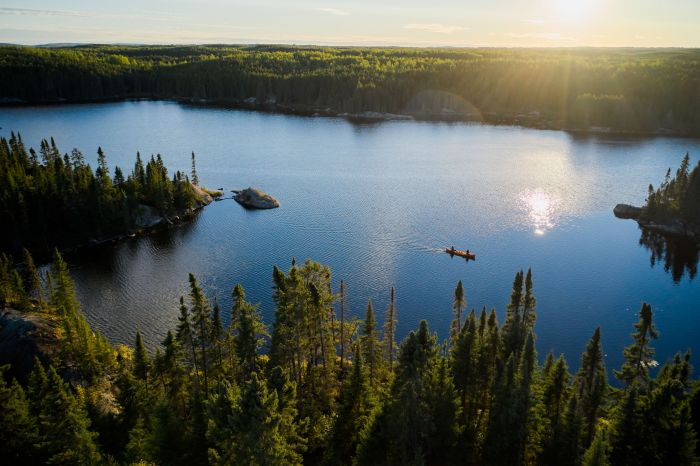
Kekekabic Lake, Boundary Waters Canoe Area; (photo/Chad Fennell)
Public Land Order 7917 was signed in January 2023 by then–Interior Secretary Deb Haaland. The order withdrew roughly 225,504 acres in the Superior National Forest from mineral and geothermal leasing, subject to valid existing rights.
The Interior Department said at the time that the withdrawal was meant to protect the Rainy River watershed, the Boundary Waters Canoe Area Wilderness, the 1854 Ceded Territory of the Lake Superior Chippewa, fish and wildlife, Tribal treaty rights, and the region’s recreation economy.
The Boundary Waters covers 1.1 million acres in northern Minnesota and includes more than 1,200 miles of canoe routes, 12 hiking trails, and 2,000 designated campsites.
Conservation Groups Respond
Save the Boundary Waters criticized the signing and said the law officially revokes Public Land Order 7917. Ingrid Lyons, executive director of Save the Boundary Waters, said the outcome was expected after the Senate vote, but still disappointing.
“This decision dismisses outright years of rigorous scientific evidence, the voices of hundreds of thousands of Americans, and the clear will of Minnesotans,” Lyons said in a statement. “But Americans won’t stop fighting for permanent protection of this most visited Wilderness.”
What Happens Next
The signing does not mean mining starts tomorrow. Any proposed project would still need to clear state and federal review, permitting, and likely court challenges.
Still, Trump’s signature marks a major shift. The 20-year federal withdrawal is gone, and future protections may be harder to reinstate under the Congressional Review Act unless Congress authorizes them.