


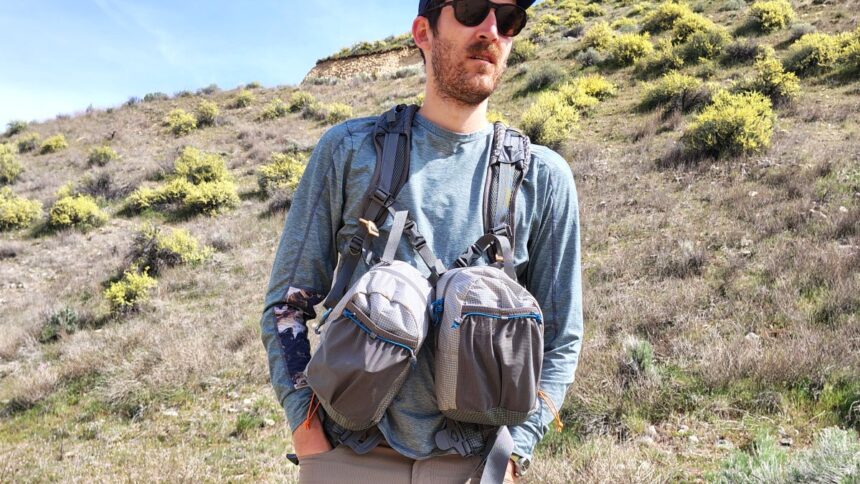
A backpack famously lives on your back—it’s right there in the name. But what about a body pack? That’s the design concept behind New Zealand-based brand Aarn Packs.
With twin mini-packs perched up front between the hipbelt and shoulder straps, Aarn’s Mountain Magic 50 Pro is designed to redistribute weight, improve your posture, and boost comfort on the trail. Those are big promises, they come with a big price tag: $400. After a month of testing, here’s how well Aarn’s “body pack” concept works in the real world.
The Mountain Magic 50 Pro has two giant “balance” pockets in front
A Backpack…for Your Front
The main attraction of Aarn’s body pack design is the two zippered pouches (or “balance pockets,” in Aarn-speak) that sit just below your chest. Each pocket is 3.5 liters, with a zippered opening and a curved aluminum stay that slots into the hipbelt. Those stays are the real workhorse of the entire system, directing the weight of the pockets onto your hips rather than pulling on your shoulders. Compared to most hipbelt or shoulder strap pockets, the balance pockets are cavernous, each capable of holding two 750-milliliter bottles plus snacks and a phone. The balance pockets are removable and interchangeable, with four different sizes available, from 2.5 to 7.5 liters.
Outside of the balance pockets, the Mountain Magic is a lightweight pack in the mold of the Osprey Exos or Gregory Focal. It weighs 2 lbs, 14 oz (2 lbs, 5 oz without the pouches), carries 43L (in the main body), and is rated to carry 33 pounds. It’s constructed of 70-denier robic nylon (210-denier robic on the bottom panel) and comes in two sizes: short (torso length 15-18 inches) and medium (16-20 inches).
A unique suspension moves with the hiker and can be adjusted while you’re wearing the pack (Photo: Nathan Pipenberg)
The Suspension System
The Mountain Magic has a hybrid internal/external aluminum hoop stay, plus some extra torsional support from a horizontal aluminum bar that crosses in the middle of the hoop. There’s another vertical stay in the center of the back panel, which provides a bit of extra rigidity but mostly serves as a means of torso size adjustment. The hipbelt is extra wide, with dual webbing straps for adjustment, and a proprietary interlocking buckle.
The shoulder strap system is essentially a free-floating loop. The bottom of the shoulder straps are attached to a cord that runs behind the hipbelt. At the top, the yoke is connected to one big loop of webbing that can also slide back and forth. It’s designed to allow the pack to move with your body, rather than bouncing or rocking on your shoulders. It works well; the feel is similar to packs with a pivoting hipbelt like the Gossamer Gear Mariposa, but not quite as pronounced.
Other Features
The Mountain Magic has a laundry list of handy features. There’s a nice trampoline back, with a sewn-in mesh back panel stretched across the frame. It’s airy and comfortable, especially because the mesh continues all the way down to the base of the pack (it lacks a full-wrap hipbelt.) The lower section of the back panel does have a fairly aggressive contour, and it’s easy to imagine that users without much arch in their lower back might not find it comfortable.
It comes with two webbing straps (Lasso Locs, also available to buy separately) that can be affixed to various lash points on the pack to compress the side panels, or carry extra gear above or below the main pack. There’s also a longer webbing strap to turn a balance pocket into a sling bag or fanny pack.
The side pockets and front stretch mesh pocket aren’t standouts. The mesh pocket is slightly undersized, and the side pockets are hard to access while wearing the pack. To be fair, though, side pocket access isn’t a big deal when the balance pockets can fit anything you could ever desire.
The most surprising feature is the well-engineered torso length adjustment method. The shoulder harness slides freely along a vertical stay on the back panel, and adjustment is controlled by a pair of webbing straps attached to a cam buckle. One, accessible over your shoulder, pulls the harness upward, lengthening the torso size. The other, hiding behind the right side of the hipbelt, drags the harness back down. The straps are hard to miss—they’re the only bright orange bits of webbing on the whole pack—and easy to use. In fact, it’s the only pack we’ve used that allows for torso length adjustment while it’s on your back.
Access is never an issue with this pack (Photo: Nathan Pipenberg)
How It Works on Trail
In use, the Mountain Magic is a comfortable carry, and one that feels different than any typical backpack. For one, it really does have excellent load transfer ability and can easily support 35 pounds in the main pack. When we loaded the balance pockets with 4 liters of water, we found the hipbelt could support the roughly 44-pound total weight. Unlike with standard shoulder strap pockets, the Mountain Magic actually carries better with a fairly heavy load in the balance pockets.
The load balancing is immediately apparent. The Mountain Magic does promote better posture. With a standard pack, a heavy load pulls you backward, and it’s only natural to lean forward to counteract that force. With this pack, it’s easy to just stand up straight, which is especially noticeable on steep climbs.
The floating shoulder straps are also a significant comfort boost. The system allows the shoulder straps to stay in place, even when your hip movement causes the pack to rock back and forth. If you have issues with rubbing or chafing from standard shoulder straps, these straps might be the antidote.
Another nice perk of using the balance pockets for water storage instead of the side pockets is that it gives the pack a slim profile. With no bottles sticking out of the side pockets, the pack is really nice to use on narrow, overgrown trails or while bushwhacking.
Body Pack Downsides
There were two notable drawbacks we found while hiking with the Mountain Magic. The first is the complexity: There are many more cords and buckles to adjust than on a standard backpack, and it can be hard to keep them all straight. For example, the balance pockets get in the way of adjusting the hipbelt. The U-Flow shoulder strap system is nice while hiking, but also makes the pack harder to put on, since the first strap you put over a shoulder will get longer, leaving the second one shorter and more difficult to snake your arm through. The balance pockets—also super convenient once the pack is on—are annoying otherwise. They swing around when you pick the pack up by its carry strap, knock the pack over when you set it down, and get in the way when you’re putting the pack on.
The other drawback is that the Mountain Magic has a fairly locked-in feeling. Since the balance pockets connect to both the shoulder straps and sternum strap, there’s not much you can do to adjust how the shoulder straps feel—they’re always fairly snug and pulling in across your chest. Even loosening the shoulder straps doesn’t do much, since the pull of the balance pockets keeps them under tension. If you’re used to keeping your sternum strap tight, it’s probably not a big deal. Personally, I rarely use a sternum strap when wearing a framed pack, and prefer my shoulder straps adjusted to be wide and loose. The Mountain Magic feels less adjustable than average in this regard.
Aarn is a New Zealand-based outdoors company (Photo: Nathan Pipenberg)
Who Should Buy the Aarn Mountain Magic Pro?
The unique body pack concept of the Mountain Magic makes it carry differently than any other pack we’ve worn. If you feel like you’re constantly fighting against your pack or losing your balance, the Mountain Magic might be the solution.
Even if you find traditional packs adequately comfortable, the easy access to gear in the balance pockets is seriously convenient. If you love to hike all day without stopping for breaks, this is a great pack. It should also be a top choice for photographers (Aarn even offers camera-specific balance pockets), birders, or anyone else with a good reason to have heavy gear accessible all day long.
Because of the inherent complexity of putting on, adjusting, and removing the pack, the Mountain Magic is at its best when worn all day. If your style of backpacking involves a lot of stops and starts, using this pack might get annoying.
It’s not for ultralighters, because frankly, it’s not ultralight. The Mountain Magic weighs nearly three pounds and really shines when carrying loads between 30 and 40 pounds—a weight that most ultralight hikers don’t experience. The easy access to gear in the balance pockets is a huge bonus, but most ultralighters would be better served by pairing their existing pack with a fanny pack or extra shoulder strap pockets.
Finally, between the relatively short max torso length (20 inches) and narrow shoulder straps when the balance pockets are cinched down, this might be a tough fit for anyone with a long torso or broad shoulders.
The post Aarn’s “Body Pack” Concept Reinvents the Backpack appeared first on Backpacker.