

Facing stagnant sales, Panera Bread is aiming to become one of the restaurant industry’s rare comeback stories.
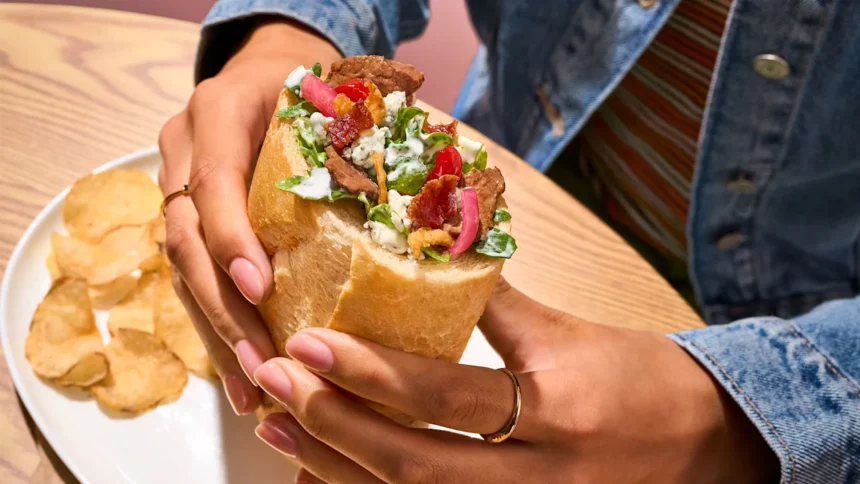
The fast-casual chain’s latest move is the introduction of new “Salad Stuffers,” a fresh spin on one of Panera Bread’s most iconic menu items: the bread bowl. Instead of filling a sourdough bread bowl with soup, however, it’s stuffing a handheld Italian-style roll with salad.
The idea sounds simple enough, and yet CEO Paul Carbone says Panera thoroughly tested the innovation before adding it to the menu. A team of chefs and bakers experimented with 20 different breads to find one with the desired “fluffy and soft” texture.
Any salad on Panera’s menu, ranging from the chicken caesar to the steakhouse salad, can become a “stuffer.” The new menu item coincides with a broader plan at the fast-casual chain to use around nine ingredients for each salad creation. That’s closer to what competitors like Sweetgreen offer, and also more than the average of five ingredients previously featured in Panera’s salads.
The Salad Stuffers were methodically tested in two regional markets over the course of three months, according to Carbone, who was elevated to his chief executive post in March 2025 after serving as interim CEO for three months and chief financial officer prior to that since 2023.
“Maybe that’s the CFO in me,” Carbone tells Fast Company. “We test, we learn, we iterate.”
A turnaround after cutting too much
Panera Bread is in the very early stages of a turnaround effort in the wake of operation errors that Carbone says included making portions smaller and swapping in less-desirable ingredients. Carbone says Panera will invest $100 million more in its company-operated cafés in 2026 compared to last year’s spending levels, funding that will add five hours of extra labor per day to each café, support menu innovation, and boost the quality of the food on the chain’s menu. Franchisees, who account for around 50% of Panera’s system of 2,249 locations, are expected to match that corporate investment.
This big spending commitment runs counter to Carbone’s instincts as a CFO, a title he held at Dunkin’ Brands, SharkNinja, and Yeti. When he was CFO at Panera and was presented with the idea of swapping in iceberg lettuce and using less romaine to save some money, Carbone says the decision sounded appealing. But it came at a cost: displeased diners.
[Photo: Panera]
“As a former CFO, it’s the best investment we’ll make,” Carbone says of the renewed focus on quality. “What we’ve done in the past—degrading quality, smaller portion sizes, labor cuts—it wasn’t working.”
A crowded, difficult comeback
An attempted turnaround comes amid a choppy climate for restaurant chains, with demand for “slop” lunch bowls sold by competitors including Chipotle, Sweetgreen, and Cava having softened. From January 2024 through September 2025, restaurant and takeout cost increases more than doubled the pace at grocery stores, according to research from consulting giant McKinsey, due to rising labor, rent, and ingredient costs.
There are also quite a few restaurant rivals currently attempting turnarounds of their own, including Starbucks and Red Lobster. But they’ve made little progress, and that’s because turning around a large, national chain is incredibly difficult, according to Fred LeFranc, founder and CEO at restaurant consulting firm Results Thru Strategy. “The number of layers from the top down to the store-level employees is pretty large,” LeFranc tells Fast Company, making operational changes tough to implement. Panera, he says, “really broke trust with their loyal customers. It was self-inflicted harm.”
In November, Panera announced a new financial target, aiming for systemwide sales to exceed $7 billion by 2028, a tall order given systemwide sales were $6.1 billion and trending downward as of 2024, according to food-service research firm Technomic.
Carbone says some early investments are moving the needle in a positive direction. Guest satisfaction scores on service and café cleanliness have improved, as has the likelihood of customers to recommend Panera since the restaurant added extra labor hours, according to Carbone. He also notes that new Frescas and Energy Refresher beverages that debuted in March have outperformed Panera’s internal goals and led to more beverage orders overall, while the chain’s Dubai-style chocolate pistachio cookie, launched alongside the new drinks, has led to an increase in bakery transactions.
As for his industry turnaround inspiration, Carbone says the “best one in the industry today is Chili’s,” admitting, “If you had said to me, in five years Chili’s is going to be the hottest brand out there, I would have said, ‘Come on, no way.’”
More changes are coming
Panera is also testing a new point-based loyalty program in Chicago, Dallas, Denver, Seattle, and in Cheyenne, Wyoming. Based on results, it could roll out nationally as soon as this summer.
It’s also trying out larger kiosks to make digital ordering easier and investing in AI for labor scheduling, demand planning, and other solutions that can be adopted at scale internationally. “It’s less about being able to strip out labor and replace it with AI and [more about] how it makes us better and smarter,” Carbone says.
This thinking points Carbone back to what he learned when Panera’s business wilted, in part due to a bad bet on lettuce. “Going to 50% iceberg was not in service of the guest,” he says. “[Now] we put everything through the lens of: Is this in service of the guest? And does it make that guest experience better?”
“Salad Stuffers” are priced from $8 to $13, depending on the salad choice and the region where they’re purchased.